


Springboard diplomacy
Elaine K Howley investigates how a small group of American swimmers and divers helped open China to westerners
As much as purists like to say that sports should play out beyond the reach of petty politics, it simply can’t. As with any human endeavor, politics always manages to find its way into proceedings. One global instance of the intersection of sports and politics led to a unique 1973 tour of China for a group of American swimmers and divers.
Sponsored by the National Committee on United States-China Relations and officially dubbed the ‘Friendship Through Sports’ delegation, the American swimmers and divers were the second group to visit China in an effort to ease relations. The first had come the year prior when the U.S. Olympic table tennis team toured, spawning the term “ping-pong diplomacy.”
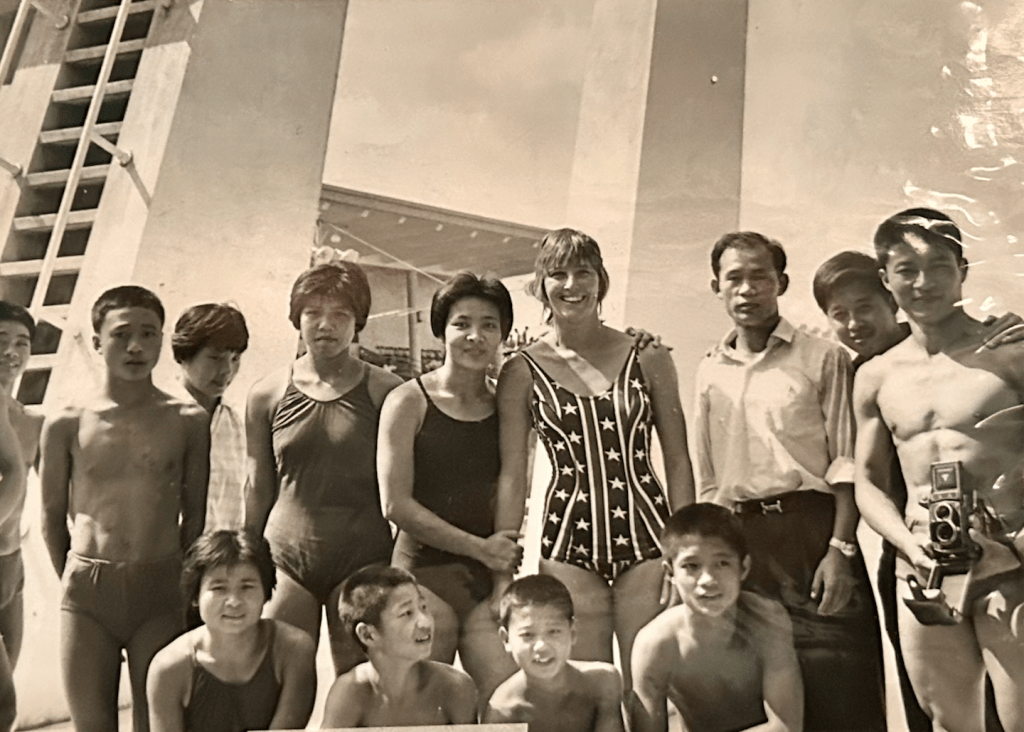
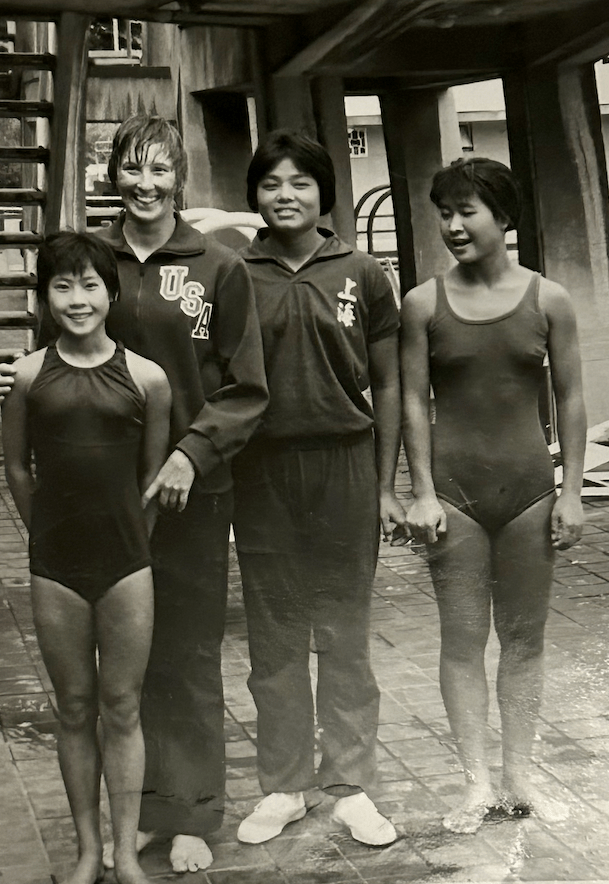
The cast of aquatic characters included some of the best swimmers and divers America produced in the 1960s and 70s. There were two divers and eight swimmers, all of whom had competed in World or Olympic championships: Jane Barkman, Ellie Daniel, Karen Moe, Lynn Vidali and Micki King on the women’s side. On the men’s, Frank Heckl, Mitch Ivey, Brian Job, Steve Power and Bernie Wrightson got the call. Joining them were two coaches – Jim Gaughran and Ingrid Daland – and press liaisons Al and Faye Schoenfield. A small handful of interpreters and fixers tended to the logistics of ferrying the high-profile coterie on its three-week-long tour of Guangzhou, Shanghai, Beijing, and Changsha.
The athletes were all champions of one sort or another and had recently dominated on the world stage, scooping up a rainbow of medals at the 1968 Mexico City and 1972 Munich Olympic Games. But it was good that the athletes were all nearing the end of their competitive careers because FINA (now called World Aquatics) promised to disqualify the swimmers if they did compete.
The issue stemmed from the 1949 Chinese Revolution, which led to the exile of Chiang Kai-shek to Taiwan, or the Republic of China. Mao Zedong – himself an ardent swimmer – was installed as head of the Communist Party in Mainland China, or the People’s Republic of China. The International Olympic Committee opted to recognise both the PRC and the ROC as valid competitive entities.
But the PRC was furious about this “Two Chinas” policy and withdrew from the IOC in 1958. That withdrawal extended to FINA, the international swimming body, and carried potentially grave implications for the visiting troupe of swimmers and divers. “FINA forbids competition with non-members upon pain of disqualification, not only of the actual competitors but of all competitors from the violating country,” Platt writes in his 2009 memoir, “China Boys: How U.S. Relations with the PRC Began and Grew.”
To get around the prohibitions, which the Americans took very seriously, Platt recounts working out a compromise, “whereby divers would exhibit together and swimmers would go off in heats, first the U.S. swimmers, then the Chinese.” Despite the lack of direct competition, the exhibitions drew tens of thousands of spectators.
Not just a show of fast swimming and superlative diving, the exchange also allowed Chinese athletes to learn about new training techniques that would soon improve their standing on the global stage. Platt writes that they asked questions on how much, when and how hard to train but were dismayed when the Americans didn’t have a set answer.
“The Chinese seemed to be looking for a simple sausage machine into which you could insert a swimmer, turn it on, and in due course a champ would pop out. There was no such thing. But individualised programs ran afoul of the regimentation that marked the communist system.”

Nevertheless, the Chinese athletes soaked up what they learned, and in time, rose to the top of the ranks. China is currently considered to be the best diving nation in the world and second best in swimming.
But the athletes weren’t just curious about what made the Americans so dominant in aquatics. They also wanted to know more about how the women managed their menstrual periods while training and competing at such a high level.
Daland fielded the question from the Chinese women’s coach, and it probably seemed an odd query – the American women simply used tampons and got on with it. But for the Chinese women, the question was as much cultural as it was one of practicality. At the time, there was a strong taboo in Chinese tradition against placing objects in any orifice while alive.
“When one dies, a body plug made of a material that accords with your rank – jade for the emperor, on down to wood for the peasant – are inserted. A tampon, in short was not only unknown but unthinkable,” Platt relates, as he found himself in the awkward position of interpreting the bewildering exchange between the two coaches.
“I tried hard to describe a tampon, but failed miserably. My best effort, ‘a small, quilted tent pole,’ was clearly the wrong scale and puzzled my listeners totally. Finally, I gave up, turned to Ingrid. Did she have one of these objects nearby?” Of course she did, and the Chinese team got a crash course in how women in other parts of the world deal with the inconvenience of periods.
Fast forward to the 2016 Rio Olympic Games where a young Chinese swimmer named Fu Yuanhui gave a particularly candid poolside interview following a race in which she didn’t perform as well as she’d hoped. She cited the arrival of her period as a reason she felt tired and weak, breaking a taboo that crosses many cultures. The young swimmer’s statement charmed viewers the world over while underscoring how much Chinese culture has changed since American swimmers and divers first met with their Chinese counterparts in 1973.

Outdoor Swimmer
Outdoor Swimmer is the magazine for outdoor swimmers by outdoor swimmers. We write about fabulous wild swimming locations, amazing swim challenges, swim training advice and swimming gear reviews.