

Unchartered waters
Why design your own open water swimming adventures? Rowan Clarke finds out
We’re really spoilt for choice when it comes to swimming events that suit every kind of outdoor swimmer. But, outside these events, there are swimmers creating their own incredible adventures.
From river expeditions and island loops to ambitious point-to-point crossings, DIY swim adventures need as much expertise and planning as swim events. Which begs the question – why bother when someone can do all that planning for you? We asked DIY swim adventurers to tell us about the freedoms, rewards and realities of planning your own open water swims.
Owning your adventure
Perhaps the most obvious benefit of DIY swims is that they’re completely personal. Without the infrastructure that’s vital for mass-participation events, creating a swim that reflects who you are as a swimmer is uniquely freeing. It’s not simply going for a swim – it’s creating a story, charting a route, and owning an adventure.

“That’s what makes a DIY swim – you make it your own, adding the bits that you know you’ll find fun,” says DIY swimmer Alec Richardson. “When you do a Channel crossing, you can’t touch the boat, but I’d happily get out, sit on the boat and have a picnic in the middle of the channel, and then get back in and finish the swim if that made it a nicer day out.”
When organising your own swim, you can shape it to reflect whatever you love most about swimming outdoors. That might be pootling down a river with friends, collecting a series of swims over time, meticulously planning an expedition, or crossing land and water with a swim-run or swim-hike.
The journey
You might ask, what’s the difference between a DIY swim and going for a swim? The answer is layered. For a start, DIY swims are often motivated by curiosity rather than training or fitness. Secondly, they usually contain an element of novelty – a new route, new waters, or a novel approach.
“You’re opening up the landscape to new routes that weren’t possible before,” says Will Watt, co-founder of Above Below, who invented the Ruckraft and coined the phrase ‘cross country swimming’.
“You’re likely to be doing something that no one’s done before, because it wasn’t possible to do. You always feel like you’ve traversed the landscape in a special way.”

It’s this sense of journey that seems to unite all DIY swims whatever form they take – formulating a route to connect mountains, islands, riverbanks, even urban landscapes in ways a lap of your local swim spot never could.
“I was thinking about swimming up the River Avon, and I decided it would be safer to swim inland than out,” says Kari Furre of the swim that would become the Bantham Swoosh. “I did it completely solo because I like swimming solo. Then gradually, we added people. We swam it with lilos and picnics, and Kate [Rew] reminded me that we did an umbrella swim, where everybody decorated umbrellas and floated down.”
Inspired by a short story, Will and his brother Tom created a swimming journey through London running from Hampstead to Herne Hill through London’s finest ponds and parks – including The Ponds, The Serpentine and Brockwell Lido.
“It was just us messing about through London, going from Hampstead in the north down to Brockwell where I swim,” says Will. “It was effectively the first unofficial swim-run event in the UK.”
Local knowlege
It’s funny to think that events as renowned as The Swimmer and the Bantham Swoosh have such whimsical origins. But, before swim-run and open water swimming were a ‘thing’, there was no blueprint or guidance, only received knowledge passed on between swimmers.
Kari explains how she’d moved to Devon in a pre-Facebook era when it was harder to meet other swimmers. Gleaning local knowledge of tides and currents from the lifeguards at Burgh Island’s hotel, she started meeting local swimmers like the writer and broadcaster, Sophie Pierce.
“It was before any formal stuff,” says Kari. “I knew absolutely nothing. I had no idea of tides or how the waters syphoned up the estuary – I hadn’t even been up on a boat.”
However informal her planning, Kari knew enough about the estuary to plan to swim on a high, incoming tide. Her story also highlights the indispensable value of local knowledge for finding out things that maps and tide charts can’t tell you; inevitably, local water users will know something your research can’t tell you.
“That’s the thing with local knowledge,” says Alec, who contacted Dan, a kayak guide in the stretch of water off Studland where he was planning a swim. “Dan said that there was no reason why we couldn’t do it, but we should be aware of this standing wave off the peninsular at certain points in the tide that you can’t swim through.”
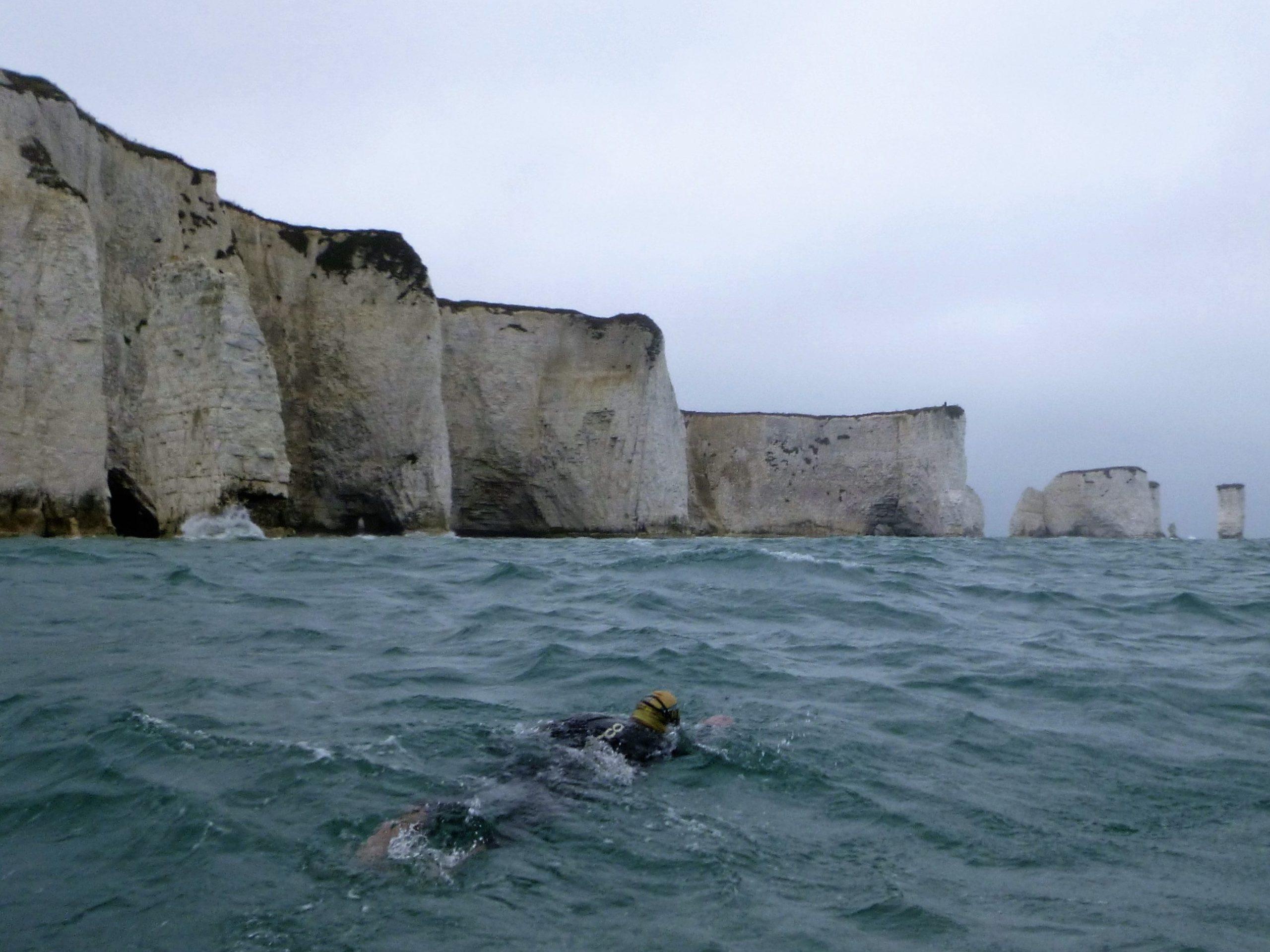
DIY swimmer and open water coach Liz Roe agrees: “I always make sure I research the lake, loch or llyn to understand as much about it as I can,” she says. “I’ve approached swim groups before and told them what I am planning and taken great advice from them.”
The art of planning
Planning is the most defining feature of DIY swims. This might be as informal as checking entry and exit points, deciding where to leave your car, and watching the weather forecast, or it can be highly technical. For those who love poring over maps and tide charts, meticulous planning is a joy. For others, it’s more arduous, but worth it for the satisfaction and freedom of devising your own challenge.
“I need to think of everything from accommodation needs, to water entry and exit points, safety cover, travel arrangements– the research takes time and I haven’t always got it spot on,” says Liz. “But it means I get to choose where and when I swim, and I can tailor my training to meet the needs of the challenges and the time I have available to train.”
For Alec, meticulous planning is about owning the challenge. After the success of his Swanage swim, he planned his most ambitious swim yet – a four-person relay swim around the Bristol Channel’s islands of Steep Holm and Flat Holm. Thanks to the Bristol channel’s extraordinary tidal flow, this involved producing “swim triangles” to estimate where each swimmer’s speed and the tidal flow would place the group.
“You have hourly triangles where you work out that the swimmer is going at a certain speed in a certain direction while the tide is going in another direction at another speed. This dictated our start and end points for each hour,” he explains. “At its fastest, the water in the Bristol Channel can flow at seven miles an hour, and if you’re swimming at two miles an hour, the tide will out-strip you by a considerable amount. So, if you’re in the wrong place and trying to go in the wrong direction, you’ve had it.”
The art of giving up
As Alec’s island swim shows, nature always has the upper hand, and no matter how inviting the water looks, the current, swell, wind or access can quickly turn a brilliant idea into a disaster.
Careful planning doesn’t eliminate risk, but it does reduce uncertainty. As well as planning your route, preparing for an emergency is key.
“I take the safety side of things very seriously – I don’t want to put myself or anyone else kind enough to support me at risk,” says Liz. “I always swim accompanied by a kayaker who could be a local swim guide, a friend or my husband. I brief them on what I need, where I need them to be, how they can attract my attention if there is a reason for me to stop – simple but it works.”
This highlights a couple of important questions: what support have you got, and where can people get out? On Alec’s Swanage swim, for example, he not only identified exit points, but also practised getting out of the water and onto a sit-on kayak with his kayakers and swimmers.
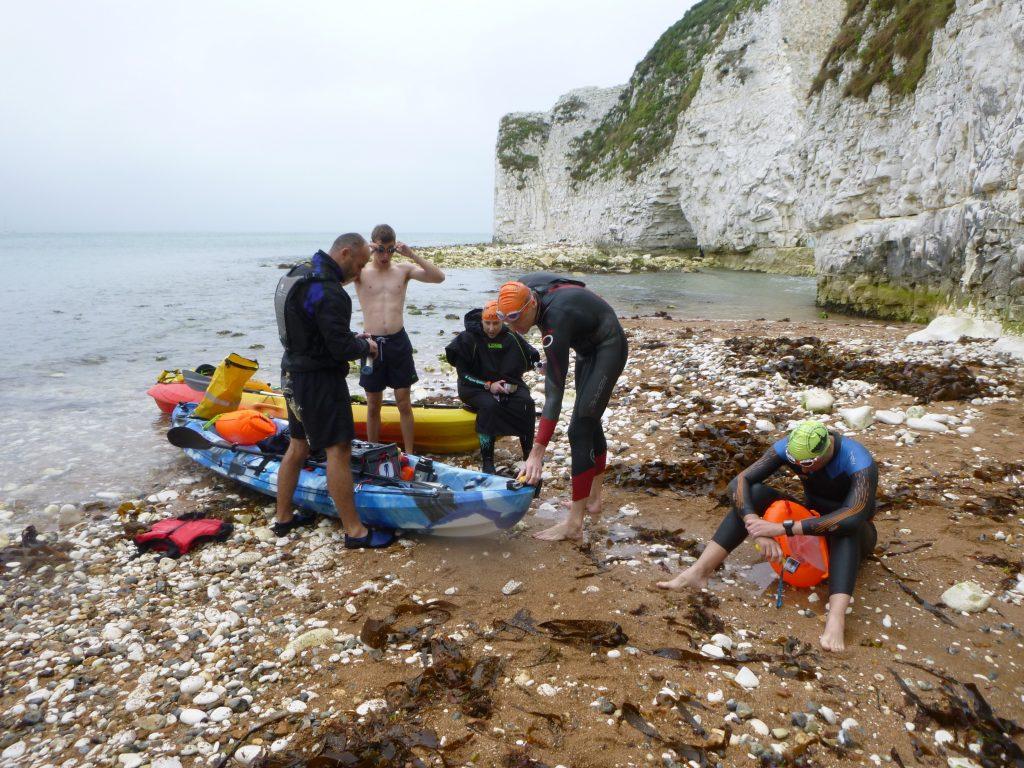
Support can take different forms. For bigger swims, kayaks, paddleboards or boats are necessary, depending on the size and technical challenges of the swim. For shorter adventures, you might tow your own safety kit in a tow float or Ruckraft.
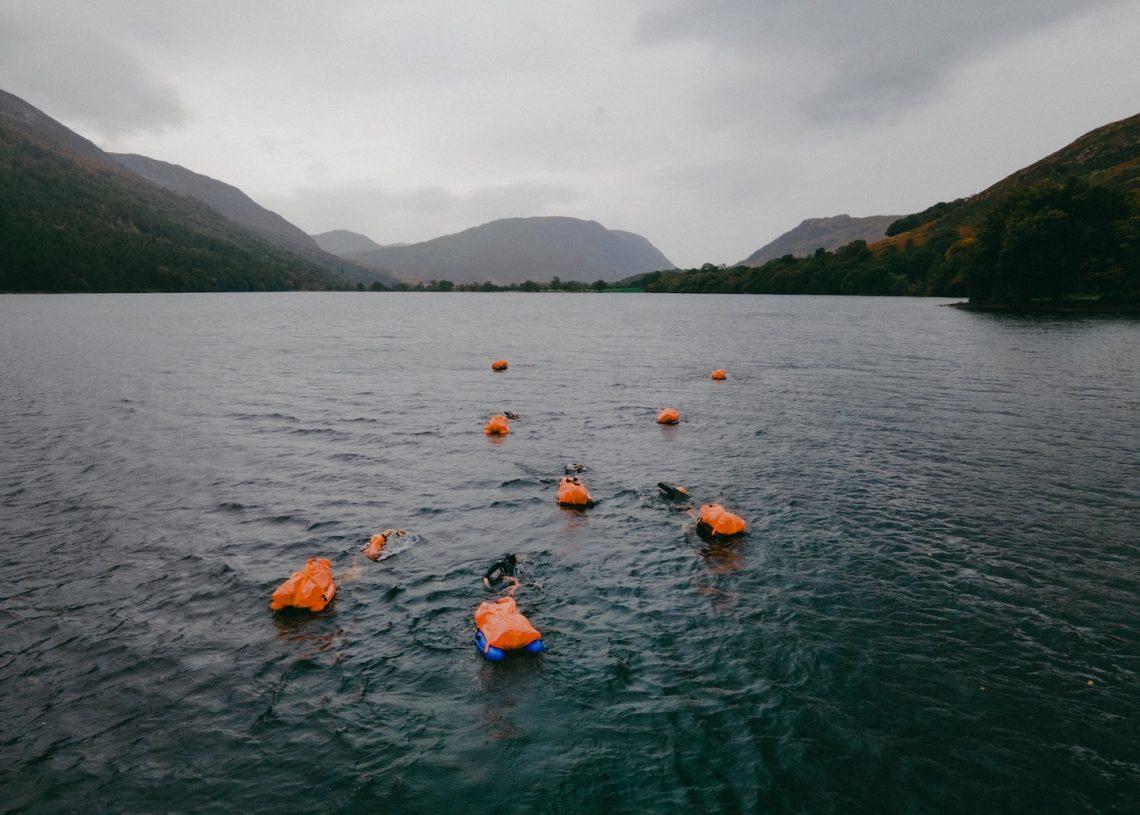
“If you get to the point where you think, I could do with getting out now, the beauty of having a Ruckraft is that you bloody well can,” says Will. “It’s hugely relaxing and enjoyable to know that towing behind you is everything you need for when you get out.” In your Ruckraft, tow float or support vessel, you can pack warm layers, food, fluids and a means of calling for help. The RNLI also recommends wearing a brightly coloured swim hat and tow float for visibility.
Ultimately, though, attitude is just as important as planning and packing. Successful swim adventures happen when you’re prepared to leave your ego behind, adjust or abandon a swim, and communicate honestly with your swim pod and support team.
Pick your pod
It’s therefore crucial to choose the right people to swim with or paddle alongside you.
“Choosing the right people is so important – I wanted people whose swimming capability I knew, who had done similar distances before,” says Alec, who involves his swim pod and support team in the planning from the start. “There can’t be anything competitive about it.”
It’s an interesting juxtaposition –adventure swimming may attract independent-minded personalities and feel like a solo activity, but success depends on cooperation and communication.
“I have really enjoyed being part of larger events, but I also love the solitude of swimming, and with some of the challenges I have been lucky enough to have the water to myself, which is amazing,” says Liz. “I’m also lucky to have friends who are happy to help out, whether that’s kayaking for me for safety cover, suggesting places to swim, cheerleading or swimming some of it with me or generally telling me I’m a bit mad.”
Stripping away any competitiveness or bravado, DIY swimming is the ultimate in swimming your own swim. It’s a world of open water possibilities where you learn to mitigate risk while remaining respectful of the natural world, and appreciate the entire journey – from concept to execution.
And the benefits are considerable: freedom, creativity, affordability, deeper engagement with place, stronger bonds with your swim buddies, and the sheer pleasure of making something special happen. A DIY swim can leave you, in Alec’s words, with the incomparable post-swim satisfaction of imaging a journey through the water and then working out how to follow it.
Find out about cross country swimming and Ruckrafts: abovebelow.cc
Read: Ask Me Why I’m Stood Here by Alec Richardson
Read: The Outdoor Swimmers’ Handbook by Kate Rew
Read: Sophie Pierce’s Wild Guides wildthingspublishing.com