

Water drawn
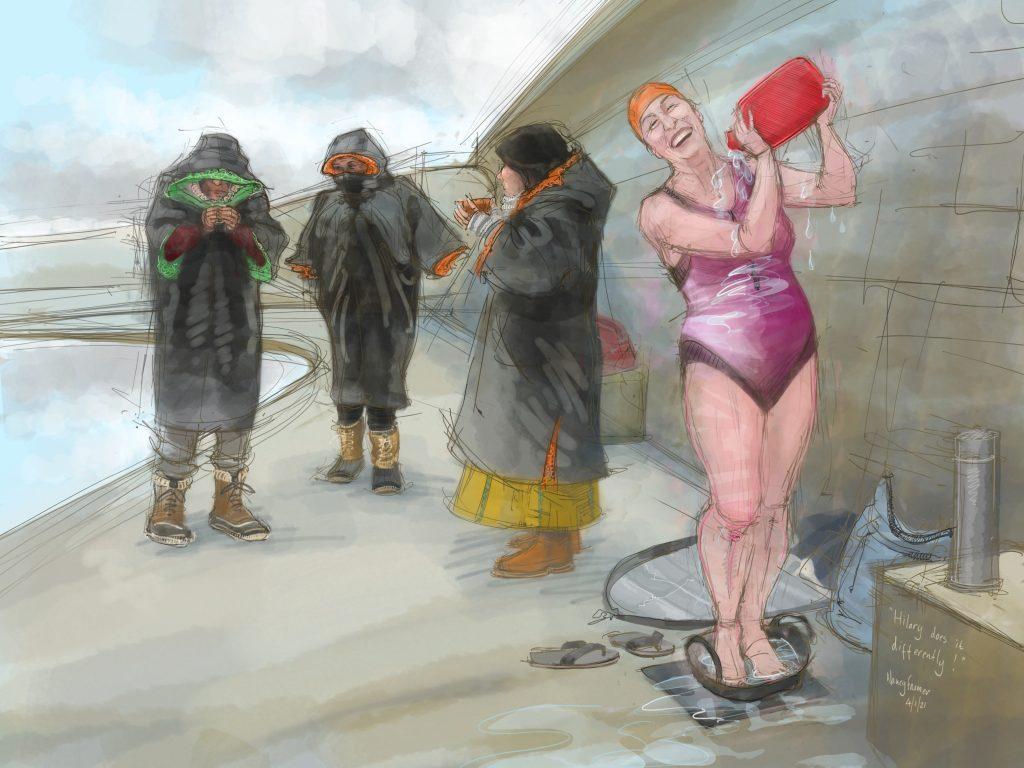
From Medusa drying her snakes with a hairdryer to the difficulties of putting your pants on in the cold, Nancy Farmer’s artwork perfectly captures the fun, hilarity and comradeship of cold-water swimming.
A cat sits in a recycling box behind artist Nancy Farmer as I speak with her over Zoom from her home in Somerset. Our interview is punctuated by the off-screen antics of three cats (“one is a psycho, the other two hate him,” laughs Nancy) and doorbells ringing. Like much of Nancy’s work, the humour comes from the small things in life, those moments that are hard to capture and easy to forget, but which tell a universal story.
If you are an outdoor swimmer, you have probably seen Nancy’s artwork – either her prints, on social media, or her designs on swim hats. Her drawings are suffused with wit and observational comedy, each piece telling a story rather than just depicting swimmers swimming. The devil is in the detail, the little quirks that speak to us as swimmers, the dialogue that is created through her depiction of bodies and water.
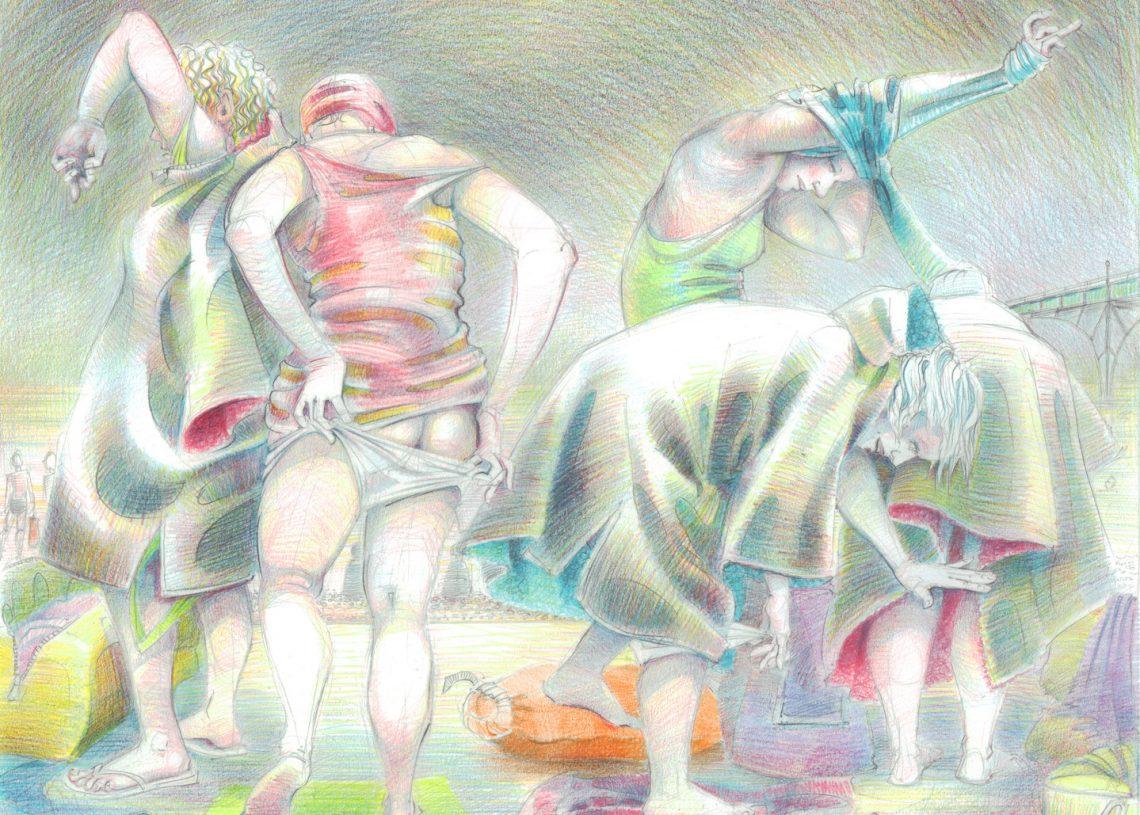
There is a joyfulness and playfulness to her work that tells you that she is an outdoor swimmer too. Her recent drawing Winter Drawers On! is a case in point – from its punning title to its depiction of the comedy of errors that putting your knickers on in the cold can easily turn into. We’ve all been there, flashing your bum at a dog walker as you try not to topple over putting your pants on! The drawing celebrates the small victory that only winter swimmers know – the triumph of getting dressed and decent with cold and numb fingers.
“The cold is important,” says Nancy. “It makes a story because you’re pitting yourself against the elements. It puts everyone in touch with a certain kind of rawness of being human. From my point of view, that’s a great focus for telling stories.”
Visual storytelling
It’s those stories, told by an artist who is a swimmer herself, that Nancy captures so perfectly in her drawings. Small moments captured in everyday swims give her something to say, a story to tell. “If I only swam in a pool every day it would get old really quickly,” she laughs.
At the beginning of our conversation, I joke that we are the ‘old guard’ of outdoor swimming – the pre-pandemic swimmers who did it before it was the latest media fad. Our swim stories are very similar – we both started our open water journeys at the Great North Swim, Nancy a few years after I first took the plunge in 2009. She has been swimming outdoors for about a decade. Like many outdoor swimmers, she took up swimming after falling out of love with running. Initially she swam in a pool, taking on the challenge of a 5km Swimathon event. A Facebook post celebrating her Swimathon swim led to her cousin’s wife, a keen open water swimmer, introducing her to the Great North Swim. And that was how her love of the open water was sparked.
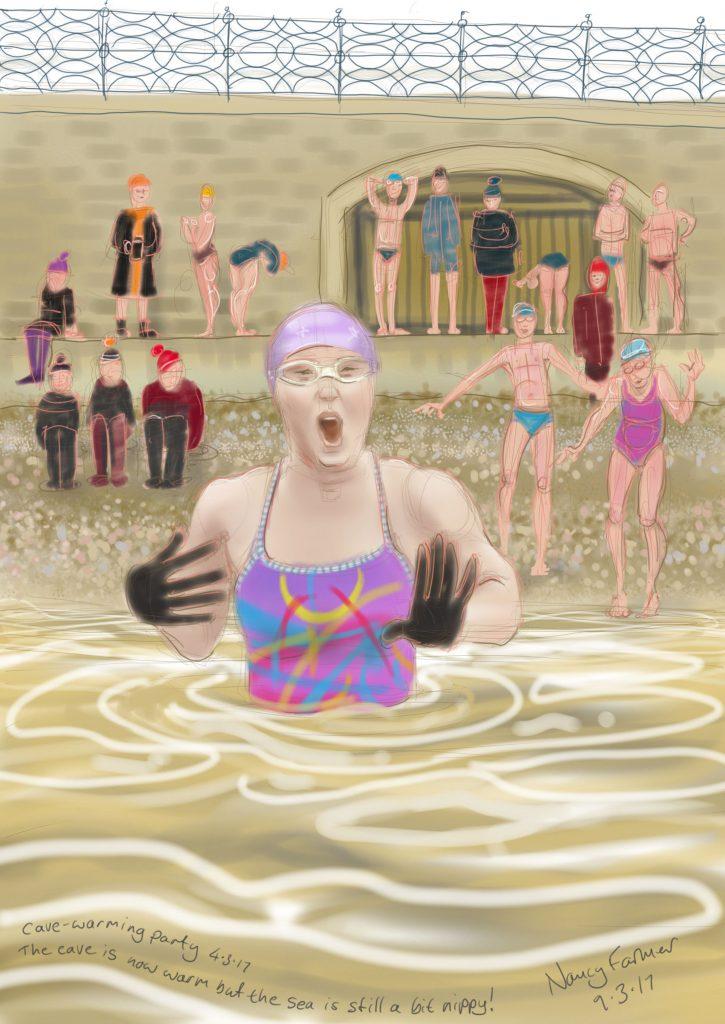
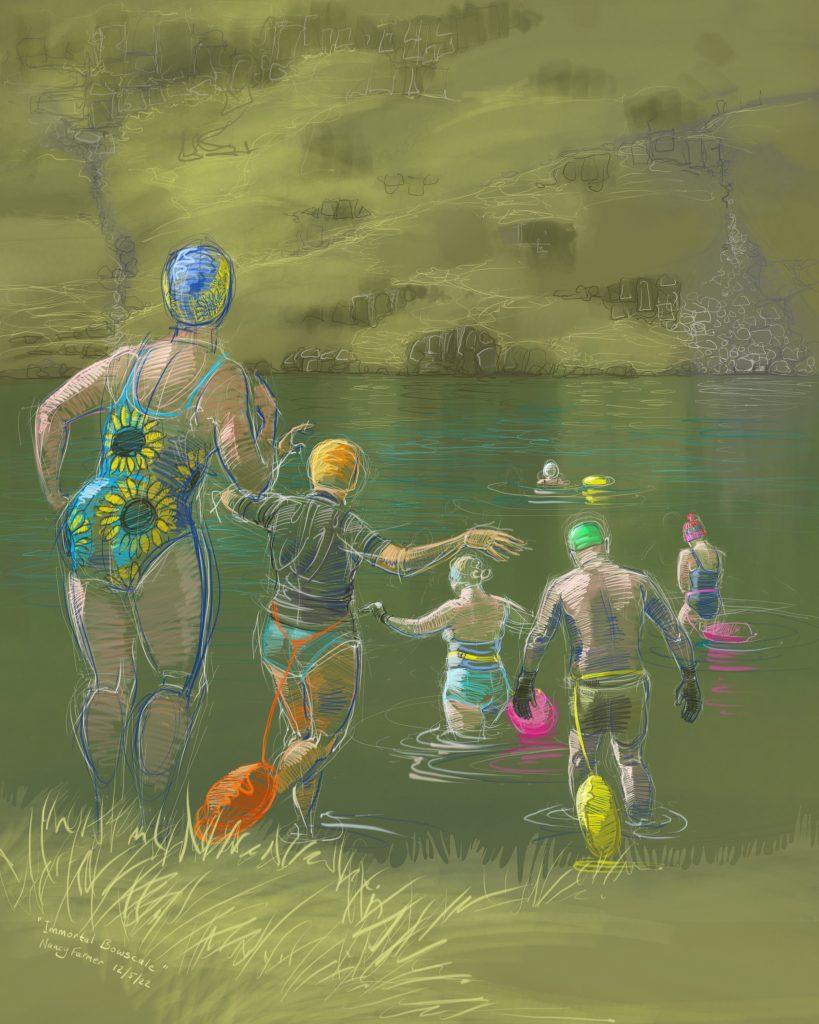
From the Great North Swim to Coniston End to End and the Dart10k, Nancy quickly racked up long-distance swims in her newly purchased wetsuit. “I had a few years of signing up to things to make me do them,” she says. “I very soon discovered I hated swimming in a wetsuit and I was fairly good without it. I did Coniston with a wetsuit, then went back the next year and did it without.”
Becoming a winter swimmer
At the time Coniston End to End was run by Colin Hill, event organiser, swim coach and long-distance and cold-water swimmer. Nancy signed up to a training weekend with Colin in the Lake District, at the end of which she received a goody bag with the obligatory energy bar and handful of leaflets for swim events and sports products. One of the leaflets was for the Big Chill Swim, a winter swimming gala in Windermere also run by Colin.
“Swimming in Windermere in January? Yeah, that’s silly,” recalls Nancy. “But I didn’t throw the leaflet away and it kept kind of hanging around, so by the end of the year I’d signed up to do it.”
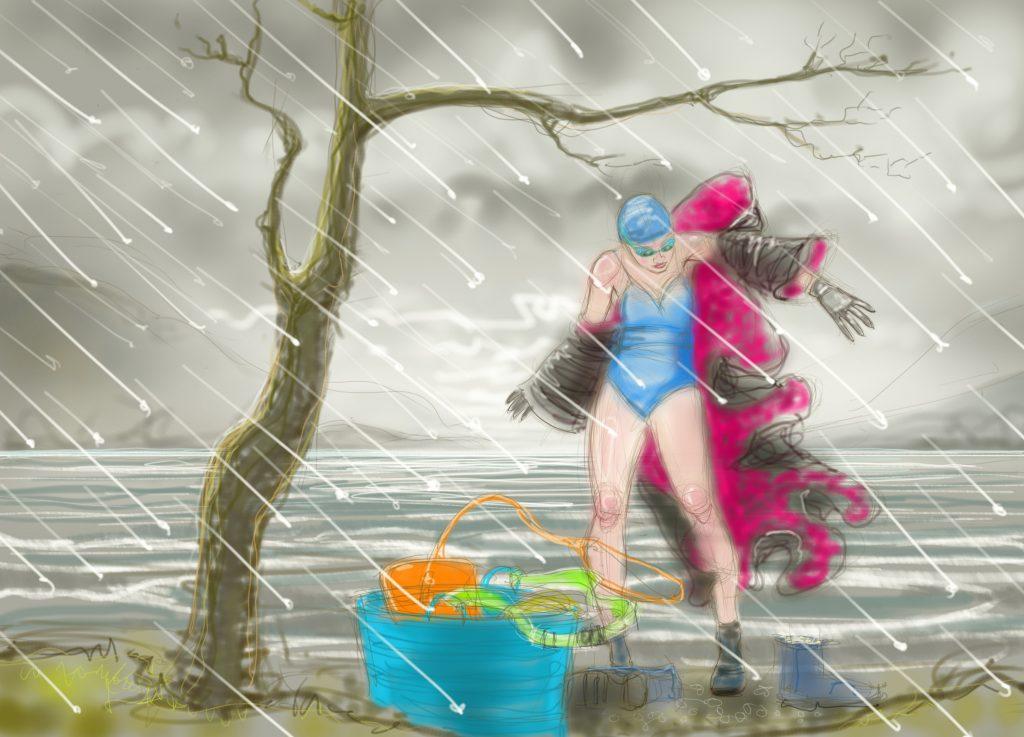
And as Nancy’s swimming developed, so did her artwork. Full of passion and enthusiasm for her new hobby, she started drawing swimmers. The first winter after the Great North Swim she started swimming every week at Vobster lake. “There was just me, Ruth and a chap called Jim. We swam every Tuesday morning, we hardly saw any other swimmers.” Nancy set up a Facebook group, which the lake organisers laughed about originally: ‘it’s just you three.’ But swimming all winter kickstarted an artistic response.
“I started drawing little pictures on my phone as you could use a lot of colour and it was much quicker than drawing with a pencil,” remembers Nancy. “I drew this little picture and I thought, ‘I’ve just drawn some people I don’t particularly know very well, in not very much.’” Not quite sure what to do with them, she would tentatively send them the pictures. The reaction was instantly positive. But it was thanks to Colin Hill that her drawings of swimmers found a wider audience.
“The very first time I did a Coniston swim, I drew this picture of the swim and I emailed it to Colin who loved it. The second time I did the Big Chill Swim, he said I should have a stand to sell artworks.” From that moment, she hasn’t looked back.
Funny bones
Nancy’s swimming artwork is a far step from her pre-swim subject matter, but I am not surprised to learn that that artwork was humorous too. “I did fantasy pictures, but they were much more satirical,” she says. “Fantasy tends to take itself very seriously. I did things like pictures of demons sitting around drinking cups of tea. If hell is eternal, it’s going to be very boring.” She also did a drawing of Medusa that still sells well: “She’s trying to dry her ‘hair’, her snakes, with a hair dryer.”
At this point, we are interrupted by cats and Nancy disappears: “One second, I need to just open the door for a cat who wants to go out.” Nancy returns to my laptop screen. “Sorry about that. It’s entirely possible that she will appear at that window and want to come back in again.”
It’s capturing that moment of comedy in everyday life that Nancy does so well in her drawings. “The trigger for an artwork is usually something quite slight,” she says. Like a plank. Contemplations on a Plank tells the simple story of a scaffolding plank washed up on Clevedon Beach. “One friend didn’t want to see a nice, large chunk of wood go to waste, but it wouldn’t really fit in her van. Another friend said, ‘I have a saw in my car.’ We had this long conversation about a plank that nobody would have remembered if I hadn’t got home and thought, ‘I’m going to draw a picture about the plank.’”
The resulting picture captures that moment perfectly. It is a moment that may have happened to you in a similar way – what to do with found items on your swims? I have a section of my wardrobe devoted to ‘foraged’ clothes – clothes left behind that no one claims but which fit me rather nicely!
“So many moments that I could have done drawings about get lost, because they’re usually relatively minor,’ says Nancy. “And if you don’t nail them then, you’ve kind of lost the moment. So there’s a picture of us on the beach, post swimming, standing around the plank talking. And it can just be a little thing like that.”
Anatomy and expression
As in so many of her drawings, it is bodies rather than faces that tell the story. “I don’t have much interest in landscapes,” says Nancy. “They’re just the background. I’d quite like to be better drawing faces, but you can create a dialogue in a picture just from the way people are standing or holding their hands. The thing I love is anatomy and the expression you get from movement.” The stances of the swimmers in Nancy’s drawings pretty much tell the stories themselves – the ungainly wobble over sharp rocks, the gleeful way they hold themselves as they enter cold water, the hesitancy captured as they hide from the rain.
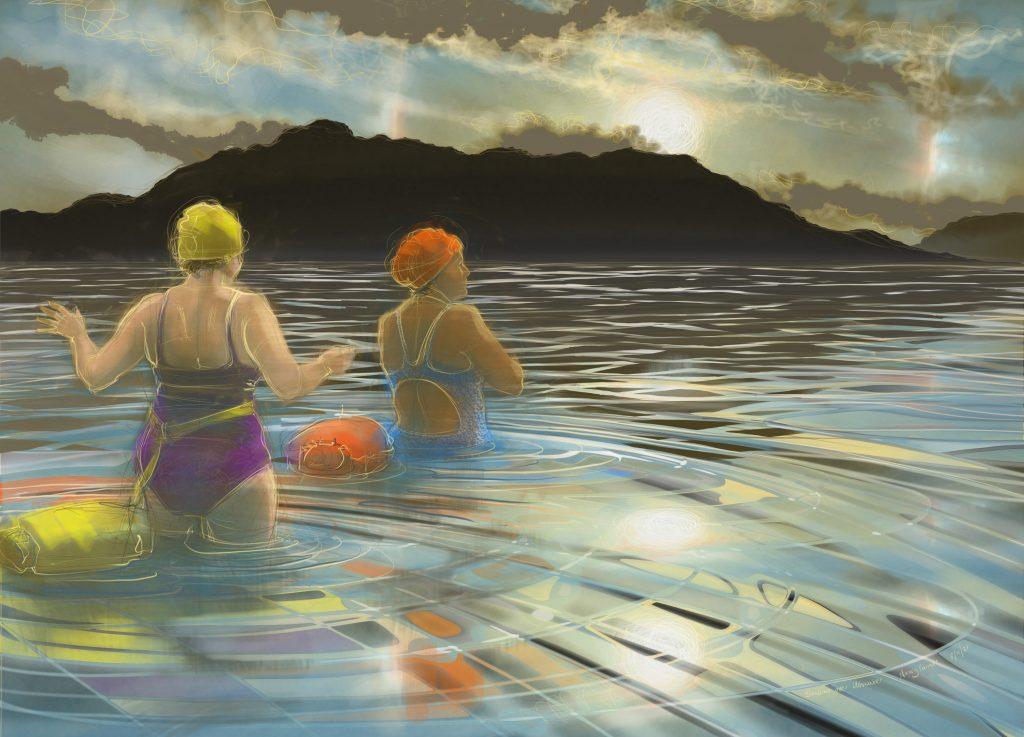
As well as dialogue created through anatomy, the other seam running through Nancy’s work is friendship. Groups of swimmers, often women, are the mainstay of her work. I ask her how important friendship is to her swimming: “Hugely. We’re a little bit famous on Mondays at Clevedon Marine Lake, as we turn up and have no intention of swimming straight away. We do intend to swim, but we have no intention of getting on with it. You’re there to have a talk and then eventually you get in the water!”
Almost everything in her life (apart from learning to play the violin – “but I’m not very good at that”) now revolves around swimming. “I’ve turned it into my life, frankly. Most of my friends are swimmers. If I didn’t swim, I’d need to find something else to do with my life.”
An enduring trend
The pandemic brought new swimmers, and new friends, to the water. “During the pandemic, there were loads more people swimming, and I think it kept quite a lot of us sane. And other people, what I might call non swimmers, started swimming. And some of those have continued.” I have seen the same trend where I swim, and it is reflected in the Outdoor Swimmer Annual Trends Report. “What’s interesting about swimming is that you can actually be quite a poor swimmer and still get a lot of benefits out of it,” says Nancy. “It’s not going to be a very good exercise, but it can still benefit them in other ways, which is what’s quite nice about swimming.”
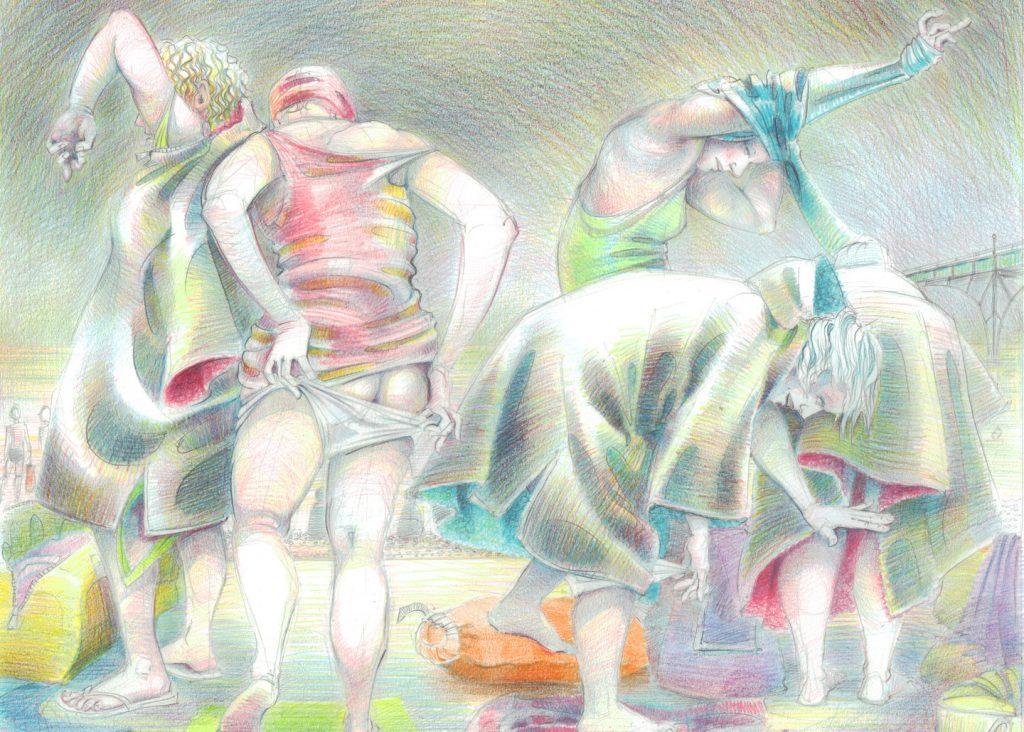
As in her drawings, all people come together – dippers and swimmers. And cats. We are waylaid by cats again. “Sorry, I’m trying to ignore the cat out the window now.” Meanwhile, Fred, my dog, lies asleep in front of the fire. Friendship and animals, surely two of the most important things in life (as well as swimming, obviously). We return to talking about the Winter Drawers On! drawing, which encapsulates friendship, fun and the outdoor swimming community – and links nicely to this issue’s theme of creativity. Nancy usually draws digitally, but for this piece drew in pencil. “You can do a lot with digital drawing, but you don’t have that tactile quality. You don’t have the infinite subtlety of making marks with pencils.”
Her resolution is to do more drawing on paper: “You can perfect it too much drawing digitally, it’s almost as if you’ve overthought it.” There is a rawness in the pencil drawing that reflects the rawness of the experience of swimming in winter and celebrates the joy that outdoor swimming brings us.
Read Nancy’s blog at waterdrawn.com, buy her artwork at etsy.com/uk/shop/WaterDrawnArt
and follow on Instagram: @nancyfarmer_artist

Jonathan Cowie
Jonathan Cowie is our former editor. He is a year-round skins swimmer with a particular love of very cold water. He has competed in ice swimming competitions around the world. He is a qualified open water coach with a particular love of introducing new swimmers to the open water.