

Breath, water and vibration
Breathing correctly makes us better swimmers, but can working on breath on dryland helps us in the water? Ella Foote joins a Sonic Freedive session at Lime Wood’s Herb House Spa to find out
If you ever work with a swimming teacher or coach to improve your swimming, one of the first things they will look at is your breathing. Before stroke technique, before pace, before distance or endurance, there is breath. When swimming in cold water the first response is respiratory. The gasp, the sharp inhale when skin meets cold and our heart-rate spikes, our breath is more reactive. For outdoor swimmers, performance and safety hinge on one skill above all others: the ability to regulate breathing. Can we train our breath like we train our bodies?
At Lime Wood hotel’s Herb House spa in the New Forest, a monthly session called Sonic Freedive combines guided breathwork with immersive sound bathing in water. It isn’t marketed as swim training, but speaking to Breathwork Practitioner and Freediver Tracey Howes, the crossover with open water swimming is evident. Breath isn’t really about lung capacity, it is about nervous system control and when we learn how notice and train our breathing, we can unlock all sorts of benefits both in and out of the water.
Why it matters…
Breathing properly maters more than we think and as modern-day humans, it is thought we have lost the ability to breathe correctly, which can affect everything from sleep to chronic disease. It isn’t just an automatic, physical act, it influences the mind too. Mastering our breathing can have a positive impact on our overall wellbeing. It can lower stress and anxiety, improve focus, enhance emotional balance, support relaxation and better sleep.
When it comes to swimming, it is the key to efficiency, endurance and safety. Swimming, as we all know and love, is incredibly demanding on our muscles and uses a lot of energy. If your breathing is poor, your muscles won’t get enough oxygen, this will lead to fatigue faster. Efficient breathing keeps oxygen flowing steadily, allowing longer or faster swimming. When we master our breathing, we can establish a natural rhythm and create power through flow.
Inadequate breathing can lead to dizziness, hyperventilation while holding your breath can spike CO2. In short, mastering our breathing makes us better swimmers.
Breathing on dry land
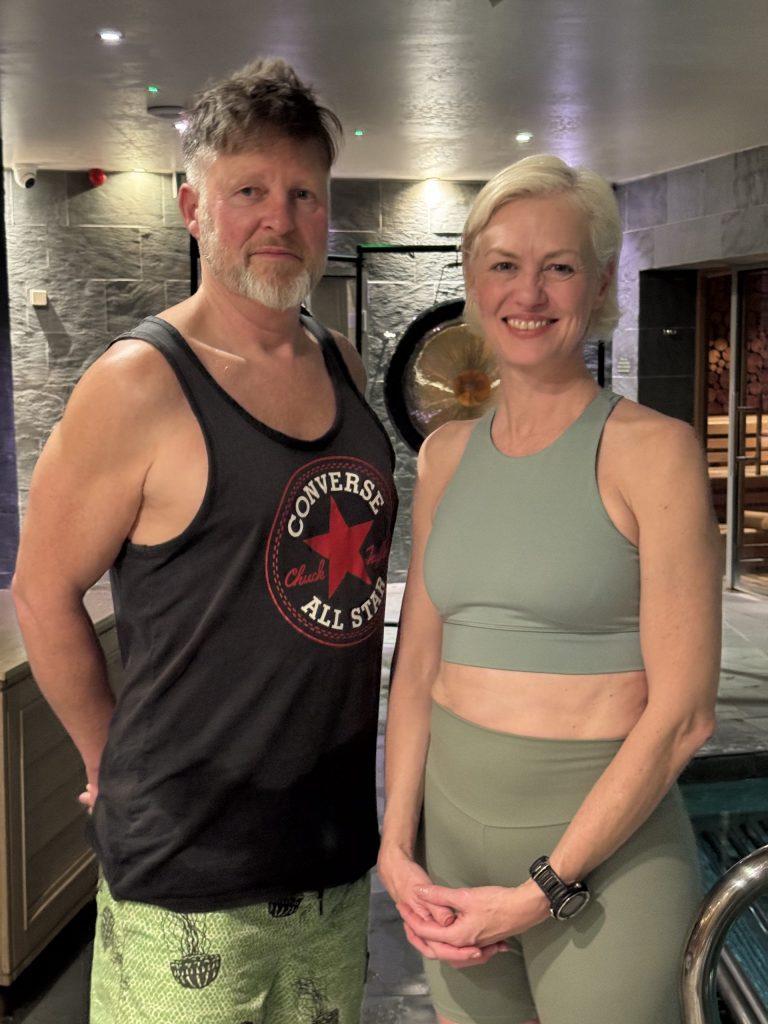
The Sonic Freedive sessions at the Herb House start with a guided breathing practice led by Tracey Howes. Blending science backed breathwork with movement, myofascial release, meditation and contrast therapy, Tracey helps people build resilience in body and mind. She was trained by Oxygen Advantage founder Patrick McKeown and cold exposure researcher Dr Susanna Søberg. As a national level freediver, Tracey understands the power of the breath in the water and shares that knowledge through retreats, workshops and one-to-one sessions.
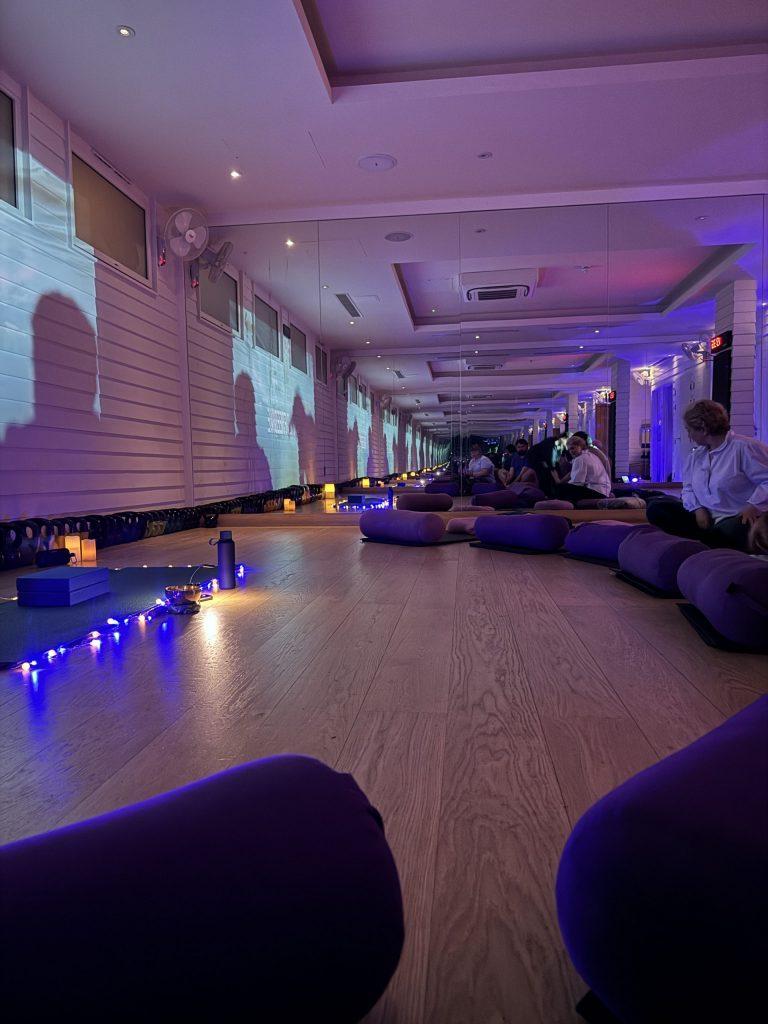
Sitting with the sound of the ocean in a studio with Tracey makes you immediately feel calm. In fact, it is only when you are asked to think about breath that you realise how shallow or weak your usual breath can be.
We start by regulating our breathing and calming ourselves down. Tracey begins by asking us to notice rather than change. Most of us, she explains, live in a mild but constant state of over or under breathing. We breathe through the mouth, we breathe quickly, we rarely empty the lungs fully. For swimmers, this pattern can show up as tension in the water, a sense of urgency between strokes, or a creeping anxiety.
In the studio, we practise slow nasal breathing, extending the exhale, pausing with full and empty lungs. The room is quiet except for the rhythmic tide of breath moving through the group. The emphasis is on calm and control. Tracey talks about the diaphragm is a muscle most of us have forgotten how to use properly. We are encouraged to breathe low and wide, expanding into the ribcage and belly. The effect is subtle but immediate: shoulders soften, heart rate steadies, the mind begins to uncoil.
This internal focus feels unfamiliar, yet it mirrors something I recognise from the water, that moment mid-swim when rhythm clicks into place and effort feels sustainable. Breath becomes tempo, tempo becomes flow.
Cold water and control
Working with cold exposure researcher Dr Susanna Søberg, Tracey teaches contrast therapy and breath regulation for immersion. I asked her about how we can use breath in and around cold water. Before entering cold water, she advises to use simple techniques that extend the exhale to stimulate the vagus nerve and slow the heart rate. One of her favourites is called Six Four: inhale gently through the nose for four counts, exhale for six with the mouth closed.
“That longer exhale attacks the vagus nerve to slow down the heart rate and calm the nervous system,” says Tracey. “It’s easy to remember and helps regulate the cold shock response.”
Interestingly Tracey also emphasises temperature awareness. “If you cannot regulate your breathing in cold water, the water is too cold for you at that time,” she says. For beginners, she suggests starting around 15°C, where cold shock is present but manageable. It typically takes 20 seconds to a minute for breathing to settle. Only once it does should you stay or begin to swim. For outdoor swimmers accustomed to bracing and pushing through, this is a useful reframe. Regulation first, then swim.
Race nerves and mass starts
Cold is not the only trigger for swimmers. Many struggle at the start of mass participation events, surrounded by hundreds of bodies, adrenaline high, breathing short and sharp. It can be hard to get into a rhythm and flow then panic can set in. I asked Tracey for tips on how swimmers can tackle this. Freediving, though very different from endurance swimming, offers transferable tools.
“I always try to do the slow breathing outside the water,” Tracey says. “Then once I’m immersed, I recognise the temperature, look around me, find something I can focus on. That focus might be sunlight on the surface or the sensation of water on skin. I combine this with extended exhalations and positive self-talk: I am here. I have chosen to be here. I give myself permission to relax.”
Visualisation is another powerful tool. Floating briefly before a dive, she scans the body from head to toe, consciously relaxing each area. Then she mentally rehearses the dive. “When you’re in that calm stage and you feel safe, you’re ready to perform.” The nerves do not disappear, but they no longer dominate. “When people are nervous, the top of the chest gets very tight,” says Tracey. “The rib cage pulls down, the diaphragm contracts and it actually makes the lungs feel restricted.”
The body, sensing uncertainty, goes into protection mode and breathing becomes shallow. Through diaphragmatic breathing, mobility work and rib cage opening exercises, freedivers learn to create space around the lungs. Even simple yoga-based stretches can loosen intercostal muscles and improve the depth of the inhale. For swimmers who feel limited by lung capacity when increasing pace, this is revealing. Often the issue is not capacity but restriction and nervous system state.
From studio to spa
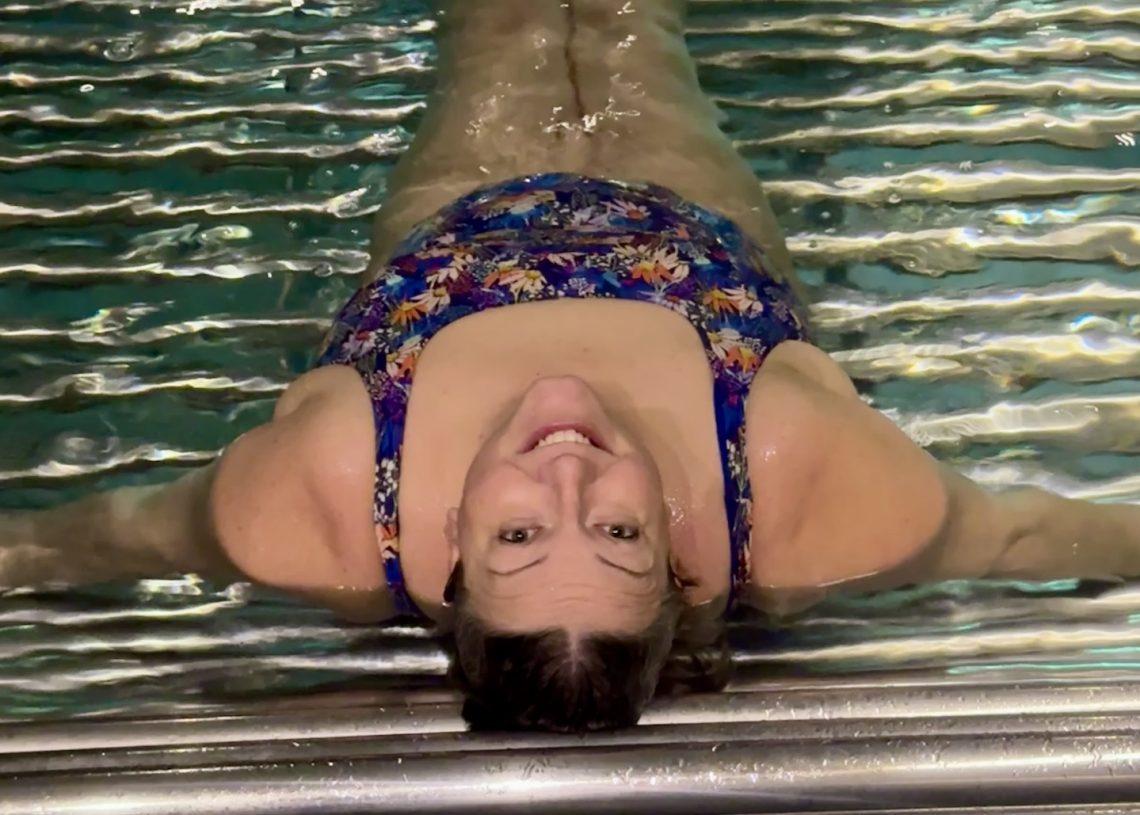
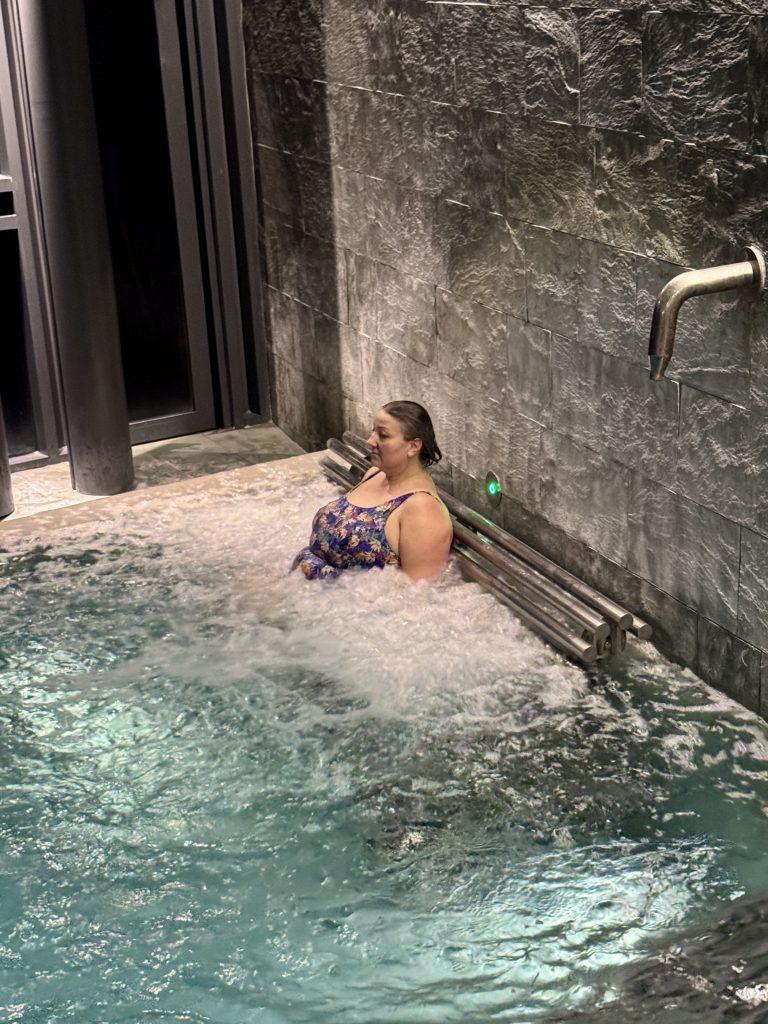
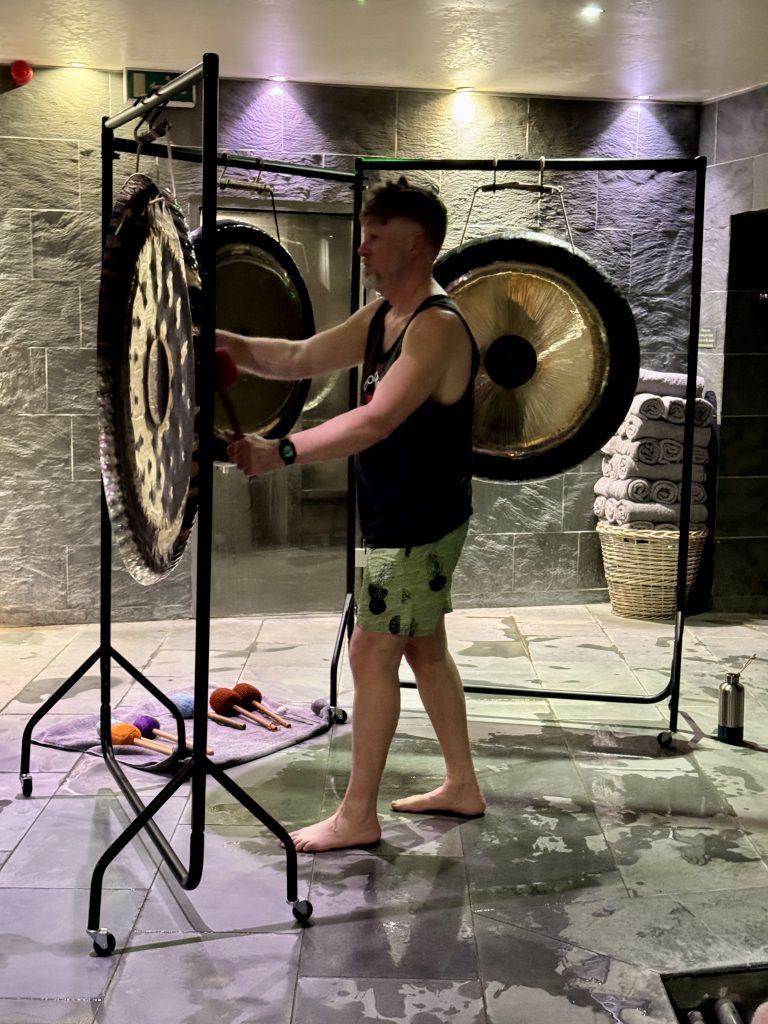
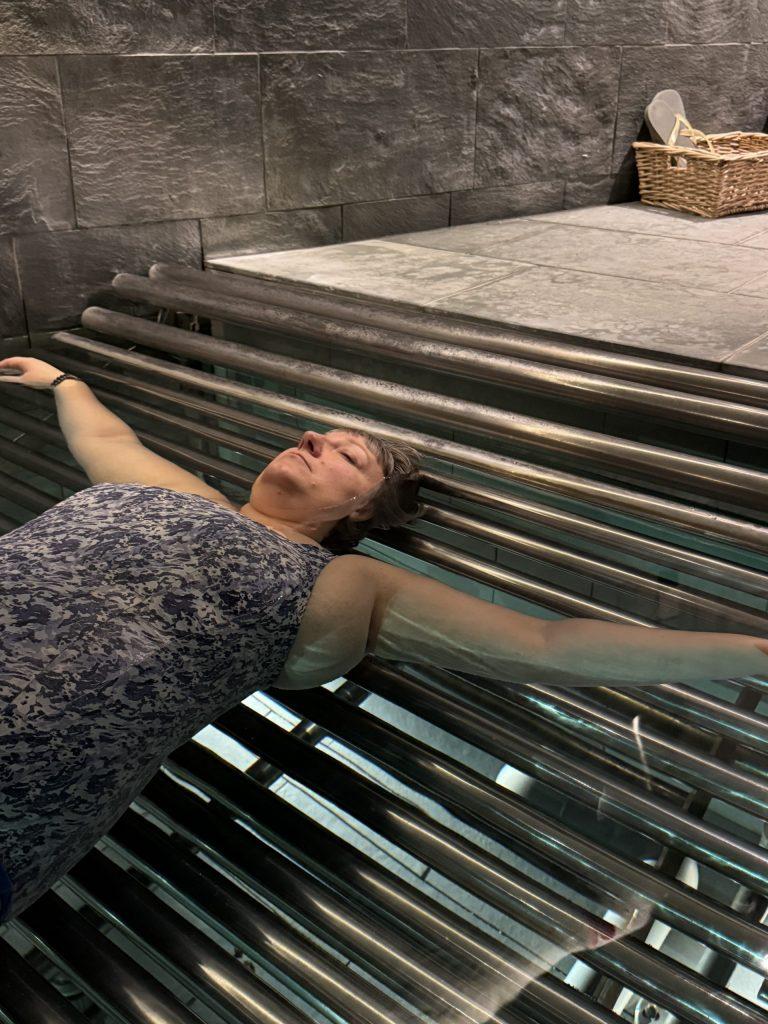
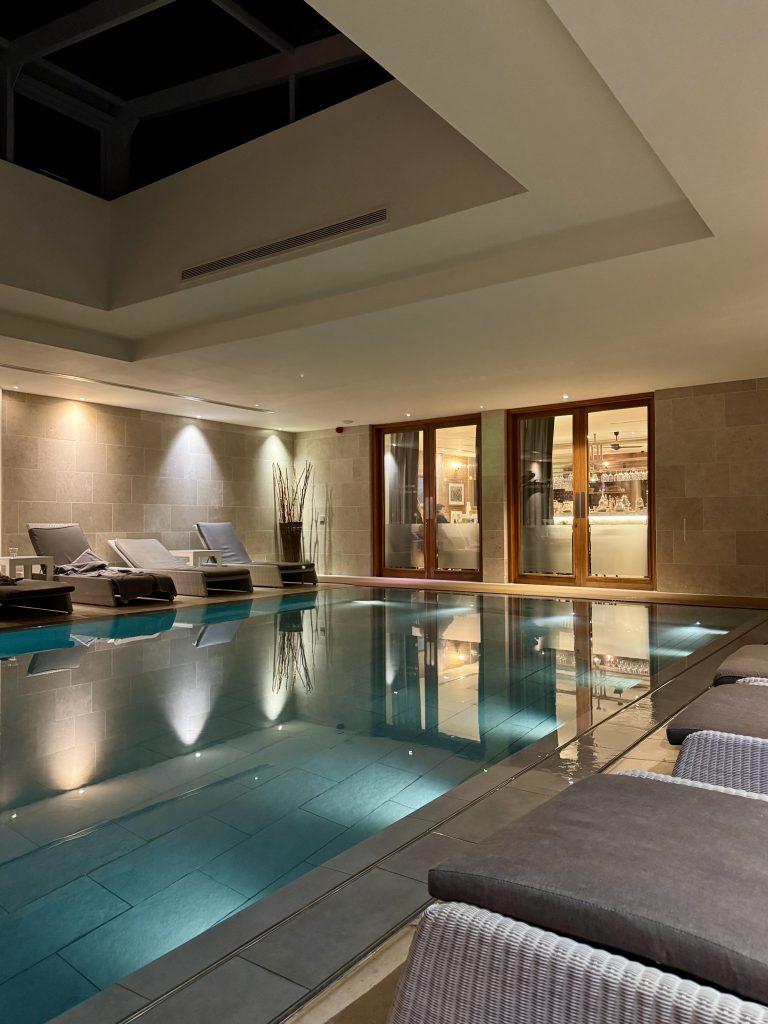
After the guided breath session, we move to the hydrotherapy pool. This is where Sonic Freedive distinguishes itself from a standard breathwork class. We join musician and gong master Rich Hale (ex-front man for chill-out band Kinobe) who uses gongs and sound while participants float or rest at the water’s edge. The vibrations travel differently through water; you don’t just hear the sound, you feel it as a low hum through the ribs and spine. Floating on my back, ears submerged, I breathe slow and deliberate, putting the awareness learnt in the studio into practice.
I have always loved the way a full inhale lifts the body and a complete exhale allows it to sink slightly in the water. This integration of sound and water is a way to deepen parasympathetic activation. For swimmers, this matters. Many of us enter the water carrying the residue of busy lives. If we can shift our nervous system before or during a swim, we change the quality of the experience. As the sound grows and strengthens, I relax and the sounds change. The thin, almost tin-like sounds turn choral and it seems like I am being sung to by a choir. After I mention this to Rich, he tells me that some say it is the sound of angels, but I can tell he isn’t convinced of this theory. Either way, one thing was certain, I felt a peace unlike anything I feel out of the water.
The Sonic Freedive sessions at the Herb House Spa are held monthly. You can book these via limewoodhotel.co.uk. Rich and Tracey hold a number of events across the South Coast and you can find out more via breathandgong.com

Ella Foote
Ella is renowned outdoor swimmer and journalist. As well as leading the editorial, digital and experiential outputs for Outdoor Swimmer she is also Director of Dip Advisor, a swim guiding business helping people enjoy wild water. Ella also teaches swimming to children and adults, is an Open Water Coach and RLSS Open Water Lifeguard.