
Building skills for long-distance swimming
Simon Griffiths suggests skills to master at each stage of your swimming journey
When I started swimming longer distances, I thought the key was simply logging more training miles – but it turns out there’s more to it.
Long-distance swimming amplifies weaknesses in your swimming. If you struggle to swim straight, the extra work you put in to get back on track becomes more significant the further you go. Technique faults or muscle imbalances you can get away with on short swims may lead to injuries. Not understanding nutrition could prematurely end your adventure.
One way to map out what to tackle first is to reflect on where you are in your open water journey. There’s little point worrying about nutrition if you get breathless and need to stop after a few hundred metres.
Assuming you have long-distance swimming aspirations, let’s explore what skill development to prioritise based on where you are now.
BEGINNER: COMFORT & CONTROL
Your first experiences may overwhelm you with sensory shocks. You have to deal with temperature, limited visibility, muffled hearing, infinite space around you. Before you move on to tackling distances, ensure you can push beyond these initial barriers.
Skills to develop
Breath control, relaxation, and comfort in the open water environment.
What to practice
Breathing: In a pool, focus on exhaling underwater, then lift your head and take a calm breath. Then try swimming 25m repeats focusing on breathing out while your face is in the water, and breathing in quickly, without disrupting your rhythm. Then do the same thing when swimming outside.
Floating: At this stage, you may panic in open water. Practice rolling onto your back to float and recover. This is a way to reset mentally and physically. In an event or at a supervised venue, it will probably result in one of the safety crew checking in on you.
Acclimatisation: Start with short dips, gradually increasing time in the water. Keep track of how you feel at different temperatures. What feels unbearable cold initially can be comfortable with practice.
COMPETENT: RHYTHM & ORIENTATION
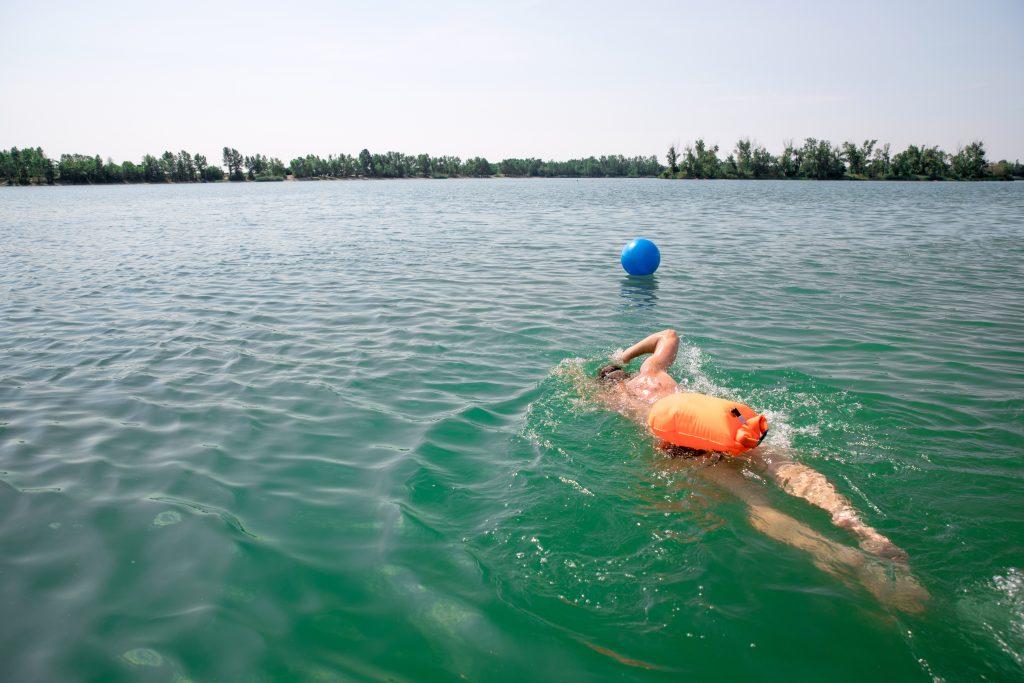
Once you can swim a few hundred metres without becoming breathless, you can progress to longer swims. But there’s still plenty to improve.
Skills to develop
Sighting, pacing, and swimming straight.
What to practice
Sighting (i.e. looking where you’re going): In the pool, every 6–8 strokes lift your eyes just above the surface to ‘spot’ a target. Keep your stroke rhythm continuous and body position stable.
Pacing (the ability to control your speed): Many people start too fast, burn lots of energy and end up swimming more slowly than they need to. Practise swimming 100m or 200m repeats at a uniform speed.
Swimming straight: In open water, pick a landmark and swim toward it. Notice the difference between sighting every 4, 6, 10 and 20 strokes. In calm conditions, you should be able to swim 10 strokes in a straight line. If you drift, work out how to fix it.
CONFIDENT: EFFICIENT & ADAPTABLE
At this level, you’re not easily phased in open water. You can swim long distances and hold your line. Improvements come from refining your technique and learning to adapt it as conditions change.
Key skills to develop
Stroke economy, endurance, bilateral breathing, and coping with more challenging conditions. (desirable but not essential).
What to practice
Swimming technique: Get a stroke analysis done if possible. Become a swim geek: read books and watch videos on swimming technique. Devote part of every swim to improving your technique.
Opposite side breathing: Create exercises that force you breathe to your least comfortable side. For example, 10 strokes to your left, then 10 to your right.
Coping with conditions: Don’t skip your swim if the conditions are a little rough. As long as it’s not dangerous, embrace them. Practice swimming into the wind, against it and across it. Notice the difference and work out how to adjust.
ADVENTUROUS: ENDURANCE & SAFETY
At this stage you’re capable of big swims, but the focus shifts from comfort and technique to strategy and, if you’re competitive, racing skills and tactics.
Skills to develop
Energy management, pack swimming and drafting, advanced environmental awareness.
What to practice
Long swims for resilience: Build up to long continuous swims (2-4 hours or more!) at a steady pace. Practice fuelling if your challenge will require it.
Pack swimming: Train with others to practice drafting, positioning in a group, and staying calm in the chaos of the pack.
Mental training: Rehearse ‘what if’ situations: what to do if you cramp, if goggles leak, or if you get cold – and anything else you think might happen.
Environment study: Learn to read tide tables, current charts, and make a point of checking weather forecasts before swimming. Learn what impacts conditions and how you need to deal with them.
LEARN PATIENCE
As you progress in swimming, you will pick up knowledge and develop physical skills. Mostly you learn swimming through doing – but reading, thinking and visualising will accelerate the process. Having a framework will guide what you do next. But remember, it’s not linear. You will have to circle back and revisit skills. Stay open to learning and enjoy the journey, including the diversions.

Simon Griffiths
I started Outdoor Swimmer in 2011 (initially as H2Open Magazine) as an outlet for my passion for swimming outdoors. I've been a swimmer and outdoor swimmer for as long as I remember. Swimming has made a huge difference to my life and I want to share its joys and benefits with as many people as possible. I am also the author of Swim Wild & Free: A Practical Guide to Swimming Outdoors 365 a Year, I provide one-to-one support to swimmers through Swim Mentoring and I'm the creator of the Renaissance Swimmer project.