EXPLORE,  EXTRA,  FEATURES,  HEALTH,  May 2023,  Premium

Spring Clean: the healing waters of springs

From geothermal spas to icy plunge pools, Rowan Clarke explores the clean, healing waters of springs. 

Us humans have a complicated relationship with water. Bringing life and jeopardy in equal measure, we’re not content with just drinking it; we want to be by it, in it and on it. But we’re terribly ill-equipped to survive in water. Lacking innate swimming skills, we can’t hold our breath or survive outside a narrow body temperature range.

What water source better characterise this complex relationship over human history than natural springs? Since prehistoric times, we have made sacrificial offerings to the gods at springs, healed our bodies and minds, tapped into clean drinking water at sacred pools and geothermal springs. Once venerated in almost all world cultures, springs were central to our lives. But then they were neglected and forgotten until, as we sought ways to reconnect with nature and with the stories that shape our world, we started to rediscover and restore them.

Healing waters

Beyond being a clean water source, natural springs have held important cultural and spiritual significance throughout human existence. Archaeologists have found prehistoric artefacts at their sites, but it was the ancient civilisations who first built sacrificial altars and public bath houses around springs in the belief that the waters were heavenly gifts containing minerals that could cure diseases and heal maladies.

Nitrodi in Ischia, an island west of Naples in Italy, claims to be the oldest wellness spa in the world. In an era when science and religion weren’t distinct, its spring waters were considered a gift from the nymphs and Apollo and are mentioned in classical Greek-Latin texts from as early as the year 8 BC, including those of Homer. 

But it was the ancient Romans who really revolutionised hydrothermal bathing. Where ‘taking the waters’ had been a luxury, Roman technological and architectural advances meant they could build public bath houses on top of geothermal springs – thus solving the problem of how to clean the great unwashed. As their empire expanded into Europe and Asia, they found new hot springs and built more bath houses, like the Roman Baths in the city of Bath during the first few decades of Roman Britain around 60 to 70 AD.

Of course, the Romans didn’t actually discover Bath’s thermal springs, that was Bladud, king of the Britons. His legend sounds a bit Monty Python – as a prince, Bladud returned from a jaunt to Athens with a dose of leprosy. Imprisoned and then banished by his father, King Rud Hud Hudibras gave him some pigs, so that Bladud could live as a lonely swineherd.

“Unfortunately, the pigs also contracted leprosy,” says Alison Stubbs, Marketing and Communications Manager of Thermae Bath Spa, and fount of knowledge about Bath’s fascinating geothermal history. “Around here in Bath, it was like a swamp and he noticed that when the pigs were wallowing in the warm mud, they came out cured. Prince Bladud threw acorns into the mud to encourage the pigs to go back in as an experiment, and they were, so he went in himself and came out of the waters cured.”

And so Bladud created Bath around the hot springs, dedicating it to the Celtic goddess Sulis, who the Romans later renamed Minerva Sulis, the goddess of health and wellness. You can visit the Roman temple with its altar and baths where Sulis was venerated as a healing divinity, whose sacred hot springs could cure physical or spiritual suffering. 

The Bladud legend and subsequent Roman cult that built up around Bath was much exploited when Bath became a fashionable spa resort in the 17th century. While the Georgians used geothermal springs medically rather than ritually and they flattened ancient remains to build the city of Bath, they made lots of tributes to its legend such as building the Cross Bath at Thermae Bath Spa in the shape of an eye as a dedication to Sulis and placing a statue of Bladud to overlooks the King’s Bath.

Holy springs

There are references to springs in pretty much every world religion, culture and point in history, so it’s hard to make generalisations about our universal human instinct to revere water sources. But the British Isles are home to some of the only studies of holy well lore from early Christian and pagan legends.

“Human beings have an instinctive relationship with water to do with the fact that it is life giving,” says historian James Rattue, who wrote The Living Stream: Holy Wells in Historical Context. “Water is also otherworldly. If you look back at the folklore that surrounds watery sites and sacred springs, one of the themes which comes through is that they are gateways to another realm of reality. Those two themes work their way through the reverence for water, and you can see that playing out even in sites which aren’t particularly old.”

Looking at a map of springs and holy wells in the county of Cornwall alone, you’ll find almost 900 sites. Mid-Wales and Ireland also have hundreds of holy wells named for local saints, wandering monks, nearby abbeys or monastic settlements. While there wasn’t much written during the Dark Ages, there is some evidence of the saints who gave their names to springs, such as Saint Sampson. A fifth- to sixth-century bishop born in south Wales, Sampson was ‘called by God’ to travel to Europe crossing the sea from near Fowey in Cornwall to Brittany, leaving a whole string of holy wells named after him. 

“Cornwall is just littered with named and ancient springs for reasons to do with the religious history of the far west of Britain,” says James. “There are stories of saints within the Celtic tradition who would stand in cold water for hours on end reciting Psalms as an act ascetic devotion”

From the earth

In motifs of ascetic devotion and cleansing both body and spirit, in warm and cold springs, and across world cultures, the fact that springs bring water from deep within the earth is key.

“With springs, you get a clear sense that this is coming up out of the earth. This is something which is alive. This is something which is moving. And it’s something where you can see the origin as well,” says James. “So, you find in folklore and stories this idea that the source is something special. The idea of going back to the origin of something has a kind of spiritual significance.”

Of course, we now understand that spring water doesn’t actually originate from inside the earth any more than it’s gifted by the gods. Anyone who recalls school science lessons might remember the water cycle, which explains how water evaporates and transpires via plants into the atmosphere, gathers in clouds cooling to form droplets, which join with other droplets until they’re heavy enough to fall back to the earth as rain.

When the rain falls on ground impervious to water, like clay, you get runoff into existing bodies of water on the surface of the earth. But, when it falls on porous surfaces, it soaks into the ground, percolating down through the tiny spaces between particles of soil and rocks. Eventually, this water can form aquifers, underground layers of permeable rock or fractures full of groundwater. Some of them are near the earth’s surface, but others can be deeper than 9,000 metres below the earth. One of the most productive aquifers in the world is the vast 100,000 square mile Floridian Aquifer that feeds the Florida Springs.

So, spring water is filtered by whatever minerals are in the ground. In the UK, most groundwater sources spring to the earth’s surface at 10-12°C. But geothermal springs come from deeper aquifers. For example, in Buxton, around quarter of a million gallons of spring water a day flows out of an aquifer that’s about half a mile below ground at a steady 27°C. Water analysis suggests that Buxton’s magnesium-rich spring water fell as rain around 5,000 years ago, which is pretty mind-boggling.

Spring fails

Bathing in warm, pure, millennia-old rainwater was right up the Georgian’s alley. After the Reformation in the 16th century, the religious superstructure that made holy wells make sense disappeared, but they remained important places within their communities.

“People went there for different purposes,” says James. “They might still have a reputation for healing particular disorders or diseases, but they became less saintly sites and more practical sources of clean water for villages and towns.”

A century later, as the Scientific Revolution gathered pace, the Georgians started building geothermal spas as places of healing and respite care. In Bath, the rainwater that fell in the limestone-rich Mendip Hills more than 10,000 years ago, now springs up in Bath at 45°C through three natural springs. What makes Bath particularly striking (and popular for filming period dramas) is that it’s one of the Georgian’s first planned cities. In other words, they flattened and rebuilt the entire city, including St John’s Hospital, or the ‘hospital of the baths’, and the Royal Mineral Hospital to capitalise on its warm, healing waters.

“Royals came here, including Mary of Moderna who gave birth nine months later,” says Alison, standing in the Cross Baths just across the road from what was St John’s Hospital. “From the outside, it looks like windows have been blocked out, but people staying in guest houses would change into their undergarments, get carried here in a sedan chair, enter the baths secretly and then get carried away afterwards so nobody would ever know who was bathing here.”

By the 19th century, half the town lived off the waters selling cures, housing invalids and carrying them in ‘Bath Chairs’ to be treated. In the 20th century, the NHS prescribed the warm waters as therapy. But then it all stopped abruptly after a tragedy that exposed the dangers of geothermal springs.

“People learned how to swim in the Bow Street Baths, which were demolished in the 80s because of an incident where a girl died,” says Alison. “You could actually bathe in the Roman Baths in the 70s and 80s, but because of this incident, they closed all the waters in Bath for about 20 years.”

It turned out, explains Alison, that an amoebic organism found in warm, fresh water called naegleria fowleri infected the girl causing a meningitis type illness. Although the presence of the amoeba and chances of infection are incredibly rare, if you fall into the Roman Baths these days, you have to undergo a thorough decontamination process.

Restore and revive

But you can swim in Bath’s geothermal springs. Cooled, filtered through sand, treated with ultra-violet rays and the lowest dose of chlorine possible, Thermae Bath Spa was sympathetically restored and reopened in 2006. From the rooftop pool or Cross Bath, you can see Bath’s Georgian dedication to the healing spring waters and to its fascinating ancient history, and you can place your hand in 10,000-year-old rainwater springing from the earth at 45°C.

There has also begun something of a renaissance for cooler, sacred springs. Keen to restore historically significant sites, community groups and re-wilding projects across the UK have rediscovered and cleaned springs and wells. Some of these springs just provide drinking water, but others the opportunity to quite literally immerse yourself in nature and legend, such as St Helen’s Spring near Hastings and St Anthony’s Well in the Forest of Dean.

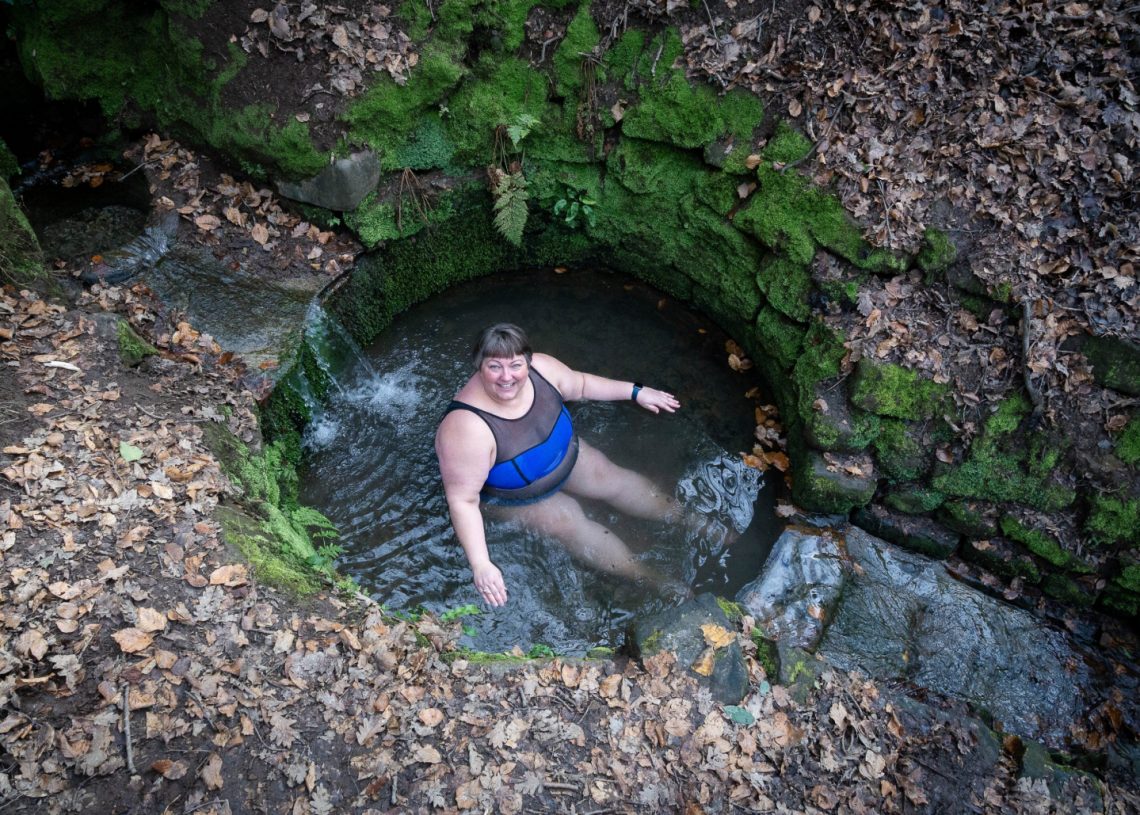
“St Helen’s was a convent 900 years ago, sited in the wood. There is now a Trust who are working to protect this spring, and are digging out a figure-of-eight pair of larger pools, where the nuns used to keep carp,” says Guy Haywood of the British Pilgrimage Trust who restored the well. “Getting fully immersed in the seven-foot diameter bathing pool is a truly refreshing experience, and it has been known to heal people. There is a two-foot diameter font pool just above the bathing pool, and above that is where the water bubbles out from the roots of a large tree.”

This revival goes hand-in-hand with our desire to reconnect not only with our natural landscape, but also with the legends, magic and stories that shape it. In natural springs, we can find fresh, clean water in which to bathe and swim, as well as fascinating history and superstitions and traditions that have survived over centuries, such as pilgrimages, wishing wells and votives.

“Some springs that have fallen into complete disrepair and disuse get rediscovered and restored. Sometimes the religious authorities rediscover their local holy well and reincorporated it into some kind of local custom,” says James. “But there are quite a number of stories of both wells and springs that have just been bulldozed.”

Our world may be very different, but in water, we are the same creatures with the same challenges as our ancestors. We still get in cold water to purify and reset, we still bathe in warm water to relax and ease aches and pains. We’re also still affected by extreme temperatures, pollution and poor water quality. 

But, now that our understanding of the world has shifted from magic and folklore to science and technology, we can use water testing and purification methods to keep ourselves safe in spring water. Whether we bathe in 100,000-year-old rainwater heated by the earth like our Roman forebears, or follow the footsteps of Celtic saints into their cold, sacred wells, springs give us a wonderful opportunity to immerse ourselves in magic, myth and spring clean waters.

This article is from the May 2023 issue of Outdoor Swimmer. Click here to subscribe to the magazine.

The Living Stream: Holy Wells in Historical Context by James Rattue is available from all good book sellers. For Britain’s Pilgrim Places by Guy Haywood, see The British Pilgrimage Trust. Visit Thermae Bath Spa. Images: Bruno Teves Visuals,Laura Nesbitt.

To see all the online content from the May 2023 issue of Outdoor Swimmer, visit the 'Spring(s)' page.
Stay up to date with The Dip, our free weekly outdoor swimming newsletter.

Outdoor Swimmer is the magazine for outdoor swimmers by outdoor swimmers. We write about fabulous wild swimming locations, amazing swim challenges, swim training advice and swimming gear reviews.