


April 2023,  EXTRA,  Features

This must be underwater love

Photographer Lexi Laine invites us to dive into her underwater world. Words by Rowan Clarke.

How often have you thought about what’s below you when you swim? While some outdoor swimmers enjoy imagining the watery world beneath the surface, others find it terrifying, the music from Jaws ringing in their ears. In fact, many people cite fear of what lies beneath the water’s surface as a reason to stick to the swimming pool.

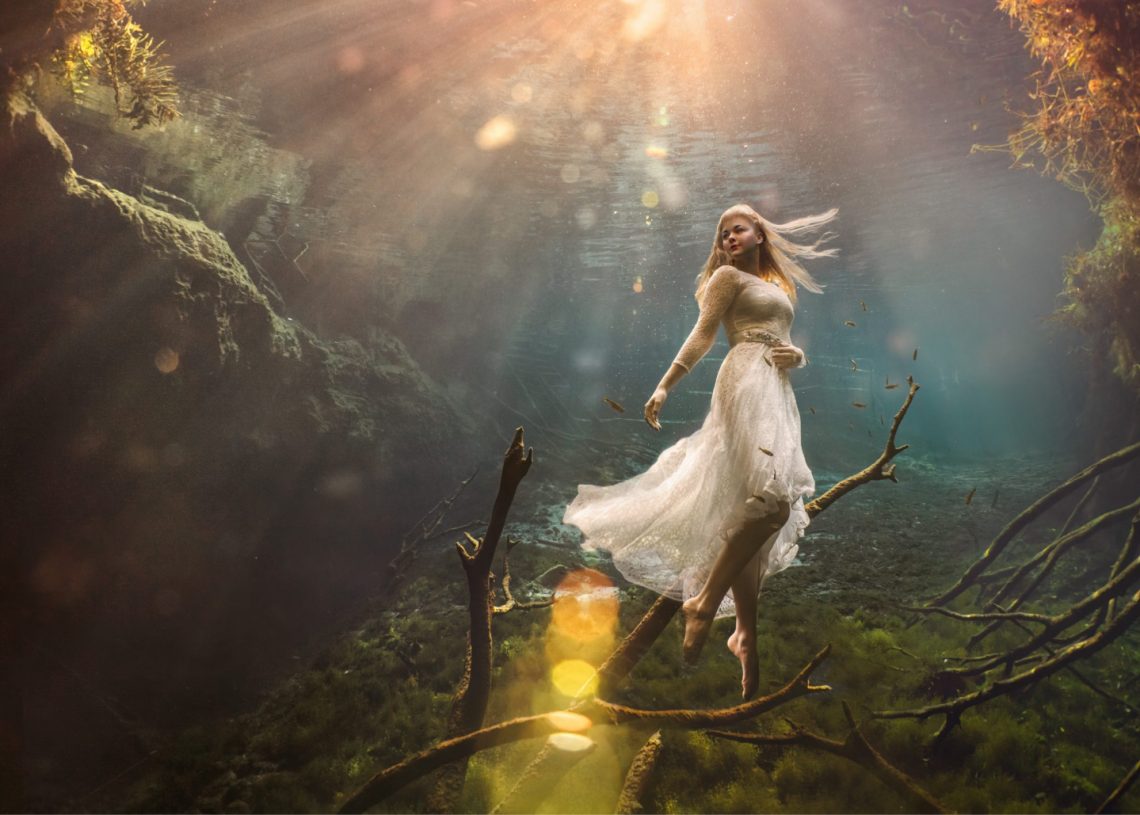
But not Lexi Laine. A freediving photographer, Lexi’s exquisite portraits of women underwater in the sea and inland pools are beautiful, heavenly and serene. Quite apart from wonderment at how she composes such incredible photographs, Lexi’s art also sparks conversations about our evolving relationship with aquatic environments and our ongoing duty to protect them.

Watery beginnings

While Lexi’s compositions are visibly beautiful, our complicated feelings about being underwater make individual responses to them very varied. Humans are born with reflexes to hold our breath and make swimming movements, but that doesn’t mean swimming is innate. In fact, the great ape family are among few mammals that lack innate swimming skills. What’s more, all great apes share what anthropologists describe as an ‘evolutionary relevant’ fear of being in deep water. It’s only us humans who have the desire and intellectual capability to overcome these fears and learn to swim, dive and take great pleasure from moving in water.

So, what sets us apart from our chimpanzee cousins? In 1972, author Elaine Morgan published her book The Descent of Woman that advocated the aquatic ape evolutionary theory. The theory goes that pre-humans diverted from other apes to hunt for food in aquatic habitats leading to distinct adaptations such as hairlessness and standing on two legs in order to be able to wade in the shallows.

While the aquatic ape theory doesn’t hold much water (excuse the pun) among anthropologists, it’s incredibly compelling, especially for people who immerse themselves in water. Parallels between humans and other aquatic mammals, such as lack of body hair and the presence of subcutaneous fat and a diving reflex, convince many academics that there is something in this idea that our early ancestors lived in water.

Going deeper

The diving reflex is fascinating. A weaker version of the same multifaceted physiological response that aquatic mammals use to stay underwater for extended periods, our heart rate slows, our lungs shut off and blood is shunted to our vital organs to preserve oxygen. Evolutionary hangover or not, we are capable of training this response to dive in deep water without equipment.

So-called freediving is still practised by sea-faring tribes such as the Bajau who find food underwater (and who show physiological adaptations for diving), but it’s also become a sport that pushes the limits of human endurance. The current static breath hold record is 24 minutes and 37 seconds held by Budimir Šobat who breathed pure oxygen before his dive.

But Šobat has never operated a camera or worn a dress during his dives; skills that Lexi and her models have added to their freediving practice. While you’d imagine that wielding a camera would hinder Lexi’s dives, like the deep-water spear fishermen she finds having a task helps her dive.

“I’m the type of freediver they call a ‘distraction freediver’ where my breath-hold is much better when I’m not thinking about it,” says Lexi. “If I’m distracted by thinking about what my camera settings are and looking to see how my model is moving in the water, then I don’t think about the breath-hold at all.”

And yet, as you look at Lexi’s photos, you can’t help feeling astonishment not only at Lexi’s ability to freedive to nine or ten metres, but also at her talent for taking beautiful photographs in minute-long dives.

“I’m looking at what the model is doing. I’m looking to see how she’s moving, and then capturing that split second where everything comes together with fabric and hair and movement,” explains Lexi. “I’m also having to think about camera settings. Sometimes, I’ll decide on an exposure that I think would be best when I’m at the surface, but then if we dive down deeper than I expect us to or if we’re not as deep, then the exposure will be completely wrong. So, I’m often adjusting shutter speed or aperture or ISO while holding my breath and looking to see what the model is doing. It’s the ultimate in multitasking!”

Facing our fears

When appreciating Lexi’s talent, you can’t help but reflect on how her affinity with water allows her to occupy underwater spaces. Not just Lexi’s, but also her models who look as though they belong there. Like ethereal beings, mermaids, sea creatures or coral, they form part of the underwater landscape.

“I started by trying to capture the feeling I have when I dive where I don’t feel like I’m a visitor, I feel that I belong there. It seems quite ethereal and otherworldly, but that’s my world,” says Lexi. “It’s just so extraordinarily beautiful under the surface and I feel very blessed that I have the physiology and capability to be able to dive down deep and look at the way the light interacts with different parts of the underwater topography. The natural underwater world is just fascinating. It perhaps seems a little surreal for someone to be in a dress in that environment, but I try to capture it in a way where they don’t appear to be out of place.”

But Lexi’s feelings about being underwater aren’t universal. As well as having this evolutionary phobia of water, many people also fear the unknown. So it’s hardly surprising that we find the underwater world unnerving when more than 80 percent of our ocean is unmapped, unobserved and unexplored; when natural bodies of water are full of weird creatures, scary currents and strange plants. We can’t breathe underwater and our bodies don’t move in the same way. So, how do Lexi’s models look so calm and ethereal?

“It feels like you’re a visitor to a world that isn’t your own. So, it’s this kind of enchanted beautiful landscape that you want to explore, but you can’t stay down there forever,” says Laura Evans, who has been modelling for Lexi for four years. “There’s that moment when you go below the surface and see what’s beneath you and around you, and I do get a little heart flip because you can never really be sure what you’re going to see. It’s really exciting but also nerve wracking.”

People’s fears and phobias around water also vary from person to person. Laura feels at home in the sea, but she says that shooting with Lexi in Mexico’s cenotes really challenged her fear of inland waters. “If I can’t perceive the depth, then I imagine it’s bottomless and it’s kind of vertigo, where I forget that I can actually swim,” says Laura. “Bearing in mind that some of the cenotes were used as Mayan sacrificial sides, that there are skeletons at the bottom, there can be alligators, my actual fear isn’t of the rational stuff. It’s fear of the unknown, irrational, like what’s going to come up from the bottom? Am I going to fall?”

And yet, Laura can pull off Lexi’s artistic vision of looking as though she belongs in the underwater world. With practice, she has mastered the niche skill of freediving and posing. She says that the former is a skill you can learn, but her masterful ability to compose her body, to move with grace she says comes from her childhood obsession with playing underwater.

“When it comes to physicality underwater, it’s quite a spiritual feeling,” she says. “When I’m underwater, I feel like the most evolved, artistic version of myself and therefore I embody this dancer, in a way. I just feel at home and I move slowly and creatively. It’s just a feeling that I can’t quite describe that I think you either have or you don’t. And that’s not to say it can’t be learned, but it’s just something that’s completely from my heart.”

Women and water

From Elaine Morgan’s feminist treatment of the aquatic ape theory to myth and legend to current social groups around outdoor swimming, there’s a strong female element around water. Lexi was always interested in how women could be depicted in water in a non-sexualised way, studying art around this topic when at art school.

“When I went to art school, all my work was based around the female form. My dissertation was a discussion about whether there is any way that you can portray a female nude without it being sexualised, and whether it can be done in a way that’s progressive,” she says. “I love the idea of photographing women in their element without it being like a sexualised bikini model photo shoot.”

As well as creating works of art around nudes, Lexi also experiments with how fabric behaves in the water by shooting her models wearing dresses. “I think the way fabric behaves lends itself to the aesthetic that I really like, especially painting from the baroque period of art,” she says. “I think the way the light can hit fabric and water looks heavenly, like the Italian frescoes on the ceilings of grand old churches.”

While they create an ethereal aesthetic making the models appear like heavenly creatures, the dresses also highlight that juxtaposition between what we see and the practicalities of shooting in an alien environment. In other words, there are serious safety and practical considerations needed to pull off such beautiful compositions. Lexi carefully scouts each location ahead of a shoot, weighing up factors such as currents, temperature, buoyancy and local wildlife as well as the fabric of dresses the models wear and how they interact with the water.

“I remember the first time I shot in a long dress. I was totally complacent, but it was a really scary experience,” says Laura, who’s only needed help getting back to the surface once. “It depends on the material, but most of them become very heavy and when we’re shooting in freshwater that’s something we really have to bear in mind because I could easily sink So, in a big dress, I’ll get in and try to suss out how much it wants to kill me!”

Our relationships

As with swimming outdoors, mutual trust and bonds between model and photographer are key for the safety and success of the shoots. Speaking to Lexi and Laura, it’s clear that their bond enables them to communicate and understand each other at a deep level. This is shared by a mutual love of being underwater and for the environment in which they work.

“One of my biggest challenges is to try and make work that has meaning without it coming across as contrived or preachy,” says Lexi. “I see the majority of my work as a celebration of how beautiful the underwater world is. And so, you can raise awareness about how important the environment is from that perspective by showing people how beautiful and pristine it is. But then, every now and then, I will make an image that’s a little bit more punchy, like models wrapped in plastic or in nets.”

It’s a salutary reminder that wherever our affinity with water comes from, we are very far from that now. As we glimpse the underwater world as swimmers on the water’s surface or through art work like Lexi’s, we note the negative impact our species is having there.

“I feel like it’s really important for me to make these images because it’s something that I can talk about to try and raise awareness,” says Lexi. “A lot of people who aren’t in the open water swimming community don’t see how horrible it is when you go to an absolutely perfect, pristine location and find carrier bags and ghost nets floating around.”

Lexi’s amazing compositions are beautiful. But they also tell an intricate story about human beings as aquatic apes or visitors in another world. They explore our affinity with water, our origins, our fears and fascination; and just how important it is to help protect these environments.

See more of Lexi Laine’s work. This article is from the April 2023 issue of Outdoor Swimmer. Click here to subscribe to the magazine.

To see all the online content from the April 2023 issue of Outdoor Swimmer, visit the 'Underwater' page.
Stay up to date with The Dip, our free weekly outdoor swimming newsletter.

Outdoor Swimmer is the magazine for outdoor swimmers by outdoor swimmers. We write about fabulous wild swimming locations, amazing swim challenges, swim training advice and swimming gear reviews.