
A pool of one’s own: the rise of natural swimming pools
With an increased interest in outdoor swimming there is a new demand for privately-owned swimming ponds. Ella Foote takes a dive into the trend.
As a swimmer, it is natural to dream that one day you will have your own pool, all to yourself in your home garden. For decades these imagined pools were perhaps blue tiled, rectangular and would come with pool filters, chemicals, and heat pumps. But now, with the growing interest in ‘wild’ swimming a new dream pool has entered our minds, the natural swimming pond.
“I don’t think we would have considered anything other than a wild pool,” says Tracey, a swimming pond owner in Northeast England. “It had been a joke for most of my adult life that I would have a one-lane swimming pool in my backyard.”
You might also like:
Tracey and her partner Lynette have always loved to swim and before they had their pond would travel to the coast for dips in the cold North Sea. With a reasonable sized garden, but terrible soil to grow anything, it was a dream to consider a swimming pond. When Tracey retired, she had a little money and so spent it all on the idea of having her own pond.
What is a natural swimming pool?
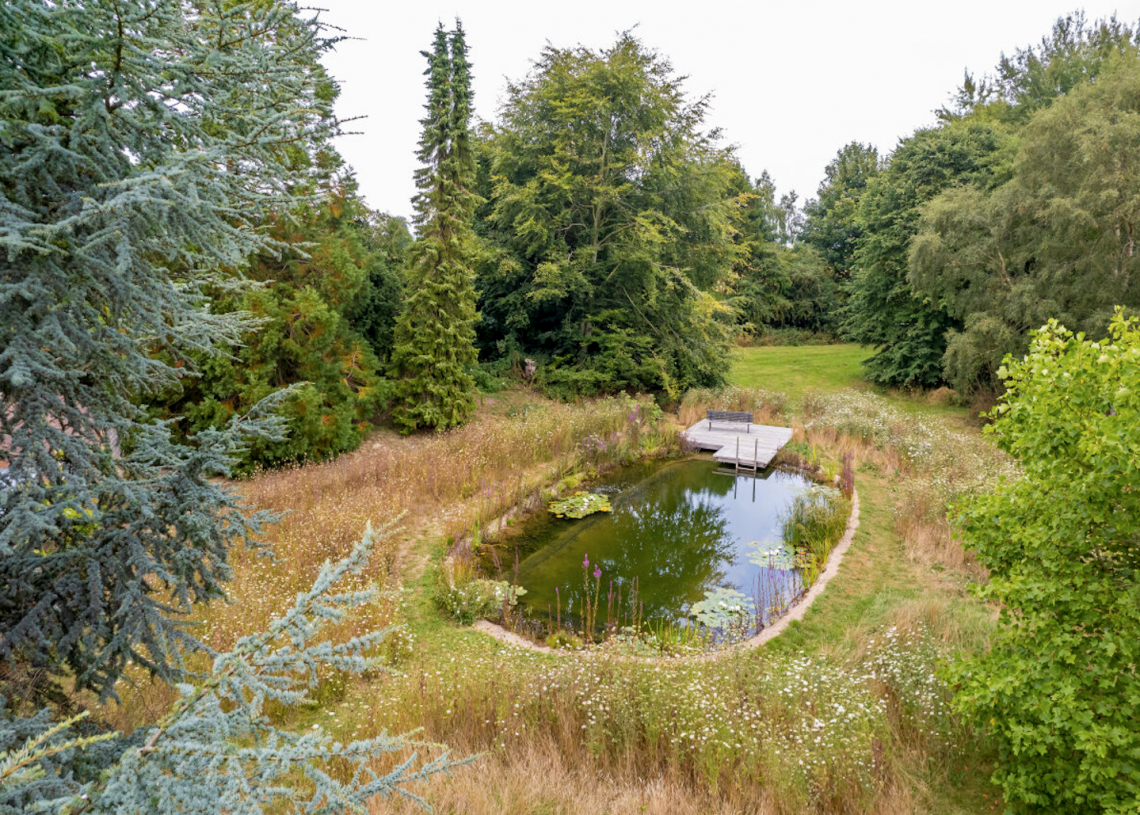
A natural pool or swimming pond is a pool that is free of chemicals and is filtered by water plants. Aquatic plants grow in areas around the pool which absorb nutrients from the water keeping the water balanced and crystal-clear. A hidden pump system below the surface circulates the water ensuring algae doesn’t develop and the result is a natural water pool that feels like wild swimming in your own garden.

Natural pools are often designed with a concrete tank that is contemporary while ponds are shaped from the earth. The benefit, much like any outdoor swimming, is being able to swim in chemical-free water but also, they are easier to maintain and have lower running costs compared to conventional pools. As well as having your own place for relaxing, playing and exercising, a natural pool will transform a garden into an wildlife haven.
“We had increased the wildlife in the garden by leaving grass to grow in other parts of the garden, but since the pond we now have dragonflies, frogs, toads and swallows dipping down to feed,” says Lynette. “We have a kingfisher and four different breeds of bat, including one only found near water.”
“It is very beautiful,” says Tracey. “We owe a lot to Sarah and her team at Ellicar Gardens. When she first visited, she was able to view the land and recommend the best location for our pond. It sits beautifully between trees and so when you’re swimming, you are swimming towards this amazing blue cedar tree.”
Unlike a conventional pool, which has complex filters, heating and chemical systems, a natural pool could seem like an easy build or project to do yourself. However, expert knowledge ensures you have a biologically balanced pool with naturally clean water built securely with the soil type and best location in your garden.
Location is key
“We are not opposed to trying things ourselves,” says Tracey. “We had looked online at other people’s ponds who had done it themselves, but there is something about accepting that some people have got expertise to enable something to be created in a way we couldn’t do. I am really glad that we didn’t do it ourselves, there is no way we would have managed to do some of the things that Ellicar did for us. The soil structure here is complex and it needed to be strong enough to hold the pond in the way it needed to be held. We wouldn’t have known the best place to put it to ensure it worked best.”
Sarah Murch and her husband Will trained as water specialists with natural pool pioneer, Biotop, fifteen years ago. They constructed their first natural swimming pool in their own garden and set up their business, Ellicar, to design and build natural pools and ponds for private homes and public spaces. Today they are award winning and renowned for the design and installation for some of the world’s most stunning natural swimming pools. As well as a natural pool specialist, Sarah is a landscape designer, passionate gardener, wild swimmer and dedicated goat keeper – she has a herd of prize-winning Golden Guernsey goats.
A growing trend
“We have been building and designing pools as part of our garden design for the last 15 years,” says Sarah. “But while we might have done one pool a year we are now doing six and enquiries have had a huge spike. We saw a huge growth in interest during the pandemic, but it isn’t going away, it is still steadily growing.
“While our business before was focused on gardens with pools there has definitely been a switch to pools with gardens alongside them. We are also seeing more people wanting small pools, which is fantastic. We used to do mainly large pools at around 100-300 square meters but now we are seeing a demand for 40 square meter plunge pools.”

As well as a change in the type of pool people are seeking there has also been a change in demographic of those planning pools. “When we first started our clients were retired people who had made their money and wanted a space for their children and grandchildren to come and spend time,” says Sarah. “Now we are seeing a lot younger people in their 40s and 50s who are often entrepreneurial in nature. We are also seeing more demand for ecological builds like Tracey and Lynette’s pool. These pools don’t use concrete and are more ecologically and sustainably made, which is really exciting to do. People are not afraid of cold water anymore, so that has made a massive difference. The growth in outdoor
swimming of course has made an impact.”
Space and funds
Planning, building and creating a natural pond is an investment. Not only do you need land and space to begin with, but a small pond starts at around £80,000.

“We joking called our pool the ‘money pit’ for a while,” says Max Parker, Piglets Boutique B&B founder. Max and his wife Chrissie built a natural pool to give their bed and breakfast a unique experience for guests. “We would never have considered a conventional pool, I hate chlorine,” says Chrissie.
Max agrees, “once you have experienced swimming in a natural pond you wouldn’t want to swim in anything else. It is a huge undertaking, but we are so thrilled with it.”
“It is a lifestyle choice,” says Sarah. “Some people spend significant money on a massive car, why not on a pool? It is an investment that changes your life. We have a client who doesn’t go abroad on holiday anymore, it completely changed her lifestyle.” As well as a place to swim and get a cold-water fix, the pools become places to socialise and spend time around. Gardens flourish and people with pools show new interest in the environment and wildlife.
A haven for wildlife
“We have learned so much about the birds and insects that visit the pond,” says Lynette. “We have paid more attention and discovered the lifecycle of invertebrates seeing them at a larvae stage and what happens under the water surface. We have also had to learn about water plants and flowering stages, it continues to be amazing.”
It doesn’t take much to convince an outdoor swimmer that these wildlife oases are a great idea for your own garden but there are things to think about before you embark on a pool project. “There are some general things to consider,” says Sarah. “You don’t want a pool under or close to trees, roots will get in the way of the build but once built, leaves will become a real problem in the pool.
“You also want as much sun as possible, especially with English summers, so think about where the sun is going to be and where you might like to sit by the pool. It isn’t just about swimming, maybe 10% of the pool is for swimming the rest is this amazing thing in your garden, it is a sky mirror, and you are going to want to be beside the water if you are not in it. You then need to think about wind direction, any other surface water and location – you don’t want a pool at the bottom of a slope where everything will run into it.”

Of course, there are many other things like groundwater and soil structure to consider, which is why it is good to seek some expert advice. “Also really important is the water plants,” says Sarah. “The oxygenators are massively critical to drawing out phosphorus from the water and the underwater plants play a massive role in the filtration system and are hard to grow if your water is low in nutrients.”
Despite the cost and initial complexities once a pool is in place there is so much you can do yourself and it is easy to learn. “You will learn about your pool by experiencing it,” says Sarah. “It is all part of it, being in a water environment as the seasons change. At this time of year, it can be very mellow with everything turning golden and then in spring with the blues and yellows, like a garden it changes daily and you will get to witness it.”
Find out more about natural swimming pools at ellicar.co.uk