Diving Lake District
April 2023,  EXTRA,  FEATURES,  Premium

Diving for trash and treasure in the Lake District

Register to get free articles

No spam Unsubscribe anytime

Want unlimited access? View Plans

Already have an account? Sign in

Freediver Angus Hosking is on a mission to clean up litter from the lakes of the Lake District

Two huge fins gracefully submerge beneath Windermere in the Lake District. Although the water is clear I soon lose sight of Angus Hosking as he dives deep below the surface. As I stand on the jetty, a group of swimmers in bobble hats slowly breaststroke past me, unaware of the diver beneath them.

Further out in the lake I can see another gaggle of swimmers and the sounds of laughter and chatting echo around the bay. It is a busy Sunday at Windermere. Suddenly a snorkel followed by neoprene hood, mask and Angus’s grinning face break the surface of the water. He triumphantly holds up a pair of sunglasses in his gloved hand.

A 23-year-old factory supervisor, Angus is on a mission to clear the Lake District’s bodies of water of litter. He started freediving four years ago, but soon discovered that the underwater environment in the Lake District isn’t as pristine as one might imagine.

After dropping some boat keys in Windermere at Low Wood, he dived down to retrieve them and was shocked by how much litter he could see. After tidying up the area he decided to dive further afield to see the extent of the problem. He now covers the whole of the Lake District, picking up litter that – even if we cannot see it – still has a detrimental impact on the environment.

“Just because it’s out of sight doesn’t mean it should be out of mind,” says Angus. “People need to be conscious of their impact around deep water.”

A hoard of trash

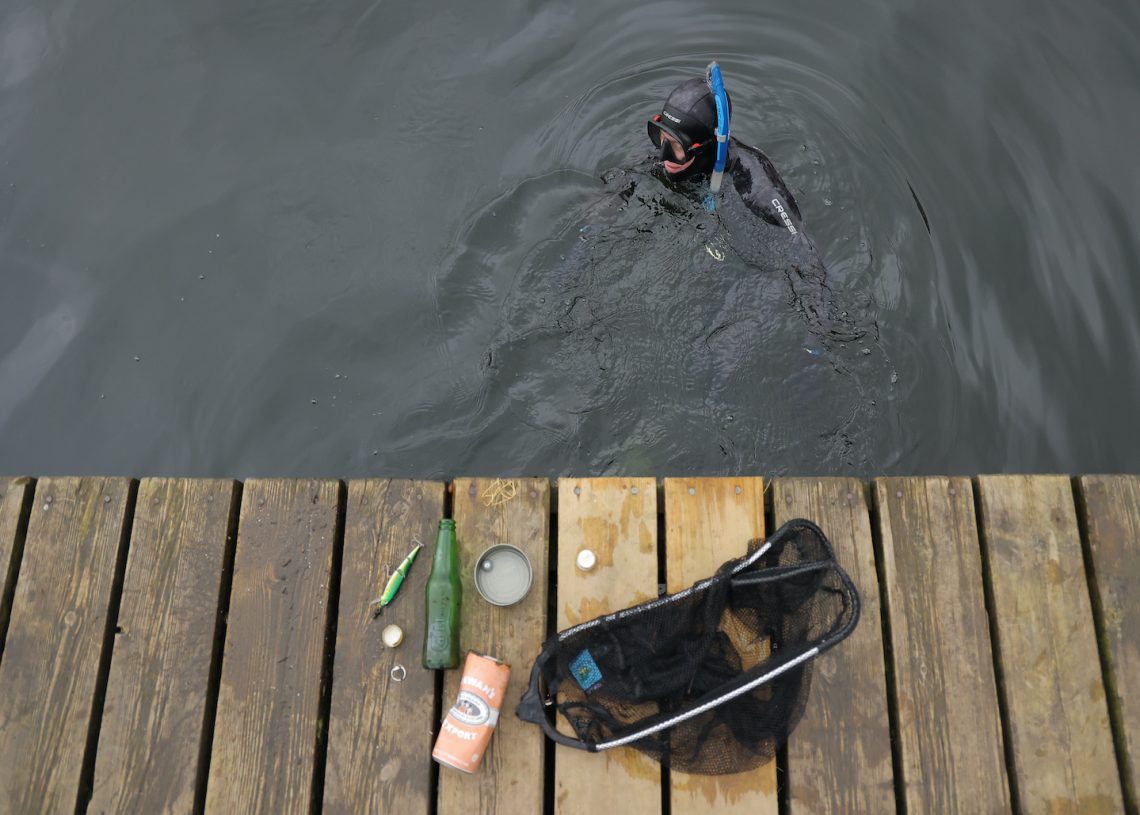
In the few minutes that Angus has been in the water he has already collected a small pile of underwater litter on the jetty. His most common finds are glass bottles, cans, vapes and cigarette butts.

Today he is diving at Rayrigg Meadow in Windermere, an area popular with tourists in summer. His first finds are the pair of sunglasses, a wet wipe and a CD. A streak of fish eggs clings to the surface of the CD.

“Pretty much everything that I find will have some kind of life on it.” Wildlife is being forced to live with rubbish due to people either not being careful or deliberately littering. “People aren’t happy with litter being in a conservation area and around wildlife on land,” says Angus. “Why should it be any diff erent in the water?”

The litter Angus collects makes swimming safer for us too. Today he is diving at my local swim spot, and even on a chilly Sunday morning like today the lake is busy with swimmers and swim groups. Chatting with swimmers on the shore, everyone knows Angus and is grateful for the work he does in making our swims safer. As if to emphasise the point, Angus’s next find is a tin can that would be a nasty shock if tread on in bare feet.

“Outdoor swimmers appreciate and respect what I do and the fact that I’m doing it not for my own gain but to protect others,” says Angus. “I feel completely welcomed by them.”

Cold water therapy

He is part of our community, linked not only by our love and respect of the water that we swim and dive in, but also by our shared love of the cold. The water today is 5 degrees, and the lake is busy with swimmers from two local swim groups – Blue Mind Men and Mental Health Swims Windermere – that both swim in cold water to improve mental health.

“I like to experience the cold because it really centres your thinking,” says Angus. “It takes everything away. All the stress of work, all the stress of family life and every other thing that’s going on in your life so that you’re only focusing on the one thing that you’re doing there and then.”

While we as swimmers will only spend a short time in the water, Angus’s 7mm wetsuit allows him to dive for much longer periods of time. Today in 5 degrees he would be able to stay in the water for up to two hours. “Although I’d probably feel very uncomfortable by the end,” he laughs.

But staying in the cold water for as long as he can, while holding his breath and searching for litter, is a big part of why Angus loves what he does: “You’re just free for that short period.”

Angus breaks the surface again and reaches up to add more finds to the growing pile on the jetty. This time it’s a fishing lure and a small lead weight lost from a fishing line. They are soon joined by a fishing net. Not all littering is deliberate: some, like the fishing kit, is thrown into the lake with the intent of being retrieved.

“There’s a lot of fishing line as well,” says Angus. “It’s a bit dangerous because you can get tangled up in it.”

Sparkling finds

And then there are the objects he finds that were never meant to enter the water in the first place. Angus has been called on to rescue keys, rings, phones and other expensive items that have inadvertently found their way to the bottom of Windermere. He has made the news by retrieving engagement rings dropped while the prospective fiancé was down on one knee and wedding rings lost on wedding days!

Today Angus finds two pieces of jewellery. One of the first things he brings up from the bottom of the lake some five metres down is a silver locket; later a ring is added to the treasure trove. The locket opens to reveal a photograph of a smiling couple. We can’t work out if they are mother and son or how old the photograph is, but Angus will post on social media to try and reunite the locket with its owner.

Reuniting lost items with owners is one of the unexpected joys of underwater litter picking. Perhaps the most unusual item he has reunited with its owner was a prosthetic leg lost by an open water swimmer.

“She dived in off the jetty here and it just popped off, but she didn’t realise,” says Angus. “She got back to the shore and then the penny dropped. I found it for her.”

Pieces of history

The treasures he finds tell the social history of the lake, from worn pieces of Victorian glass that are like semi-precious stones to modern-day mobile phones packed full of precious metals. Like mudlarking on the banks of the Thames, spend some time sifting through pebbles on the shores of Windermere and you will find broken bits of old pottery and glass, often embossed with the names of long-gone local manufacturers and companies. From industry to tourism, each find is a snapshot of its time, of the lives
of its owner.

Until recently the oldest item Angus had found was a stoneware ginger beer bottle made locally near Hawkshead that was around 120 years old. But last week he found something even older: “a French coin from 1856.”

Treasure is not the reason he dives, although the publicity he gets from reuniting lost items with their owners helps spread his message about the environmental damage litter does to our lakes. The message certainly seems to be getting across, and it’s really encouraging to see a #2minutebeachclean cleaning station now installed at Rayrigg Meadow so people have the tools to do their own (land-based) litter pick.

“In the three and a half years since I started Lake District Diving, we have had an impact on not just adults but kids locally,” says Angus. “I worked with a local college and did an art installation with them involving litter. I think the upcoming generation are more interested in trying to minimise their environmental impact.”

After half an hour in the water, Angus gets out to warm up and we inspect his finds. I think the McEwans Export can must date from the 1980s (I remember my dad having a supply of them in our utility room), the glass bottle and tuna tin are much more recent. No vapes but a lighter and a couple of bottle tops to go with the fishing gear and jewellery.

A small haul today; in the summer more tourists unfortunately means more litter. But Angus is optimistic for the future. “I think it is slowly getting better. Unfortunately, there are always going to be people that litter but hopefully that way of thinking is dying out.”

Follow Lake District Diving on Instagram and Facebook

This article is from the April 2023 issue of Outdoor Swimmer. Click here to subscribe to the magazine.

To see all the online content from the April 2023 issue of Outdoor Swimmer, visit the 'Underwater' page.
Stay up to date with The Dip, our free weekly outdoor swimming newsletter.

Jonathan Cowie is our former editor. He is a year-round skins swimmer with a particular love of very cold water. He has competed in ice swimming competitions around the world. He is a qualified open water coach with a particular love of introducing new swimmers to the open water.