

Leszek Naziemiec’s Yukon Odyssey
After conquering the 1,000km Vistula River in his native Poland, adventure swimmer Leszek Naziemiec turned his attention to the far north and Alaska. By Jack Bright
The Yukon River, flowing 3,190km from its source in Canada to its Bering Sea outfall in Alaska, is more often associated with gold prospectors than open water swimmers, but both may search for something special that only untamed nature can provide, so inevitably a swimmer had to take on the mighty Yukon.
Until this year nobody had attempted a significant swim in the river, which is not surprising given its location just below the Arctic Circle in some of the northern hemisphere’s harshest landscapes, its banks sparsely settled and overlooked by dense forests and towering mountains. Accessing the river requires careful planning and as for swimming it, the potential unknown represented by currents, sediment, glacial water and bears is enough to make even the most daring think twice. Enter Leszek
Naziemiec, a seasoned open water swimmer from Poland, specialising in cold and adventurous swims.
A past chairman of IISA Poland, who has completed an ice mile in Spitsbergen in 2017 and an ice kilometre in Antarctica in 2018, Leszek is no stranger to the elements in remote locations. Now he was homing in on the Yukon as a challenge to be prized, yet feared, asking himself the question: would it be possible to realise such a swim?
Veteran cold-water swimmer
Leszek has an impressive amount of experience when it comes to extremely cold water and remote locations stretching back to 2007 when he first started winter swimming. He has been instrumental in promoting ice swimming in Poland and helped bring the IISA World Championships to Głogów in 2022. A child psychologist and physiotherapist by profession, he is the author of several books including one about wild swimming and in recent years this rugged yet humble man has turned his attention to wilderness, seeking a closer connection with the natural world. He spent hours studying maps, setting his sights on northern rivers. “Nobody swims northern rivers,” explains Leszek, “so for me it was a challenge, because of the unknown.”
He assembled a strong team to assist him comprising of paramedic and safety specialist Adrian Uciński, documentarists Tomasz Woźniczka and Michał Żuberek, and Piotr Sadurski, a boat builder and expert in river navigation. As for preparation, Leszek had already swum the 1,000 km length of Poland’s Vistula River in a 2018 stage swim so he knew what it would take physically and opted to swim in the lakes, rivers and sea around the island of Wolin on the Baltic coast where he lives.
Into the unknown
“Being physically prepared was the easy part. It was in my hands, whereas the Yukon River was an unknown. We could only guess at what the situation would be like. Would there be too much sediment, debris or flooding? How fast would the water be? And then the bears.” Leszek explains the anxiety he felt in relation to the chances of the river being swimmable.
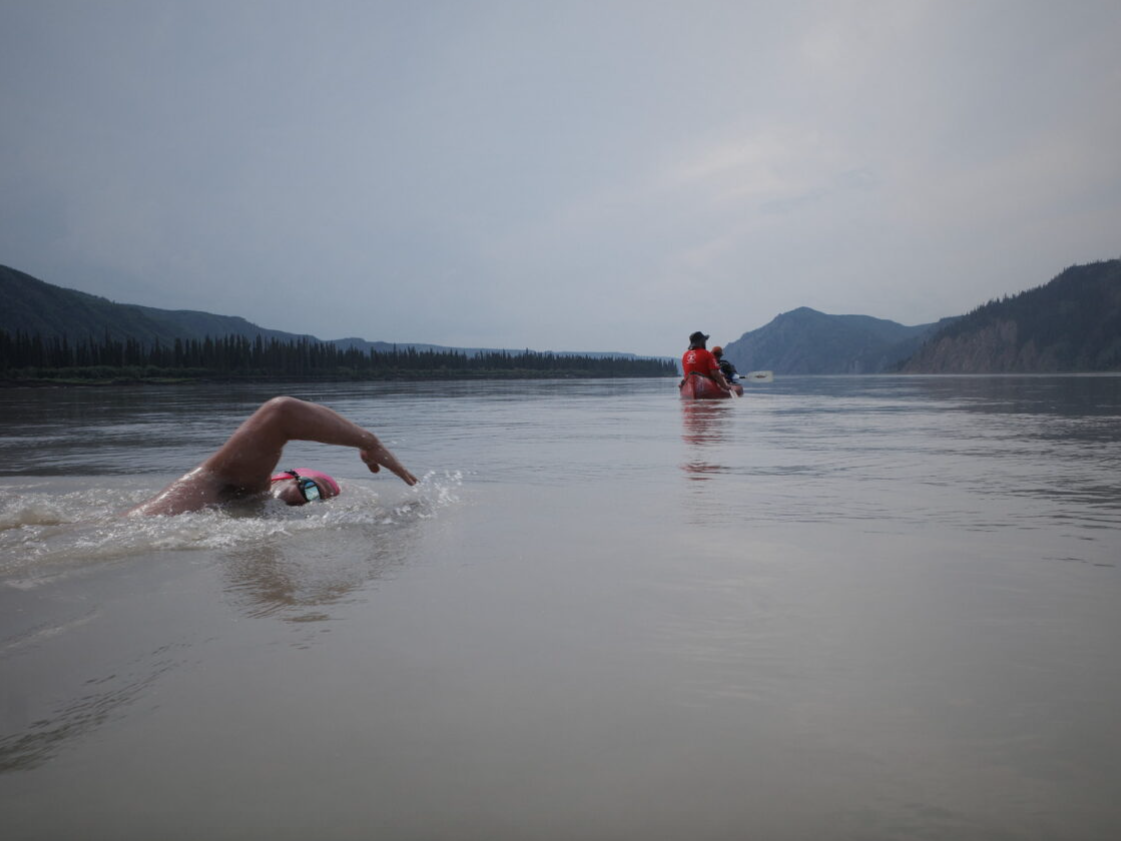
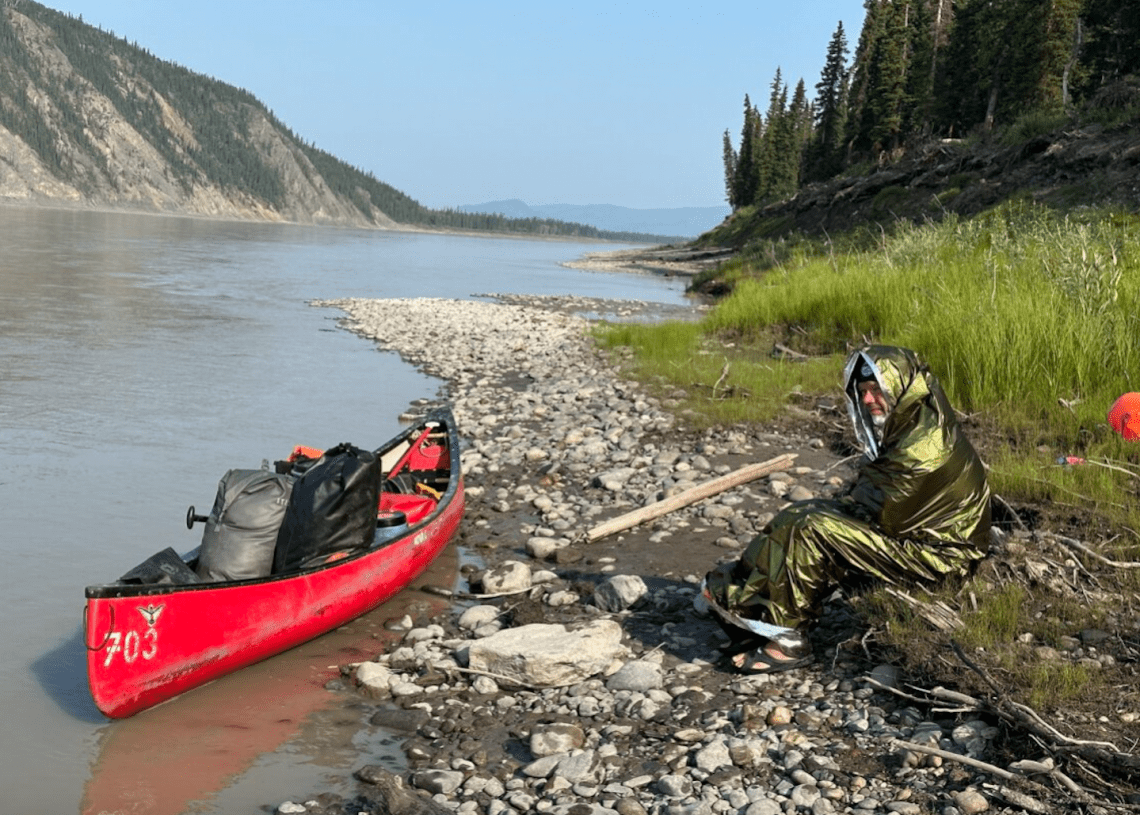
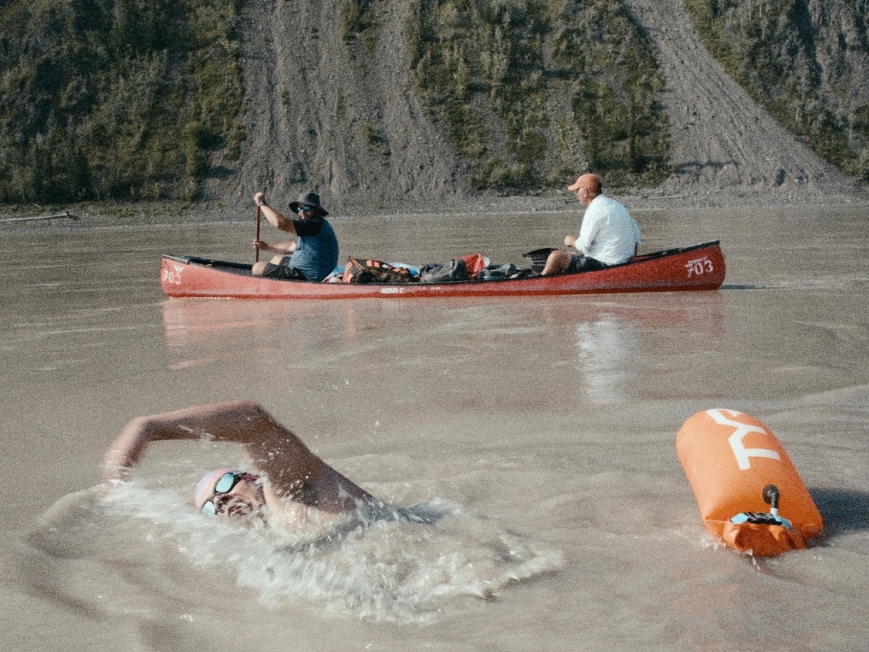
A 250km stretch of the river was chosen for the swim between the settlements of Eagle and Circle. Although remote, both are connected by paved road to the regional capital Fairbanks, so transport in and out was relatively easily arranged, while for the swim itself, the five-man team had two canoes, with all food and equipment stored in watertight barrels and drybags. On inspecting the water at Eagle, it was like a murky sediment soup and surprisingly warm at 17 degrees Celsius, and although flowing quickly it appeared to be swimmable.
Sighs of relief they would at least be able to attempt this long swim down one of America’s wildest rivers.
A promising start
Starting at 8am on July 24, and swimming mostly freestyle Leszek covered 60km on day one, continuing until 7pm and stopping every 1.5 hours for an energy bar and once for a hot meal, when his by now shivering and still Speedo-clad body was wrapped in foil.
“The first day was tough as I had to get used to the river. There were meanders and the current changed and sometimes I had to sprint to avoid it taking me. The temperature fluctuated, and when mountain streams joined the main channel it dropped to about 12 degrees, so it was quite challenging,” Leszek recalls.
With a successful first day behind him, Leszek was more confident going into day two but was suffering physically with stomach cramps. Nevertheless, again he swam from morning until night covering 62km. His usual swimming pace of around 3km per hour was enhanced by the current so that he swam around 7km per hour, but despite the river’s assistance the distance was huge and the swimming hard work as the temperature fluctuated in the vast Alaskan wilderness.
Encounter with a beaver
Then there was the wildlife. The team took various measures to avoid contact with bears, including choosing foods which were not strong in smell, kept 100 metres from their campsite in sealed containers, and where possible camping on fluvial islands instead of directly on the riverbank. The team watched carefully for bear tracks and on their discovery moved elsewhere. Luckily the powerful bear spray they had was not needed.
Beavers presented a bigger problem when on the third day Leszek had to briefly enter a tributary of the Yukon. “At its mouth, a beaver was swimming with two cubs on her back. When she saw me, she carried the cubs back to the shore and returned to block my way. She wagged her tail in the water and wouldn’t let me pass,” recounts Leszek. “Connecting with nature was part of the swim, along with the incredible vastness. Huge mountains, thick forest and the immense river threading its way through this beautiful landscape, completely untouched by humankind.”
Power of the mind
Despite this fatigue was starting to build. Though a stage swim with breaks to eat and sleep, it was relentless, and finishing was imperative. Failure was not an option.
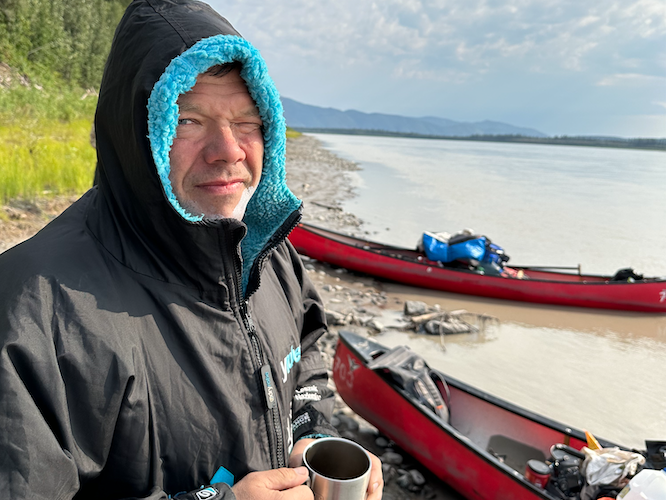
Being a trained psychologist, Leszek knew how to work with his brain and stay calm in the face of a long, tiring swim in wild waters but he still had doubts, revealing that he was never sure what was round the next bend in the river. “We really didn’t know the conditions and locals could only give us so much knowledge as they don’t usually navigate this part of the river. I was especially concerned about eddies, but they proved to be no more frightening than in the Vistula in Poland.”
On the morning of day five Leszek was tired and his right ear was starting to hurt. There was just 31km left but he was on the brink of exhaustion and sickness. The finish was tricky as although the village of Circle is located in a calm bay, you have to be careful not to pass it, because the river here is 4km wide and due to the numerous channels and islands, it is difficult to be sure of your exact position. Good navigation was essential, and Leszek’s team carefully guided him to the bank where this pioneering swim finished just below the Arctic Circle, 251km after it started.
Read more inspiring readers’ swim stories.

Outdoor Swimmer
Outdoor Swimmer is the magazine for outdoor swimmers by outdoor swimmers. We write about fabulous wild swimming locations, amazing swim challenges, swim training advice and swimming gear reviews.