

Our right to swim
What does having a right to swim really mean? Rowan Clarke investigates
Should access to swimming outdoors be a right? It’s an interesting question that sparks a complex debate involving philosophical, legal and public health arguments.
Some countries don’t need to have this debate; they already have comprehensive rights to access nature, including waterways. But in other countries, there are significant campaigns for such rights. Here, people face physical and political barriers from barbed wire fences to fears around safety, protection of land ownership rights and poor water quality.
We consider what having a right to swim actually means, what barriers exist between people and water, and how important it is to fight for our right to swim.
Getting to the water
In the developed world, there’s a right to roam continuum. At one end of the spectrum, countries like Norway, Finland and Scotland have comprehensive rights to access land and water responsibly. At the other end, nations like England and Wales have very restricted access.
Right2Roam campaigner Jon Moses put it beautifully in a BBC News interview: “Most of the green and pleasant land I can see in front of me may as well be wallpaper,” he said.
When we spoke to Jon for our Swim Politics issue (March 2025), he described how the section of river near where he lives was fenced off. It’s a familiar story that highlights how our right to swim is inextricably entwined with our right to roam. Not only are they both about our freedom to access nature, but also about bodies of water being cut off by private land.
“Us campaigners would say that there’s a public right of navigation on all rivers you can physically navigate, including by swimming – it’s a common law right,” says Imogen Radford from The Outdoor Swimming Society. “Landowners disagree. They say, with riparian rights, that they own the banks and the land underneath the river. Most don’t claim to own the water, but they say that you have no right to navigate it. The other problem is, how do you get into the water? If it’s private land, it would be trespass.”
Kinder Trespass
The legal argument about access to inland bodies of water in England and Wales are incredibly complex. But the main message is that trespass is a civil matter, not a criminal offence.
The right to roam movement was fuelled by such an act of civil disobedience. In 1932, around 400 working-class ramblers trespassed on Kinder Scout in the Peak District to demand public access to open countryside and challenge the wealthy landowners who kept the moors private for grouse shooting.
Eventually, in 2000, the CROW (Countryside and Rights of Way Act) gave us access to open country and common land in England and Wales. This was a big step forwards, but the CROW has limitations, not least the fact that it doesn’t extend to waterways.
“At the time, the 2000 CROW legislation was very exciting,” says Imogen. “But it’s limited, both in area and geographically. Also, as far as swimmers are concerned, it’s absolutely no use whatsoever.”
The Outdoor Swimming Society organised its first Kinder Swim Trespass in 2021, which became ‘Kinder Unbound’ in 2024: More than 20 small protests in off-limits bodies of water, including reservoirs, around England and Wales.
Crucially, the OSS is fighting for free access to open water that would grant us the freedom to swim without paying for the privilege – a similar freedom to the one afforded to Scotland by the Land Reform (Scotland) Act 2003.
Safety concerns
Just as the 1932 Kinder Trespass gained huge public support, there’s strong support for a right to roam in England and Wales. In March 2024, the All-Party Parliamentary Group for Outdoor Recreation and Access to Nature called on the Government to bring new legislation to extend responsible access to blue and green landscapes. The Outdoors for All manifesto is supported by 41 governing bodies, including Swim England and the Outdoor Swimming Society.
But there’s also a faction of opponents who dismiss the access movement as part of a broader, left-leaning push for progressive social change.
Some of these opponents’ objections are wildly misplaced: “I don’t want your dirty arse in my drinking water,” commented one Facebook user complaining about the Kinder Unbound swim trespasses in reservoirs.
Most of the opposition, however, cites concerns over public safety and private property rights. These two worries are interconnected; messing up someone’s land to access a river, and fear of litigation if someone drowns.
Are these valid fears? In Scotland, where people have been free to roam and swim outdoors for the past 20 years, landowners had the same concerns. But instances where land has been spoiled or landowners sued by people exerting their access rights have been few and far between.
“Initially, there was a lot of concern about liability and insurance premiums going up, and that once access rights went live, the masses would be leaping over fences and running around the fields,” says Bridget Jones from NatureScot. “The reality is that the majority of people like to be on a managed path. A small proportion are more adventurous, going off the path and going for a dook or wild swim in places that you wouldn’t normally get to. The issues just didn’t occur.”
Swimmable cities
Questions of water safety and private land ownership also highlight vast social inequities.
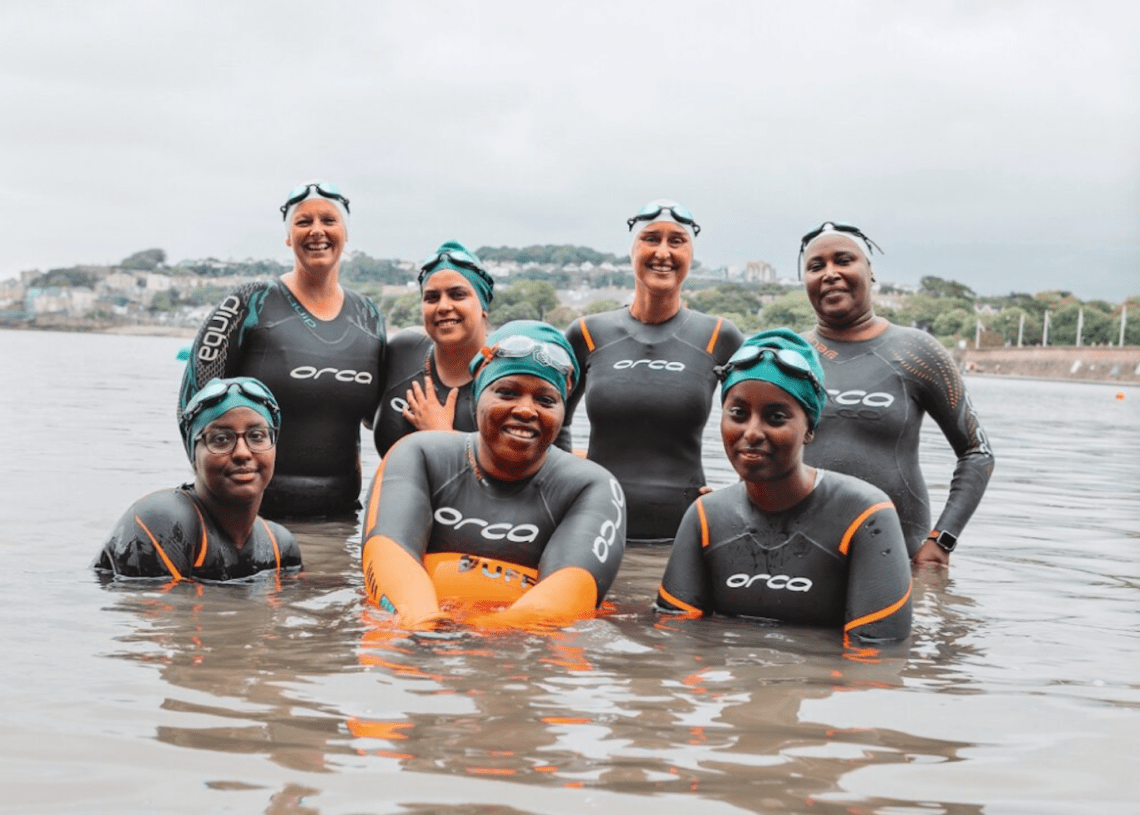
“It’s about accessibility, knowledge, and feeling comfortable in that space,” says Maggy Blagrove, founder of Open Minds Active, which reduce health inequalities within disadvantaged communities in Bristol. “Opening up blue spaces is so nuanced and intersectional. It’s about safety, but it’s also about diversifying these spaces and tackling the barriers, whether that’s cultural, racial, or the fact that people can’t travel to outdoor spaces if they’re from a disadvantaged community.”
They’re important points. For so many people, blue spaces simply aren’t accessible or welcoming through a lack of knowledge, ability, confidence and sense of belonging, or practical barriers such as no transport or means to pay the entrance fee or membership.

As we highlighted in last month’s issue, private venues play a crucial role in the growth of outdoor swimming. But not everyone can afford them. Nowhere is this more evident than in cities, where the vast majority of socially disadvantaged people live.
“I think that a city’s swimmability can be defined by a reasonable access to natural waterways,” says Chris Romer-Lee, cofounder of Swimmable Cities. “It gets complicated by cost. We don’t want to go down the route where every blue space has got a charge attached to it because it needs infrastructure – lifeguards, showers etc. That precludes any kind of play and makes it a more exclusive sport or activity.”
Not that a right to swim is about having unfettered access to every body of water. There are parts of the River Thames, for example, where currents, pollution and boat traffic would make swimming unsafe. But there are very few parts of the river where you can even get close to the water.
“It’s not always about swimming, and we accept that you’re not going to be able to swim everywhere,” says Chris. “We’re not asking for a blanket access, we’re asking for sufficient access across the safe areas of urban water to sit by it, touch it, and if we’re extra lucky, submerge in it.”
For the environment
In the UK, despite Scotland’s efforts, a lack of freedom to access nature is reflected in statistics. A 2022 survey of almost 15,000 people in 14 European countries showed that the UK bottomed the table for wellbeing and ‘nature connectedness’. That’s a deficit of health benefits and the pro-environmental behaviours that address climate change and support biodiversity.
Sticking with cities for now, we see the impact of this every summer as we struggle to cope with heat waves.
“At Swimmable Cities, we’re always talking about resilient cities, climate adapting cities,” says Chris. “As climate change really bites, we’re seeing higher temperatures, more misery, people dying from heat related illnesses, etc, and therefore, we need access to blue spaces to cool down.”
We can also see a lack of proenvironmental behaviours – apart from anything else it’s cheaper to swim in an energy-heavy leisure centre than a private open water venue.
On the flip side, we see how responsible access to natural bodies of water creates nature connectedness. More and more communities around rivers become citizen scientists, for example, who help monitor and improve the health and biodiversity of our waterways.
There are so many ways in which swimming outdoors is better for our health, our communities, and our environment – benefits that Bridget has seen in the growth in outdoor swimming in Scotland over the past 20 years.
“We call it our natural health service,” she says. “It’s very much about raising awareness in the health professions about the preventative benefits as well as how it helps with recovery.”
While Scotland has successfully handed over the responsibility for swim safety to its citizens, could England and Wales do the same?
We share the view with the OSS, Swimmable Cities, Open Minds Active, NatureScot and many others that the key is education, not prohibition is key.
“We’ve got such an ingrained culture of ‘that’s private, keep out’, and we’ve also got this ingrained fear of water,” says Imogen. “But if you try to keep people out of the water in order to stop them drowning, it just does not work.”
Chris and Maggy agree.
“In the same way that parks are free to access, blue spaces should be free to access,” says Chris. “You can get yourself in just as much trouble in a park or crossing a road. We need to remind ourselves that if we learnt how to handle bodies of water like we’ve learned to cross the road safely, then we wouldn’t be putting up fences, and kids wouldn’t be getting through those fences and drowning because they haven’t been taught to swim.”
“I think it’s awareness raising, getting people confident in the water, and then opening up the spaces making them welcoming, accessible and within easy reach,” says Maggy.
If you live somewhere with a right to swim, lucky you. And if you don’t, continue fighting for it – not just for yourself, but for everyone and for the environment.
For more information on the right to swim in England and Wales, visit outdoorswimmingsociety.com/category/right-toswim/