


Son of the Sea
Maisie Bartlett talks to children’s fiction author Richard Pickard about ocean adventures, representation and identity – and being born with webbed feet
Shortly after the release of his second book Son of the Sea, we asked Richard Pickard to share his own experience with the ocean and how his love of the water has prompted two magical novels and his hopes for encouraging a new generation of outdoor swimmers.
How did your childhood coastal adventures inspire your book Son of the Sea?
That was definitely the starting point for the story of Casper because I have that same feeling that he does; that pull to the sea and just wanting to be in the water whenever I can. If I’m at the beach, I have to go in the water, it doesn’t matter what time of year it is. If I’m walking past the sea I just have to make sure I get at least a quick dip in. I feel the same with rivers and lakes: if there’s the chance to have a swim I’m there in my swimming trunks, ready to dive in.
Would you say your book encourages readers, particularly children, to put down their phones and reconnect with nature?
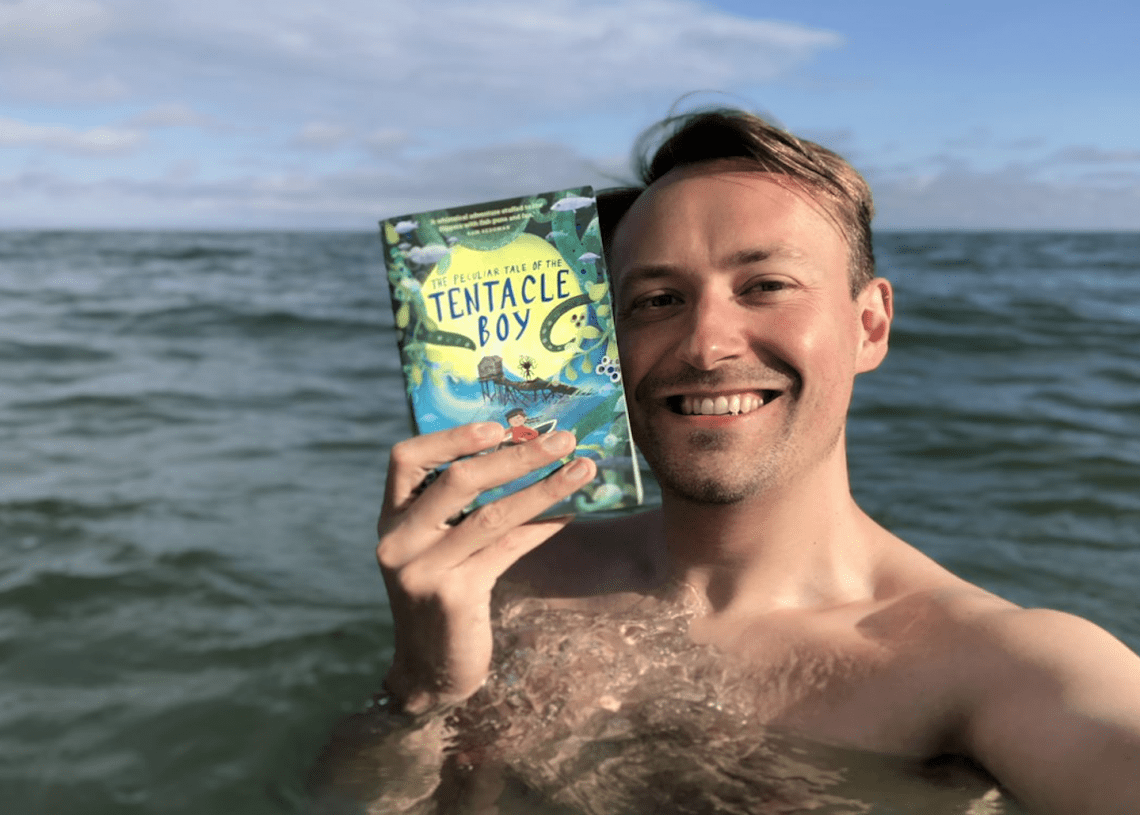
Definitely. My first book, The Peculiar Tale of Tentacle Boy is set in a strange fishing village, where a girl named Marina is very bored by life there. She decides she wants to have a real life adventure rather than just telling stories. Similar to Casper who is stranded in the middle of the country, cut off from water – he wants to get out there to see the world, just swim and have a great time. I would say my books definitely encourage being among nature, getting out and having adventures in the fresh air.
How do you hope your books will encourage children to engage more with the outdoors?
My books are definitely aimed towards parents who want to get their kids into swimming or even just learning more about the oceans and taking on new adventures. A big part of Son of the Sea is that Casper longs to be by the sea and to swim, his greatest goal in life is to swim the English Channel. So that’s his real driving purpose throughout the story. It really does have this message of setting yourself goals, getting out there and trying to achieve them, no matter the obstacles that you face; whether it’s your parents keeping you away from the sea, or just a huge pair of webbed feet that some people might not accept. Both of my books are about self-acceptance, and being proud of who you are.
Speaking of acceptance, you’ve been praised for including LGBTQ+ relationships in your books. Could you tell us more about your experiences and inspiration behind that?
Queer relationships weren’t represented at all in children’s books growing up, which for me would have been the late 90s. If I’d had books that normalised being gay, then it would have been fantastic for me growing up when I was the target age of my book.
Son of the Sea has an adult gay couple; but it’s not a huge plot point, it’s very much incidental representation, just normalising same sex relationships. People reading it won’t even think twice about it, they’ll just see a couple who happens to be a same sex but it’s not making a huge statement. They’re just represented as another couple, like any other couple would be in a children’s book. I think that if kids see gay couples in books at a younger age, it will just become normalised, which it should be and which it is.
Where did your love of the sea and being outdoors begin?
I’ve always absolutely loved the sea especially, the beach and just swimming. Although I grew up in Hertfordshire, just outside north London, all my grandparents lived on the south coast. My mum’s parents lived in Chichester, so we’d spend a lot of time down there and go to Bognor Regis and that coastal area; but then my dad’s parents lived in Bournemouth.
We’d get put on a coach at the start of the summer and sent off to either place a few weeks, because both my parents worked full time. We actually had a beach hut in Bournemouth for about 30 years. So all my childhood summers were spent running around beaches and diving into the sea and spending a lot of time down there. And it was amazing.
Do you have any favourite spots for outdoor swimming?
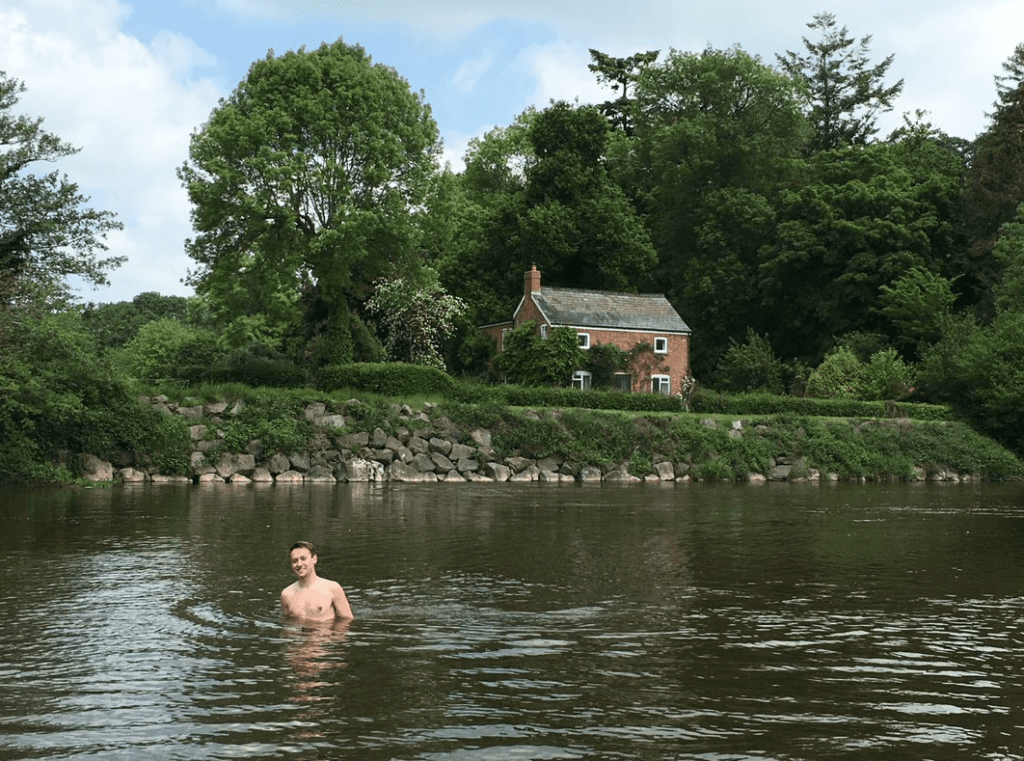
Yeah, Medmenham which is near Marlow, it’s a lovely little bend on the River Thames. There’s a popular spot which is quite secluded on the riverbank, which is really nice. It’s off the main road and you go down a drive, then the waters just suddenly there; it’s amazing, just so quiet and peaceful.
Another one of my favourite places is in Wales: the Warren, in Hay-on-Wye (pictured above). You walk off through the residential streets which come into a huge field that opens out, then across the field at the bottom, there’s the river. It has a few different levels so a few mini waterfalls that break the swimming spots into three separate banks. It’s really secluded as well with just one beautiful house on the other side of the bank, but nothing else around.
Outdoor swimming has a lot of health benefits, what benefits have you felt for your mind and body?
It’s just so revitalising isn’t it? It clears your mind, hits a reset button. And you never leave the water feeling worse than you did when you got in. It’s really helpful with my writing as well; a lot of my inspiration comes when I’m swimming.
Thinking about characters, the plots of my book and unravelling plot holes or just trying to think up new fun twists. It’s quite often when I’m swimming in the water that my mind’s just clear and then things sort of fall into place. I often have to run out and try to quickly write them down before I forget about them.
Son of the Sea by Richard Pickard is an amazing book and is available in all good book shops now (£7.99 published by Chicken House).

Outdoor Swimmer
Outdoor Swimmer is the magazine for outdoor swimmers by outdoor swimmers. We write about fabulous wild swimming locations, amazing swim challenges, swim training advice and swimming gear reviews.