


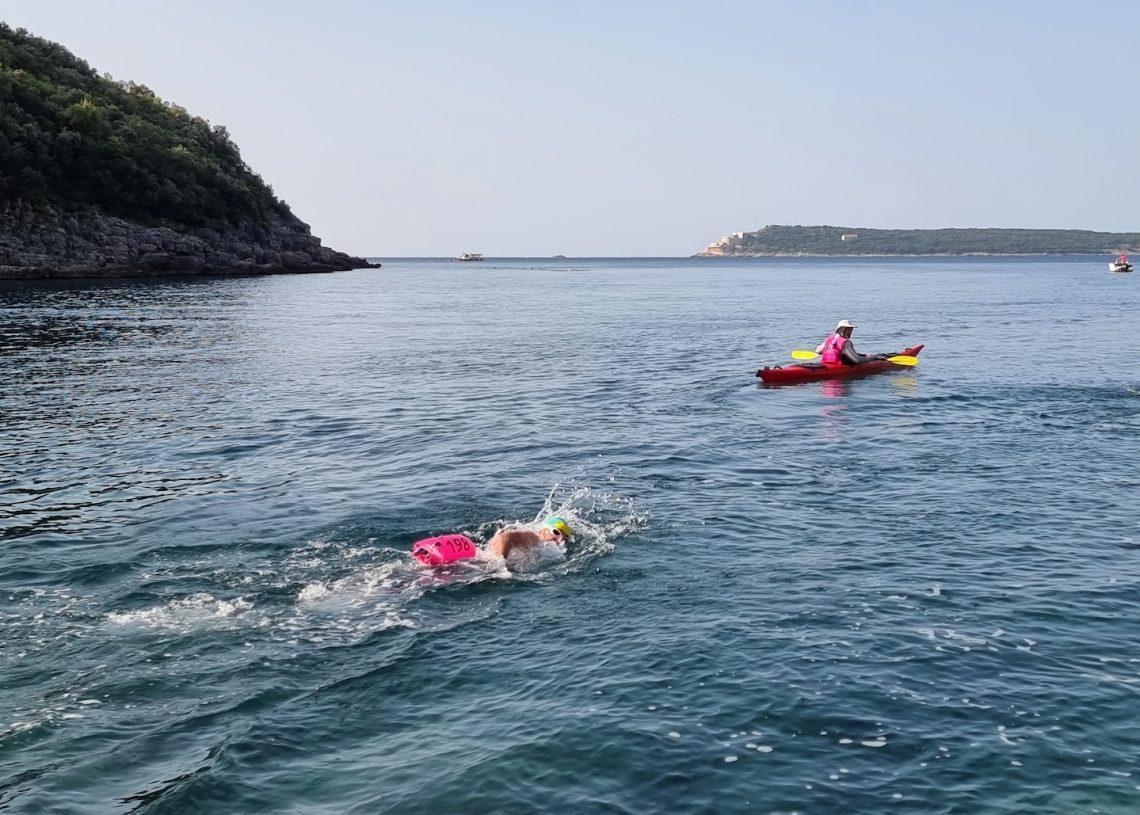
How to get your head around long-distance swimming
Simon Griffiths offers his insights on how he mentally prepares himself for longer swims in the open water
I grew up swimming with my town club. I mostly raced 50m and 100m, occasionally 200m.
Once a year, my club held a one-mile race at our local lido. My memory of those swims is
that they were long, cold and miserable. I only did them a couple of times but it cemented in my head the belief that a mile was a too far to race, regardless of the fact that I regularly swam further than this in training. The idea of swimming 5km, 10km or longer in one go was beyond comprehension.
Fast forward to the present day and, truth be known, I still find distances of more than 400m intimidating when swum in a pool. However, I now think of a mile in open water as a short swim.
Objectively, swimming long distances in open water is harder than in a pool. There are no turns where you can rest momentarily, and you may have to deal with challenging conditions, so what makes it subjectively easier, at least for me?
One reason is that if I race a mile in the pool, I always know exactly how far I’ve swum and how much remains, and I gauge my effort accordingly. I swim at my limit and collapse at the finish line while running the risk that I might crash before I get to the end. In open water, the time pressure is removed. I don’t compare one swim to another because conditions are always different. I swim slower too, to keep something in reserve in case the swim turns out longer than I expected. Also, in open water, there are often opportunities to draft or swim alongside other swimmers, both of which make it easier. And
maybe too, there’s something in the sense of freedom you get in open water that gives your
swimming a boost.
If you haven’t tried long distance swimming yet, I recommend giving it a go. You can probably swim further and you may enjoy it more than you think. As someone who found the transition to long distance swimming challenging but now occasionally enjoys settling in for the long haul, I thought I’d share some tips.
• Before you attempt your first open water swim, ensure you can swim for at least 500m continuously without getting out of breath.
• If you’re planning a 10km marathon swim (or longer), try to do at least a few swims of 40 to 60% of the distance first.
• In training, find a swimming pace that feels comfortable, relaxed and unhurried. Then work on getting faster by improving your technique rather than trying harder.
• For swims longer than around 90 minutes to 2 hours, you will need to think about nutrition to replace the energy you have burnt through. Research and practise this well before event day.
• Understand how you respond to spending extended amounts of time in cold water and choose your challenges and swimming attire accordingly. You may have to train for cold water tolerance as well as endurance.
• Remember to protect your skin from sun and chafing on long swims.
If you find long-distance swimming is your thing, there are hundreds of challenges you can tackle and a global community of marathon swimmers to support and encourage you. But don’t feel compelled to swim ever-longer distances. There are plenty of fun, interesting and challenging short and medium distance swims you can do too.

Simon Griffiths
I started Outdoor Swimmer in 2011 (initially as H2Open Magazine) as an outlet for my passion for swimming outdoors. I've been a swimmer and outdoor swimmer for as long as I remember. Swimming has made a huge difference to my life and I want to share its joys and benefits with as many people as possible. I am also the author of Swim Wild & Free: A Practical Guide to Swimming Outdoors 365 a Year, I provide one-to-one support to swimmers through Swim Mentoring and I'm the creator of the Renaissance Swimmer project.