


Training for speed and shorter distances
How can we train effectively and what can we do to improve our speed without compromising our technique and overall performance? Nicola Butler has your guide
In this issue we are focusing on swimming careers and a range of shorter distance goals within swimming. So how does this link with swimming in the pool? Most events this summer will be host a specific distance in open water, either through a triathlon, or a single open water swim. Some sprint triathlons still use an indoor pool or outdoor lido for their swim section, with a distance goal of around the 400m mark. Many single open water events will offer a series of shorter distance swims ranging from 250m – 1k through a series of loops or a long section.
You may also be training to become a Beach or Open Water Lifeguard, which requires you to swim 400m in a set time. With such a range of distances and goals, how can we train effectively and what can we do to improve our speed without compromising our technique and overall performance?
Speed: a simple formula that explains a lot
Swimming performance in both the pool and open water really does boil down to a simple formula:
Propulsive Force – Resistance = Acceleration
Propulsive force is the forward momentum you create with your arms and legs. Ideally, you need to generate more forward force or reduce resistance to go faster. Most swimmers focus on more power excessive pull and greater effort. Smarter swimming starts with minimising drag. The objective is to create less resistance to achieve more speed from the same amount of effort.
To swim faster and at speed, reducing drag is more effective than trying to increase power.
Now, to improve overall speed, let’s look at how drag occurs in the water and what drills, solutions and sets we can do in the pool to reduce this for shorter distance swims:
Friction drag: This is the water sliding across your skin or suit. It’s minimal, but at high speeds it matters. Solution – shaving key limbs, removing jewellery, wearing tight suits/swimwear and bullet hats.
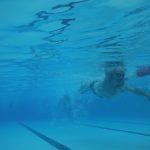
Form drag: This is the shape of your body in the water. If your head is lifted and hips are dropped, then you’re pushing more water than needed. A long, narrow body moves faster in the water. Drill – practice tight pencil like positions in the water from pencil dives through to simple push and glides off the wall.
Wave Drag: This occurs at the surface. When you push water, you displace it and this results in waves. When you swim at speed, more waves are created. To minimise surface disruption, you must remain more streamlined in the water.
Set & top tips: Short distance sprint training
W/up – 200-400m: Easy as 50fc / 50bk
10-20 x 25m FC power sprints / rest 30 secs: Start from the wall and push off as hard as you can. Aligning the body into a narrow, pencil-like shape, extending arms overhead with hands stacked and locked, head tucked down, and core engaged to maintain a straight line. DO NOT KICK until you resurface (this is a drill). Then sprint as fast as you can with leg kick until you reach the wall. Try not to breath a lot over a 25m sprint. This drill set also helps you to practice sprinting from standstill or in deep water, which replicates many 400m swims/mass starts.
C/dwn – 200-400m: Easy choice stroke

Outdoor Swimmer
Outdoor Swimmer is the magazine for outdoor swimmers by outdoor swimmers. We write about fabulous wild swimming locations, amazing swim challenges, swim training advice and swimming gear reviews.