

Forest bathing: immerse yourself in nature
Rowan Clarke investigates the physiological and psychological benefits of immersion in the natural landscape
It feels like we’re in survival mode at the moment. It’s bigger than post-Christmas blues as more people than ever seek treatment for poor mental health.
We’re also more disconnected from nature than ever before. That’s not a non sequitur – a growing number of reports show that increased urbanisation directly impacts our health and wellbeing.
As we drift further away from the natural world, we’re noticing that many markers of human progress – science, technology, buildings, transport – revolve around our existence as distinct and separate from nature.
In lots of ways, we’ve made huge gains as a species. But, as we continue to alienate ourselves from the natural world, we’re beginning to realise what we’ve lost.
As outdoor swimmers, we use cold water as therapy. But it’s more than that.
With every swim and dip in natural water, we’re also immersing ourselves in the greater landscape. This immersion in nature has never been more important, but why? And how much of an impact can so-called ecotherapy have on us as individuals, as communities and on our relationship with the environment?
Back to the woods
Forest bathing is an ecotherapy practice that’s growing in the UK. Adapted in our landscapes from the Japanese practice of shinrin yoku (shinrin = forest, yoku = bath), forest bathing is about opening all your senses to the natural environment for an immersive experience.
It’s not just a walk in the woods. It shares many health and wellbeing benefits with cold water immersion, including reduced stress, improved feelings of happiness, lower heart rate and blood pressure and a better immune system and recovery from illness.
Just as cold water triggers a strong physiological response, spending time among trees has a profound effect on our bodily processes. This effect, which has been well researched, is interesting enough. But what’s particularly striking is that the benefits of both cold water and forest bathing tap into bodily processes that evolved in our earliest ancestors and haven’t changed since.
Immune boost
“The physiological benefits of forest bathing are partly to do with the presence of phytoncides in the atmosphere of the forest. These volatile organic compounds are chemicals that trees emit to protect themselves from attack by fungus, insects or herbivores,” says Integrative Psychotherapist, Mountain Leader and Associate Lecturer at the University of Plymouth, Stefan Batorijs.
“What they’ve discovered in Japan is that when we breathe in forest air containing these phytoncides, they actually have an effect on our physiology.
“The primary effect is on our immune system. Phytoncides help us create far more lymphocytes or T-cells, which are the cells that go around our body locating and eliminating any disease-damaged or senescent cells. A day’s walk in the forest can boost the immune system for up to a month afterwards.”
To isolate the effects of phytoncides, Japanese researcher Qing Li put half the individuals in his study in hotel rooms containing essential oils from the trees, and half in rooms with images of forests.
But, just as science only begins to explain the benefits of cold water, Qing Li realised that forest bathing is more than isolating its sum parts.
“Qing Li made this very interesting comment. He said that in all their experiments, they can only replicate 50 per cent of the benefit of the forest. He said the other 50 per cent is the mystery of the forest,” says Stefan.
“It’s the immersion experience that’s so important. You can’t take a reductionist perspective and say, is it this, is it that. I think it’s taking ourselves back to this memory of where we came from.
“This total immersion, not just at a physical level, but also at a kind of neuroemotional level, is where we just get this buzz from being in the forest.”
Bathing the soul
This last point really resonates for outdoor swimmers. Scientific research helps us understand why cold water has such a profound effect on our physiology, and we know that the wellbeing benefits of plunging into cold water come from working with cold water shock, which is a physiological response that we share with our earliest ancestors.
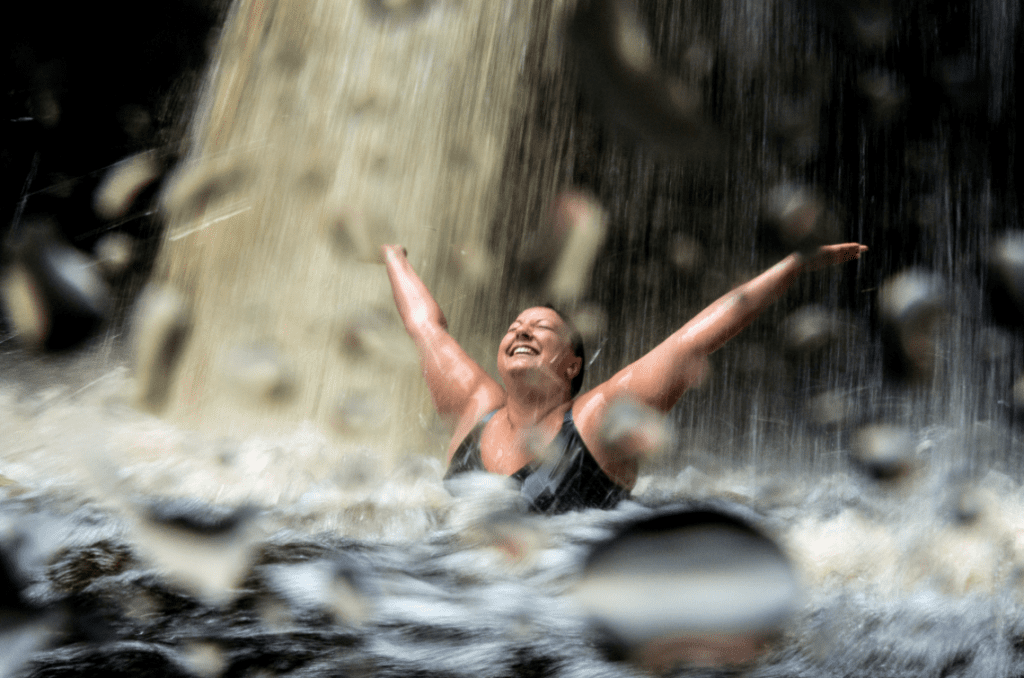
But, that’s only half of it. It’s the experiential side of outdoor swimming, our neuro-emotional response to plagiarise Stefan’s phrase, that brings us such joy – and a huge part of that comes from being in the natural environment.
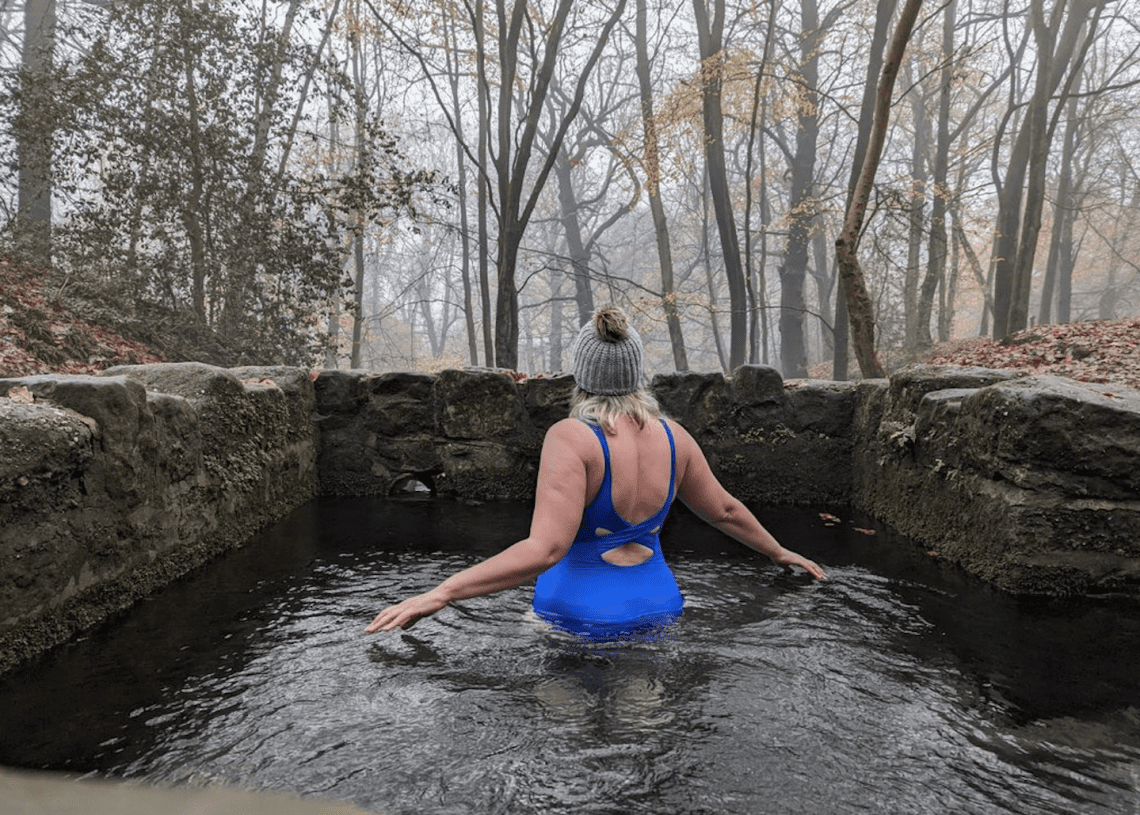
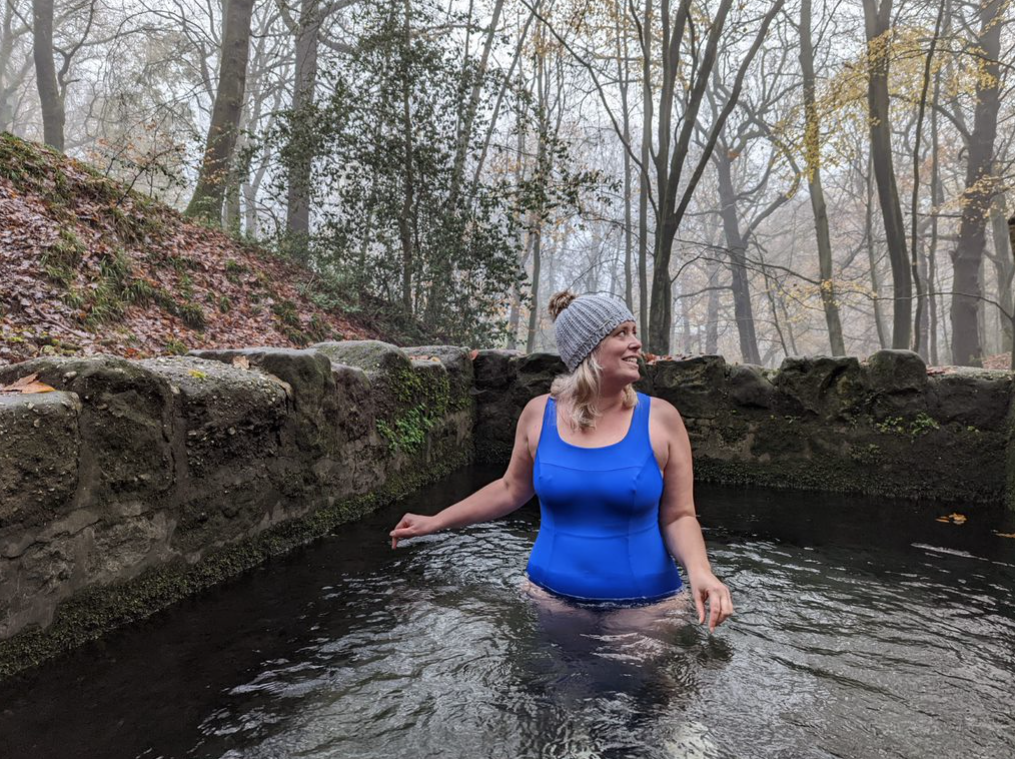
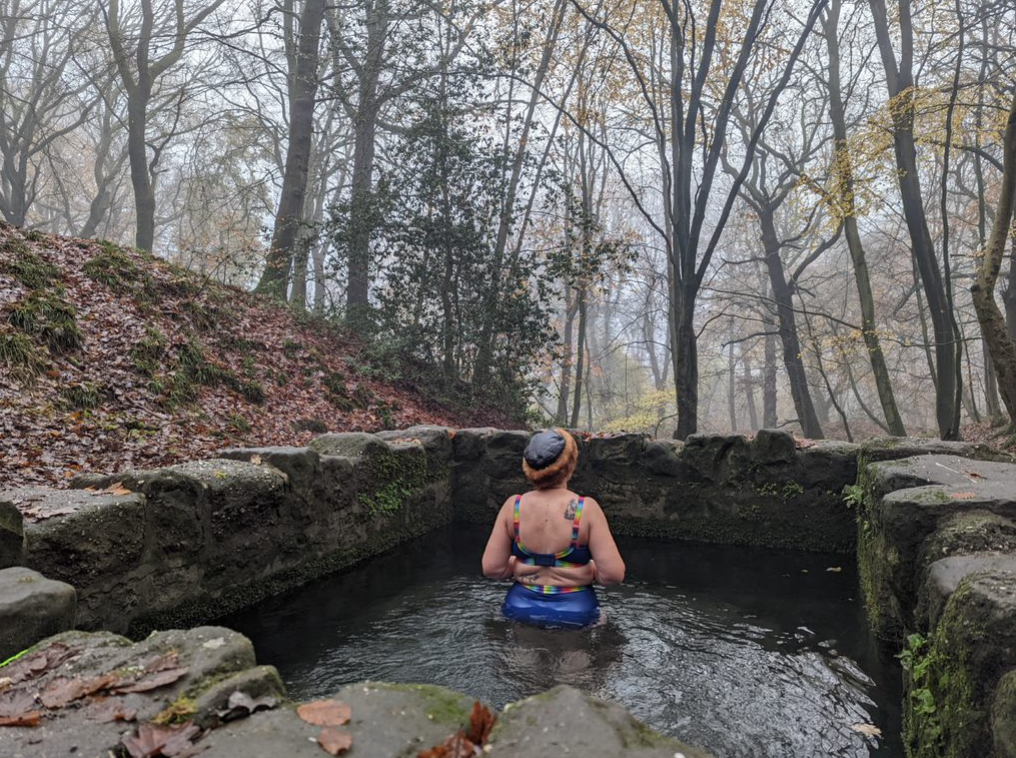
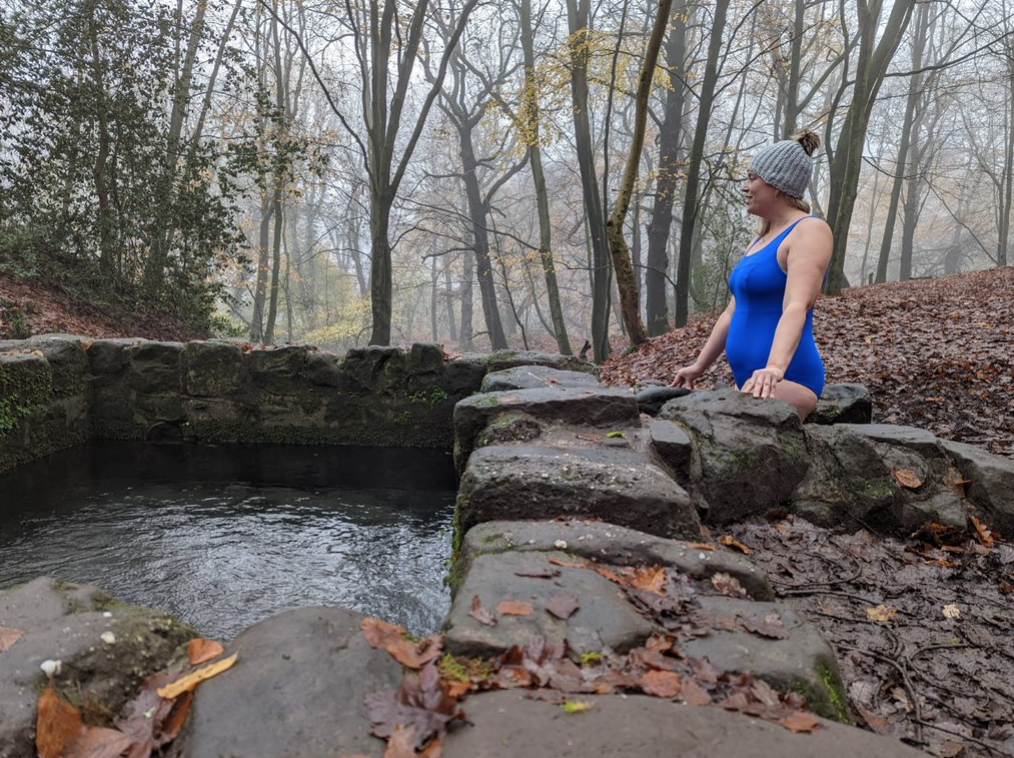
“The feeling you have when you swim is just so peaceful,” says Emma, who swims in a spring in the Forest of Dean. “It’s just being surrounded by these beautiful trees. I love the sound – on a windy day, it’s just awesome. I love the changing colours of the leaves. Every time youswim, it’s different. Today it’s misty so there’s a real air of mystery.”
So, as you’d expect, swimming outdoors in a natural landscape evokes a stronger emotional response than having a cold shower. But what’s really interesting is how that response can differ in different settings.
“I found swimming here really calming and peaceful and almost the opposite of sea swimming,” says Lucy, who normally swims in Clevedon Marine Lake. “It’s lovely to be in an infinity pool and see allthe way across the sea; you get an open, expansive feeling. Whereas here, you feel kind of nurtured.”
Stefan has not only discovered that we respond differently as the landscape changes, he also uses it to benefit his clients through his ecotherapy practice.
“I work a lot with metaphors,” he says. “So, by the sea we can look at what it is that we discover when we reach the edge of the land and beyond us there’s just this vast ocean. What is it about the wildness of this environment that speaks to us so beautifully?”
Reconnecting with nature
The problem is, wildness can only speak us if we want and have the means to hear it. Having what you need to benefit from immersion in nature is a question of mindset and privilege, which seems bizarre considering that, relatively speaking, it wasn’t that long ago that our antecedents lived in the trees.
“The amount of time that we have spent out of the forest is so tiny by comparison to the amount of time we spent in the forest, so all of our physiological and psychological systems are geared to be forest dwellers,” says Stefan.
“Our physiological systems evolved in response to the forest environment. So, when we take ourselves out of the forest, we’re no longer part of that ecosystem. And therefore, all of those physiological functions within us start to deteriorate.”
Seeking the outdoors
Never was this more apparent than during the pandemic. The lockdowns exposed the huge wealth gap between people living in socially deprived, urban areas and those with easy access to gardens and outdoor spaces.
It also saw a mass exodus into the countryside that showed us just how much we’ve alienated ourselves from nature.
Just as cold water triggers a strong physiological response, spending time among trees has a profound effect on our bodily processes
“Before Covid, I was working in an urban area and it was really startling how you’d have tracks running through woodland, and people would never ever walk off those tracks,” says conservationist, Becca.
“And then over the pandemic, people who weren’t used to going out in the countryside suddenly had nowhere to spend their spare time, so everyone just piled out into the countryside. You had people leaving litter, livestock getting chased down by dogs. People just weren’t used to interacting with that kind of landscape.”
Unfamiliary territory
Speaking to colleagues who worked with forest schools, Becca also realised that this disconnection from nature was intergenerational. “These kids just didn’t know how to walk off a path in the outdoors,” she says. “They were tripping up all the time because they expected everything to be pristine.”
Thankfully, just as our disconnection from the natural world has been systemic, so is the impetus to reconnect. Over recent years, study after study has cited the negative effects of urbanisation and the positive effects of being in nature.
For example, psychiatrists Pourabi Choudary and Debanjan Banerjee’s 2020 paper, ‘Recovering With Nature’: A Review of Ecotherapy and Implications for the COVID-19 Pandemic describes how “ecotherapy-related techniques have been shown to be effective in medical disorders like hypertension, obesity, post-surgical recovery and psychosocial conditions like depression, stress reduction, post-traumatic stress disorder (PTSD), attention deficit hyperkinetic disorder (ADHD) and adjustment disorders.”
As the evidence grows, so do funding and opportunities to socially deprived communities to benefit from being in nature, like green social prescribing and forest schooling as part of state education.
Reverence for nature
Fostering strong connections with the natural environment is critical to us and to nature. Rather than seeking out nature and using it to support our health and wellbeing, we need to find ways to reciprocate. It’s about reigniting the symbiotic relationship we have with the natural world; being a part of it rather than separate from it.
If you take a deep dive into ancient human history and mythology, you’ll find that nature was venerated; trees and water were imbued with magical and scared properties, and people treated them with reverence. But, as time moved on, veneration for the natural world soon gave way to a demand and supply mentality where humans had supreme power over nature, taking and using what we wanted.
Trees and water were imbued with magical and scared properties, and people treated them with reverence
And as this attitude became entrenched, people lost sight of our reciprocal relationship with our environment. A simple, but brilliant, example is the Working Wetlands project that Becca’s working on that puts a monetary value on the water quality processing done by the local water company that nature can do for free.
The project then received a grant to plant trees, reinstating wetlands and plant hedgerows whose roots systems absorb agricultural run-off.
“You can learn so much from nature, which also relates to us as humans and as a society,” says Becca. “But you can’t have that understanding without experiencing it; it’s not already inherently there. It definitely used to be. We are more removed than we ever have been from the wider landscape.”
But, for those who immerse themselves in the natural world, not only do they benefit, but they also become more attuned to how amazing and precious it is. And that’s where the magic happens.
Power of ritual
“I think that we have this kind of false sophistication because of the amount of technology that we have, and yet it’s these primal elements that really connect us to the core of who we are,” says Stefan.
“That’s what ritual is about, whether it’s going down to the river, getting undressed and going into that water, or lighting a fire, it’s that ritual that we’ve lost in our lives that keeps us tethered to our natural, ecological selves.”
The sacred well surrounding the spring where Emma and Lucy dip is thought to have been built in 1148 in association with a nearby abbey for use in monastic rituals. It’s now used for cold water immersion rituals.
“Spirituality means something different to everybody. One person’s spirituality is another person’s prayer is another person’s paranormal,” says Lucy. “For me, it’s more to do with the proper awe in awesome. You know, being able to feel awe at the amazingness of the natural world. If I come somewhere like this that’s so beautiful and so removed from the modern world, then I feel real awe.”
There is something deeply comforting about coming full circle back to nature. Awe, ritual, connection, learning, health and wellbeing – there are so many reasons to immerse ourselves in nature, and so many wonderful ways of doing so.
Green social prescribing
As we step into a new year, it feels like a good time to think about how we might make more connections with the natural world. And, as research and initiatives into ecotherapy and green social prescribing increase, we can hope that more people will be able to benefit too.
“Maybe somewhat naively of me, I think that if we could get the whole world forest bathing, then nobody would destroy anything or each other,” says Stefan.
“We all have a responsibility to reinforce the notion that when we come to the forest, we need to have this balanced reciprocal relationship with nature.
“I feel that it is really important that we start to change the narrative around how we treat nature. And forest bathing is a part of that. I think we have a deep responsibility to come to the forest with joy and celebration and reverence.”
Read more about forest bathing: natureandtherapy.co.uk
This article is from the January 2023 issue of Outdoor Swimmer. Click here to subscribe to the print magazine.

Outdoor Swimmer
Outdoor Swimmer is the magazine for outdoor swimmers by outdoor swimmers. We write about fabulous wild swimming locations, amazing swim challenges, swim training advice and swimming gear reviews.