What about men?
Register to get free articles
Want unlimited access? View Plans
Already have an account? Sign in
In a woman’s world, Rowan Clarke finds out why it’s important to advocate for male outdoor swimmers
Is outdoor swimming still female dominated? From social groups to events, businesses to campaigners, a female-heavy gender split seems universal and persistent. Observations that more women swim outdoors than men are reflected in statistics, social and mainstream media and, as we’re often told, in the pages of this magazine.
But, is it a fair observation that women predominate in outdoor swimming, or is it just that men are less visible? And, in a society where men dominate sport, does it even matter?
Stealth swimmers
It’s an interesting time to ask these questions. The way we talk about gender is changing rapidly and an emerging thread within that discussion is around masculinity, how it’s presented, perceived and how it plays out in a changing world.
Going back to an article we published in 2019 about why women dominated winter swimming, the discussion felt a bit simpler, less weighted. We talked about the social and physiological reasons why women were more likely to gather in groups and dip in cold water. We also discovered that a notable proportion of the men we spoke to had achieved big goals like Channel swims and ice miles.
Back then, it really felt like women were swimming socially and men rocked up alone, bashed out their training session and left again. Individualistic, goal-driven stealth swimmers ratified by Strava.

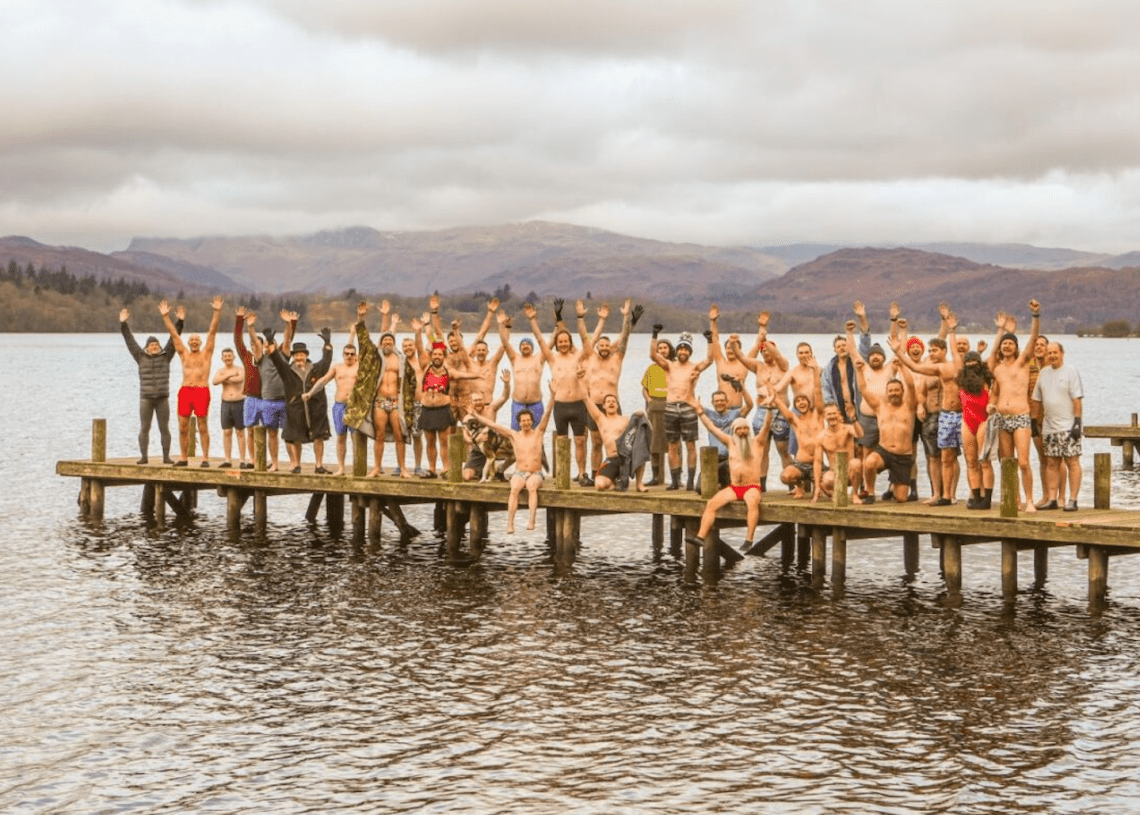
“When I moved to the Lake District, I definitely found myself in a minority at the lake. Most swimmers here are women and all the swim groups I encountered were predominantly or exclusively female,” says Jonathan Cowie, founder of peer-supported cold water swimming club, Blue Mind Men. “For many years I was a member of South London Swimming Club at Tooting Bec Lido, a year-round swimming club with a strong sense of community and support. I enjoy training for big swims but I also enjoy the camaraderie of cold water dips with friends. I wanted to find a way introduce that social side of swimming to men in the Lake District.”
Looking through Channel swimming and ice mile records, it’s apparent that the balance between the genders is shifting. Although men account for 63% of solo Channel swimmers and 56% of ice miles, 75% of ice miles this year were completed by women. At the same time, men are becoming not only more visible in social groups, but also more open about their mental health.
Why men matter
But, so what? Isn’t there something a bit unpalatable in focusing on the representation of cis-males (people who were assigned male at birth and continue to identify as male) when our patriarchal society gives them distinct advantages over all other genders in almost every area, especially sport?
“If there’s one good thing to come out of the pandemic, it is how much more acceptable it now is to talk openly about our mental health,” says Jonathan. “I am a great advocate of the power of both talking therapy and the outdoors to improve our mental health. There have been a couple of times in my life when I have felt pretty close to the edge, and in the past – like many men – I would bottle up my feelings and refuse to talk about them. Now I feel more able to talk about my problems, but for many men that still isn’t the case.”
The statistics on suicide make sobering reading: across the world, males are two to three times more likely than females to take their own lives. In the UK, suicide is the biggest killer of men under the age of 45.

These stats serve as a stark reminder that our patriarchal society benefits nobody. While non-male genders (female, trans, non-binary and others) have persistent, mammoth and complex struggles for equality, it’s not a gender war; inequality affects everyone. Alongside all the advantages that society affords men, there’s a catastrophic flip side. In open water swimming, these stereotypes of the goal-driven, achieving male versus the softer, sociable female are both pervasive and unhelpful. On one hand, it creates a need to shout about the brilliant achievements of women in the sport, on the other, we need to help men to find their way into supportive groups, make friends and feel safe and comfortable there.
“You almost feel a little bit like, am I interrupting a women’s only session? Should I be here?” says Tom, who swims in the Midlands. “I sometimes feel a bit uncomfortable when I’m getting changed because I’m surrounded by women. It’s still a very female-dominated hobby.”
Making friends
Despite feeling conscious of being one of very few men in his swimming circle, Tom is a good example of a man who was brave enough to step out of his comfort zone and join a swimming group at what he describes as a “make-or-break moment” for his mental health. And he found it life-changing.
“In the past, I’ve put so much pressure on myself to try to keep up with the Joneses. But I was just alienating myself, trying to fit into ideals that I wasn’t going to meet because I’m not that kind of person,” he says. “But I’ve made more friends doing this than any other time in my life. And I felt completely accepted as me no matter what my body shape is looking like, how fat I’m feeling, how my headspace is feeling. I feel non-judged and completely supported.”

Tom’s point about non-judgemental friendships is really important. Poor self esteem, social isolation and loneliness are contributing factors to mental health issues. The fact that men are generally much worse at seeking help and holding meaningful friendships are among the complex reasons behind those shocking stats on male suicide.
“There’s this idea that male friendships need more scaffolding, more institutional support, so more spaces for them to hang their relationships,” says Max Dickens, whose book Billy No Mates: How I Realised Men Have a Friendship Problem, brilliantly describes the social and psychological drivers behind men’s friendships style.
“Men generally need a pretence to get together with other men and when we socialise as guys, there needs to be a reason. Now that reason can be really arbitrary and often silly, but we need it. So swimming is a great reason to get together.”
Luck of the tides
But, as we’ve seen, swimming outdoors can also be a solo, goal-driven exercise. So, what gives men that extra push to make it sociable?
In Somerset, Clevedon’s swimming community boasts an unusually large number of men who swim for social reasons. With the second highest tidal range in the world, the fact that you can only swim in the sea at high tide creates a unique opportunity to socialise.

“It’s a real reason for people to come together,” says Andy, who’s part of a large social group of sea swimmers. “I think that for some men, if there’s more inclusivity in a group, they partake more openly and more freely.”
“I started here training. That’s all I came here for: training, swim, go home. Then, slowly I met more people that were doing it, so off came the wetsuit,” says his friend, Pete. “It was just a general meet-up, very casual. And that’s how I met Andy. Then, as the water gets colder there’s more faffing and you end up chatting to more people and it becomes more of a social thing. The swim gets smaller and the chat afterwards might turn into going for a coffee or lunch. It’s a day trip now and I come to Clevedon every week for my mental health.”
The Clevedon experience is a great example of how having an activity, a ‘third space’, localism and propinquity creates the perfect conditions for men to bond. A ‘third space’ is the term social psychologists used to describe somewhere to meet up and hang out beyond work and home.
Localism describes factors like transport as well as identity and a sense of belonging, and Max explains propinquity: “If you look at how people make friends, a lot of the time we think it’s to do with magic. It’s fate that you met this person, a syncing of souls. The truth is actually a lot more mundane; it’s what social psychologists call propinquity. So, propinquity is this idea that you make friends when you’re socially and psychologically proximate with others. So essentially, you’re in the same sort of space a lot, you collide with people, eventually you’ll become friends.”
Being vulnerable
But, in order to make meaningful social connections, you need to make yourself vulnerable. For Pete, the literal removal of his wetsuit is a nice metaphor for shedding his protective armour and being more open. For Andy, it’s about finding validation.
“I think validation is pretty important for men. I don’t think men get validated as a human being in the workplace and in society,” he says. “But you come and join a swimming group and you share, and then you get validated by sharing your experiences and someone will share a similar experience. I’ve heard men say that a few years ago, they wouldn’t have been able to have an emotionally connected conversation with another man. But, the more you’re exposed to this element of trust, and validated through being listened to, the more likely you are to take risks.”

For lots of men, like those in Jonathan’s Blue Mind Men cold water swim group, for example, taking risks and stepping out of your comfort zone is an important part of opening yourself up to the benefits of social support.
“There is something so important about the sense of community,” says Jamie, who swims with the Blue Mind Men. “We are all doing this ridiculous crazy thing together. When you are there for the first time in cold water, the guys will gather around or gradually walk you in, holding your hand. Afterwards people will say ‘I really appreciated that, I just needed a bit of support’. It’s amazing what you can achieve when you are really in that moment.”
So, an increasing number of men are swimming for their mental health, turning up ready for the experience of being in cold water with other people. And that’s very different from swim training.
“I think what’s important and relevant here is how you show up in a competitive activity versus a noncompetitive activity; you show a slightly different version of yourself,” says Max. “When you’re around people that you’re competing with, some masculine norms are that you should puff your chest out, be a bit more aggressive, not show weakness. And I think that makes you shut off a certain part of you, which is going to open up to proper connection. I also think when you’re learning a skill, you reveal a lot about yourself. People are literally seeing you be vulnerable.”
“There is this assumption that men only swim if they are training or chasing a PB while women only swim for the social side and the shared experience,” says Jonathan. “That’s such a reductive point of view – I know so many women who can whup my ass in training! Equally, the success of Blue Mind Men has shown that swimming for men can be about so much more than logging distance on Strava. The traditional male get-together is over a pint in the pub; what we are doing is showing that there are other ways for men to connect with each other and with the outdoors.”
And that’s the crux of this discussion. Not the number of men swimming outdoors, but the way in which they do it. While men dominate competitive sports, they also dominate suicide statistics and that signifies a crisis in masculinity that needs attention. From amazing groups like Blue Mind Men to individuals like Jonathan, Jamie, Tom, Max, Pete and Andy, finding ways to help men access the benefits of swimming outdoors is something we can all do.
Male-run swimming groups
Blue Balls Cold Water Swimming, Cornwall
Edinburgh Blue Balls, Edinburgh
Ice Guys North East, Sunderland, Tyneside and Ayrshire