

Where does swimming fit in your life?
Simon Griffiths shares some thoughts on swimming, training and life
From next issue, Alice Dearing will be writing this training section for Outdoor Swimmer. Alice was the first black female swimmer to represent Team GB at the Olympics, taking part in the 10km marathon swim in Tokyo. She was also a junior world and European champion, and she’s a co-founder of the Black Swimming Association. We’re thrilled she’s joining our contributor team. I’m looking forward to reading her training advice.
I will therefore be taking a pause from writing training content. Before I go, I want to leave you with some ideas on training principles that I hope will help you wherever swimming takes you next.
Think bigger
I don’t mean this in the clichéd way of setting more audacious goals but in the sense of where does swimming fit in your life? Why do you swim? Is it for the accolades that swimming might bring you, such as recognition for completing an iconic swim, or is swimming your stress relief valve from a demanding job or carer role, for instance? Do you swim to get fit or to help you cope with the challenges life throws at you (or a bit of both)?
Understanding where swimming fits in your life will help you set meaningful and achievable goals, and structure your training accordingly. And if you decide that unstructured swimming and dipping (rather than training) is exactly what you need in your life, then that’s fine.
Be curious, but think critically
There is always more to learn about swimming, from ways to think about swimming technique to skills to swim faster. Keep reading Outdoor Swimmer, study books, watch videos, listen to other swimmers. But make sure you engage your critical thinking facilities. Consider what you learn in the context of your current swimming ability and ambitions. Training advice for teenage elite pool swimmers might not be appropriate for adult open water swimmers.
Remember that progress is iterative
You will never have perfect swimming technique. Even if you get close, there will still be things to work on. And if you don’t keep working on it, errors creep in. Then, when you make a change to one part of your stroke, it affects other parts. If you want to keep improving, you need to constantly think about and work on your swimming technique.
Don’t obsess about technique
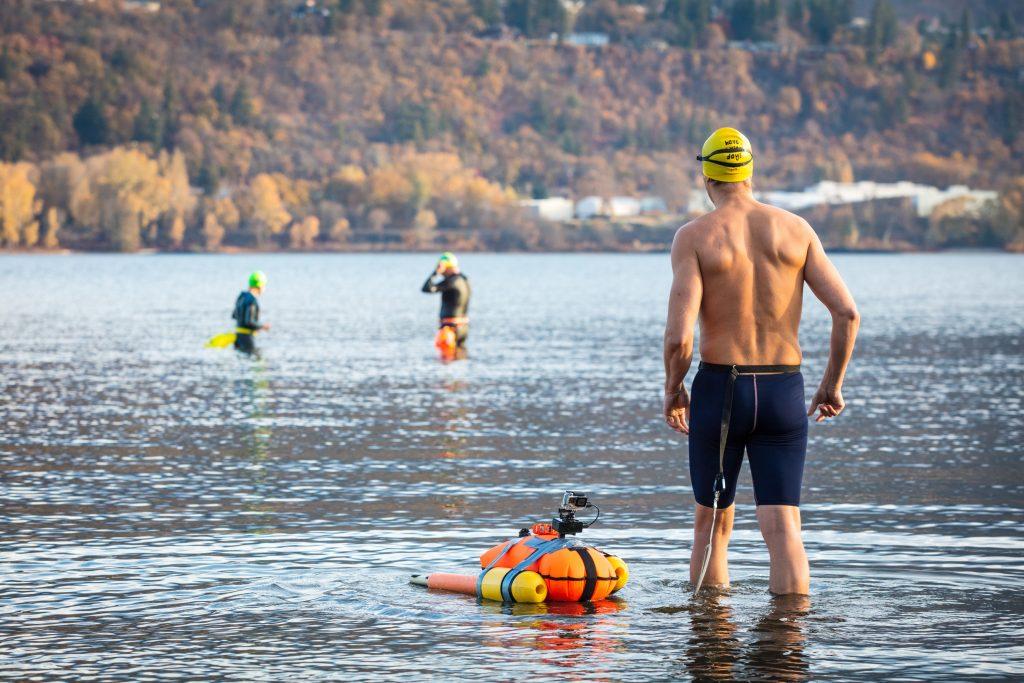
Good swimming technique is important but it’s not the only thing. You also need strength, fitness, muscular endurance and mobility. Not only do these help you swim faster, regardless of your technique, they also help you swim with and maintain good technique. You can’t execute a good catch if you have poor shoulder mobility and limited strength. You will progress faster if you work on technique alongside your strength and fitness, rather than trying to develop perfect technique first and then building fitness.
Remember, too, that to swim faster in open water, you need to practice open water skills such as swimming in rough water, sighting and drafting. And these aren’t just marginal gains either. Poor sighting and navigation will cost you minutes, not seconds. Some people estimate drafting reduces energy consumption by 20 to 30%.
Set explicit speed targets
Increasing how far you can swim is relatively easy. Getting faster is harder. Many swimmers never even measure their swimming speed, which makes it impossible to know if you’re getting faster! Setting explicit speed targets is a powerful way to focus your training. I recommend setting targets for multiple distances, from 50m sprints to 1500m. If you join a masters club and sign up to events, you can test your speed in races, which is fun – and you may find you swim significantly faster in races than you do in training. Alternatively, occasionally substitute a training session for a time trial.
Chasing distance targets encourages you to swim steady and conservatively. Setting speed targets forces you to think through all the components that could help you swim faster, from costume choice to turns, streamlining and training methods. Even if you are training for a long distance swim, having a speed focus will help you become a more efficient swimmer.
Optimise training for life, not performance
Taking your training seriously can be deeply satisfying – both at the level of an individual training session and over the course of a season or even years. You will learn a lot about swimming and how your body and mind work. You will become fitter, stronger and mentally tougher. To a degree, the more serious you are about your training, the greater the satisfaction you will get from it.
But keep sight of the fact that swimming is probably your hobby. It should add to your life and wellbeing. You need to keep it in balance with work, family and friends – and even other hobbies. If swimming starts leaving you wrung out rather than energised, consider if perhaps you’ve taken it too far.
Taking swimming seriously also doesn’t mean you can’t have fun with it. Take it easy sometimes and goof around. If this means you don’t quite reach your full swimming potential, does that really matter? Surely it’s more important to enjoy your swimming and the role it plays in your life, rather than being the best possible swimmer you could be.
I hope you’ve found my training articles helpful. If you want to explore more of my ideas on swimming, training and life, please check out Renaissance Swimmer, my Swim Further and Faster in Open Water video course or you can email me for advice on swim mentoring.

Simon Griffiths
I started Outdoor Swimmer in 2011 (initially as H2Open Magazine) as an outlet for my passion for swimming outdoors. I've been a swimmer and outdoor swimmer for as long as I remember. Swimming has made a huge difference to my life and I want to share its joys and benefits with as many people as possible. I am also the author of Swim Wild & Free: A Practical Guide to Swimming Outdoors 365 a Year, I provide one-to-one support to swimmers through Swim Mentoring and I'm the creator of the Renaissance Swimmer project.