
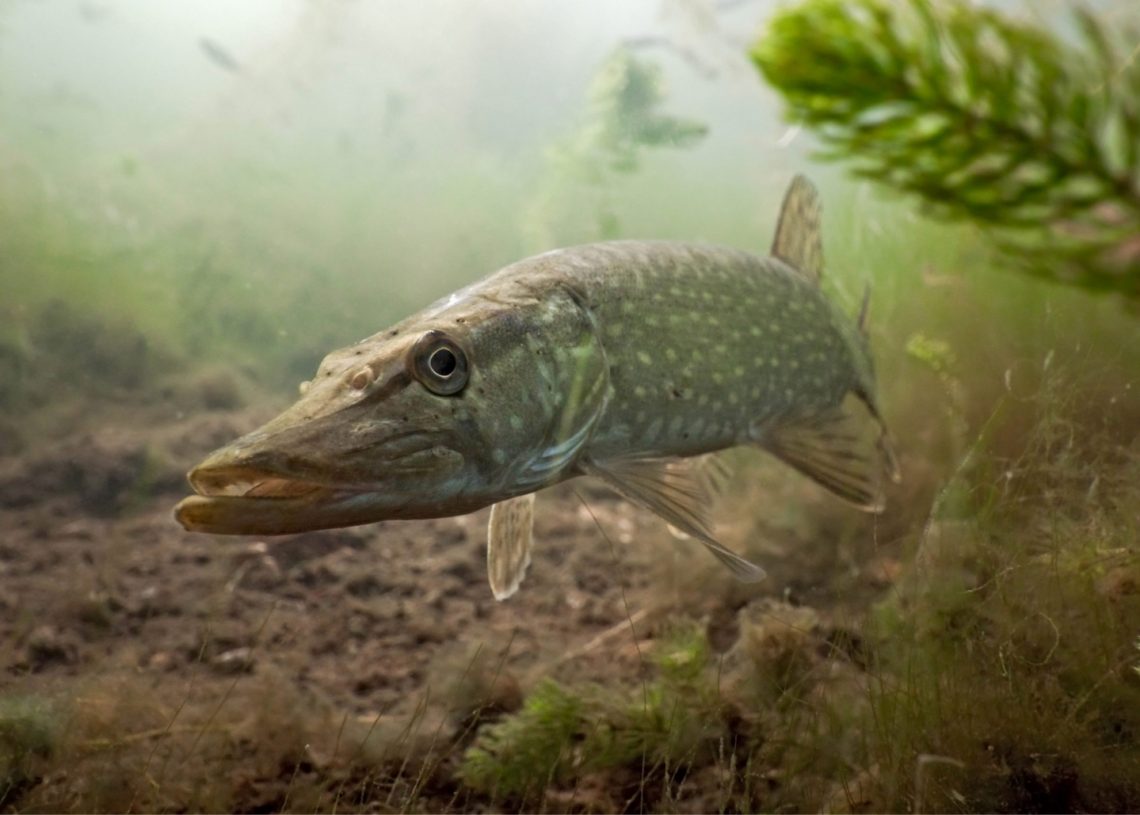
Myth busting: Can a pike bite my toes?
If you have swum in freshwater, you have swum with pike. They lurk – often unseen – in rivers, ponds, reservoirs, lakes and gravel pits. But would one even take a nibble at a passing swimmer? Susanne Masters is your guide to these impressive apex predators.
Don’t worry about your toes, pike don’t think in nibbles. They want the whole portion. Yes, theoretically a pike could bite toes, but if they did it would be a mistake. Like many dreaded risks of swimming in wild water you are more likely to be injured by hazards of modern life such as a car crash than a pike bite.
If you have swum in freshwater you have swum with pike. They live in rivers, ponds, reservoirs, lakes and gravel pits. Even large pike in clear water can be passed unseen by swimmers because pike are scavengers and lurkers. Instead of chasing prey they wait in ambush and grab it.
Young pike gobble fish eggs and small fry. As they grow so does their prey. Pike select food in relation to size, and will go for prey that is up to about half their size. Unfortunately for male pike, which tend to be smaller than females, post-spawning hungry female pike will eat nearby fish even if it is a fellow pike. In fairness the female gonad is 15-20% of their body weight whereas for male pike the gonad is only 2-4 % of body weight. So, in terms of body weight female pike expend more resources on spawning than males.
As the biggest pike ever caught in Britain weighed just under 21kg, by the age of one most people are bigger than what Britain’s largest pike would fancy for dinner. And babies in water should in any case be closely supervised by an adult, who would be pike deterring size.
But, has it ever happened?
There are sporadic reports of pike bites. In 2020 someone put their hand in a canal to pick something up and got a pike bite. In 1999 a water-skier was bitten on their foot. These pike weren’t trying to eat a person, they mistook a hand or foot for something they could swallow. A swimming person moving in water doesn’t usually look like an edible morsel to pike.
If you are bitten by a pike you won’t have broken bones or a missing digit. Their sharp teeth will leave a flesh wound. It will hurt, and like any puncture wound that occurs in water will require a visit to a hospital for tidying up, antibiotics and a tetanus booster if you aren’t up to date. But more swimmers get cut feet standing on broken glass in one year than have been bitten by pike in two decades.
March to May when pike are spawning is an easy opportunity to spot pike as they congregate in shallow water where there is vegetation for newly hatched pike to attach themselves. In slow rivers pike often lurk under cover of a submerged dead tree or branches. I’ve come face to face with a pike once. Drifting downstream in a river with my niece she pointed at a large pike ahead of us. It hung motionless among strands of vegetation. We could see its powerful, long jaw and that it was watching us. After several seconds, unbothered, it swam off. Our audience with a pike was over. Perhaps the menace of pike is their reminder that in their territory we are not necessarily the apex predator.
This article is from the March 2023 issue of Outdoor Swimmer. Click here to subscribe to the magazine.
To see all the online content from the March 2023 issue of Outdoor Swimmer, visit the 'Hemispheres' issue page.
Outdoor Swimmer
Outdoor Swimmer is the magazine for outdoor swimmers by outdoor swimmers. We write about fabulous wild swimming locations, amazing swim challenges, swim training advice and swimming gear reviews.