Beachcombing: Tales from the shoreline
Rowan Clarke meets the beachcombers finding tiny objects that tell extraordinary stories
What does the beach mean to you? For sea swimmers, that liminal space between land and water might be a place of anticipation, reflection or social connection, of laughter, sunbathing and cake. But for many people, the shoreline is scattered with tiny treasures that tell stories about our place in time and space, about the state of humankind, the sea and our entire planet.
Beachcombers search intertidal spaces for things of value or interest. A seemingly innocuous hobby, the objects they find give beachcombers an incredible insight into our past and present. From fossilised prehistoric creatures to lobster-pot tags from across the Atlantic, dead birds with stomachs full of microplastics to sea beans full of wonder and magic, the closer you look, the more you discover.
Stories of change
Beaches have a way of connecting us to stories from the past. For anyone lucky enough to visit the beach as a child, scouring rockpools for crabs, the scratch of barnacles on bare feet or collecting pretty shells, sea glass or fossils will bring back memories of summer holidays. As adults, those happy memories (combined with your cold-water addiction, let’s be honest) may compel you to potter on the beach with children from your own family.
But will younger generations see the same rockpools that you did? The answer, the lesson, is that they almost certainly won’t because the shoreline is constantly changing in every way imaginable – ecologically, geologically, tidally, environmentally and through human impact.
Recent photos in The Independent showing the extent of erosion on East Anglia’s coast, houses and gardens lost to the sea, demonstrates the relationship between land and water and the impact of climate change.
But evidence of how much the shoreline changes isn’t always so dramatic. As microcosms of the ocean, rockpools represent broader changes in the sea. While each dynamic habitat varies from tide-to-tide, it seems very likely that climate change and human interference has changed these tiny ecosystems over the last few generations. In his book, The Jay, The Beech and The Limpetshell, writer Richard Smyth explores shoreline flora and fauna through the generations, reflecting on his childhood and rockpooling with his young children. Particularly interesting is his exploration of the Victorian poet Edmund Gosse and his father, Philip.
“Throughout the book, I’ve tried to make connections with people who have explored nature in the past and the universal themes that can feed through to us today,” says Richard. “In the same way that I do with my childhood and my kids’ childhood, I like to try and figure out how everything fits together.”
Philip Gosse was a great 19th century naturalist who popularised rock pooling through his books about seashore life. Ironically, his books contributed to the 19th-century seaside boom and collectors stripped rock pools causing irreversible damage to their ecosystems – something that Philip’s son Edmund describes in his famous psychological biography Father and Son.
“Edmund used to go exploring the rock pools with him. Their personal relationship was very difficult and heart breaking, but the saddest part is when Edmund writes about the fragility of the seaside,” says Richard. “He writes about how the beauty that father and son explored in the rock pools has probably gone for good. And the fact that Philip Gosse lived long enough to know this is really heart-rending for me. But he drives these images, like where he sees his and his son’s silhouettes reflected in the rock pool – I think of that when I’m there with my own daughter and son.”
Stories from prehistory
Richard Smyth is also interested in early 19th-century father and child beachcombing pair, Richard and Mary Anning. Richard, a cabinet maker and part-time fossil hunter searched the beaches of Lyme Regis in Dorset with his daughter Mary, supplementing his wages by selling interesting objects that he found on the shores. When she was 12, her brother found the crocodilian skull of what was later named the Ichthyosaur, and over the next year, Mary found the rest.


Watched over by Mary’s statue, Lyme Regis remains incredibly fossil-rich. Here, the cliffs are some of the most prone to landslip in Europe. As they collapse into the sea and are broken down by the waves, fossils appear as remnants of a 180-million-year-old Jurassic seafloor.
One landslide also brought a Victorian rubbish dump to the beach, making it a treasure trove of delights for mudlarkers and fossil-hunters like Eleanor Gould.
“We used to go to Lyme Regis every year to see my mum’s cousin who was a geologist,” says Eleanor. “We took her to this landslide, because she loved landslides, and she was well into her 80s, skipping around showing us the Cretaceous and Jurassic beds. I think there’s this sense of impermanence that’s really present in Lyme Regis, but also the fossils bring this sense of total permanence that you’ve got these things still exist millions of years later.”
Learning to find sparkling pyrite (fool’s gold) ammonites and tiny star-shaped crinoids among the pieces of Victorian ceramics and seashells, Eleanor turns her treasures into silver jewellery. From
moulds of the things she finds on beaches, she’s made crab-claw earrings, shark-tooth necklaces and a pendant from an ammonite.
“I really love the fool’s gold ammonites because they’re so perfect and sparkly – it’s like, they’ve been made by a machine,” she says. “You’re the first person who’s seen them in hundreds of millions of years, and so the addiction is strong.”
Magical stories
For Sally Hubard, beachcombing is more than an addiction, it’s a therapy. In much the same way as many swimmers take to the water to cope with mental and physical health issues, Sally combs the beaches of Shetland looking for egg cases, lobster pot tags and magical drift seeds or sea beans. In her book Sea Bean, she explores themes of interconnectedness through the treasures she finds on the seashore.
“There’s the plain extraordinariness ofthe length of journeys, whether it’s a bird or a tropical sea bean or a cigarette lighter from Greenland,” says Sally, who travelled extensively before developing arthritis.
“I’ve got the sort of brain that craves travelling to new places. But moving to Shetland and having not only children, but also this autoimmune condition that radically transformed how I move about
in the world, gives these travelled objects greater significance – I can’t move too much, but I’m finding things that have moved tremendous distances.”
The sea bean after which Sally’s book is named became her most coveted find. Having being cast into the sea by tropical trees, not only do these beautiful heart-shaped seeds travel thousands of miles in the oceans’ currents, but they’re also mythical, magical tokens of fertility and strength imbibed with stories and legends.
“Sea beans connect back to pre-Christian times and Old Norse beliefs. A woman in Shetland was executed, and the evidence against her in the witchcraft trail was that she had one of these. I mean, literally, it probably was just a birth charm,” says Sally. “And then connecting forwards, Shetland Women’s Aid uses sea beans symbolically in therapy sessions to represent how far the women have travelled on their own personal journeys and how resilient they have been to get to this point.”
Cautionary tales
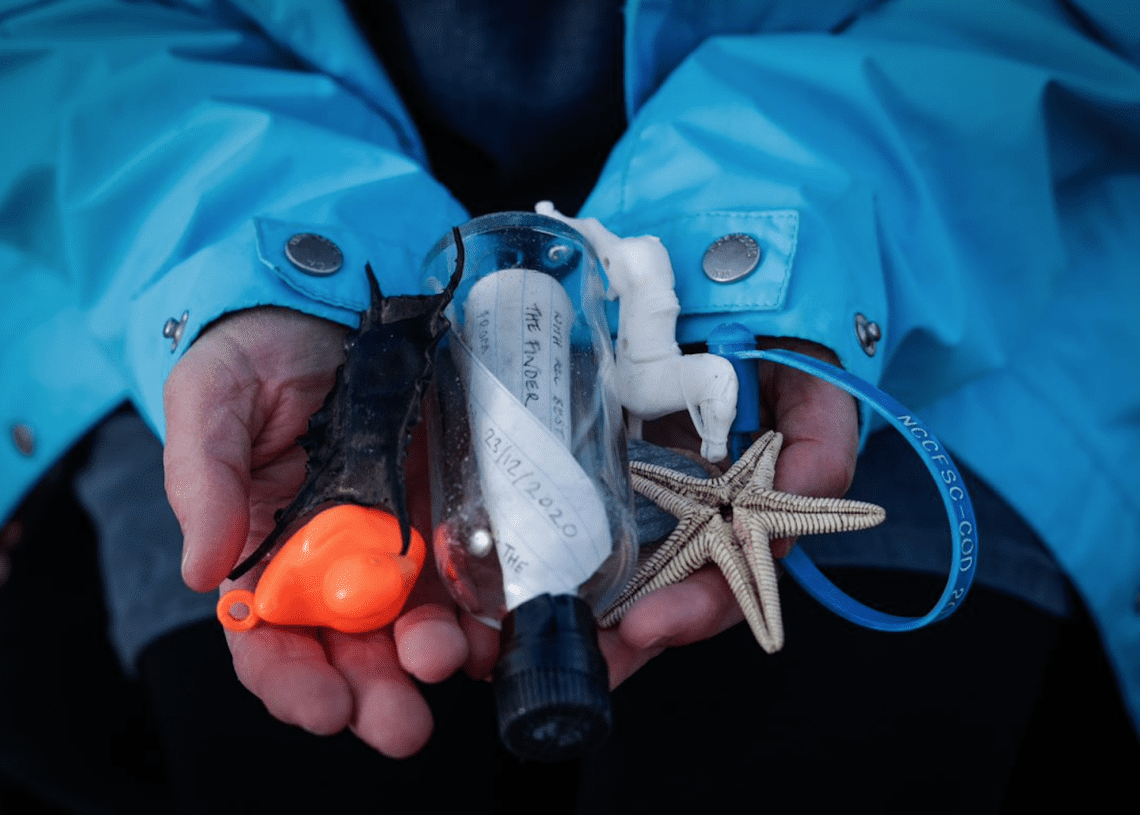
Everything that Sally finds has travelled. Among her collection, she has the plastic tags from lobster pots from Newfoundland, labels from North Sea oil rigs, messages in bottles from Norway, all telling the story of the climate emergency in which we find ourselves.
“In the book, I mention that my first trip to a beach in Shetland was in the summer and the beach was beautifully clean,” she says. “But when I started going back to the same beach and other beaches in the winter, I was completely shocked by the level of plastics. It’s like a feeling of overwhelm – you almost try to block it out because it’s just so immense. You realise that you can connect it to your own life and you start looking at other plastic that you use. And then you see these everyday items and it’s impossible to separate your human self from the impact on the ocean.”
There’s no skirting around these issues. According to the National Geographic Society, there are 5.25 trillion pieces of plastic in our oceans. As sea levels rise and oceans expand, storm patterns become more energetic, eroding our coastline faster than ever before. At the same time, pollution, poaching and climate change are driving more ocean-dwelling species to extinction.
“Every time I go to the beach, there are always microplastics in the sand. I’ve spent hours and hours cleaning that up and sometimes it feels a little bit overwhelming,” says Nicky Green, CEO of the 2 Minute Foundation who initiated the 2 Minute Beach Clean campaign. “We need to not be so reliant on single use plastics. Plastic is made of oil; the planet is warming. So, it’s all interconnected.”
As well as climate change, there are other difficult stories told by what beachcombers find on the shoreline. As objects travel across the world, they wash up tales of racism and colonialism. An example that Sally gives is that of the lobster tags she’s collected; only 10 per cent are issued by native councils showing how much harder it is for indigenous fishing communities – who use more sustainable fishing practices – to get licenses and capital for fishing.
“I like these discussions about the sea and how it’s moral and indifferent to us, but actually, it’s also like an archive. You go on a beach and it will throw up an object for you to examine and that object might be a plastic bottle of skin whitening cream; that’s racism there,” says Sally. “Or it might be a Barbie doll torso, which are all white and have this hyper-feminine figure, so that’s sexism and misogyny. That’s what the sea does – here you go, today you’re getting this, consider this; here’s an oil and gas label tag so, have a think about that for a minute.”
Stories of hope
Flip that around and the beachcomber’s outlook is that the shoreline can teach us so much about ourselves and our relationship with our planet. Ok, it’s not holding us in a flattering light, but by thinking about what we find on the beach, we realise just how interconnected we are with the rest of the world, past and future. Then, we can stop, think and start to take positive action.
For starters, beachcombers can tell us extraordinary stories from ordinary objects washed up by the sea that spark our imagination. For example, Eleanor describes vibrant pieces of sea glass from a burned-down factory in the north-east and a Cornish woman famed for finding a rare black Lego dragon washed up after a container of Lego fell into the sea in the 1990s.
But objects washed up by the tide also teach us about ourselves and how we face the climate emergency.
“You have to try and stay positive through the climate crisis,” says Nicky. “First and foremost, start picking up litter, that’s the gateway into the plastic-free lifestyle because you start to think about what you’re consuming at home. Not all plastics are bad. But it’s the single use, it’s the fast consumerism. We just don’t need to be taking single use water bottles with us anymore. We don’t need to buy takeaway coffees; we can take our reusable cups. It’s the simple things that we can change.”
The 2 Minute philosophy, explains Nicky, is that we do a short litter pick before every swim as a way of giving thanks to the sea for everything that it does for us. By swapping out single use plastics and picking up the plastics we find on the beach, we can make a small but significant impact.
“We can all be imperfect environmentalists; we have to navigate ourselves through this climate crisis and through the 21st century and lead our lives as well without it getting too much,” she says. “It is really overwhelming, but as individuals, if we can all do our part, then we feel that we can make collective change. It’s just about navigating ourselves through and all being really good stewards of the planet – we all need to be in this together.”
When you next stand on the shoreline anticipating a sea swim or sharing cake and coffee as we warm up, have a look at what the sea has washed up or uncovered. What stories can you find; what can you learn from the seashore? You might be amazed or moved, and hopefully, you’ll be even more inspired to look after our beaches.
FIND OUT MORE ABOUT BEACHCOMBING
• Sea Bean by Sally Hubard
• The Jay, The Beech and The Limpetshell by Richard Smyth
• Find your nearest beach clean: 2minute.org
• Go fossil hunting in Lyme Regis: lymeregismuseum.co.uk