


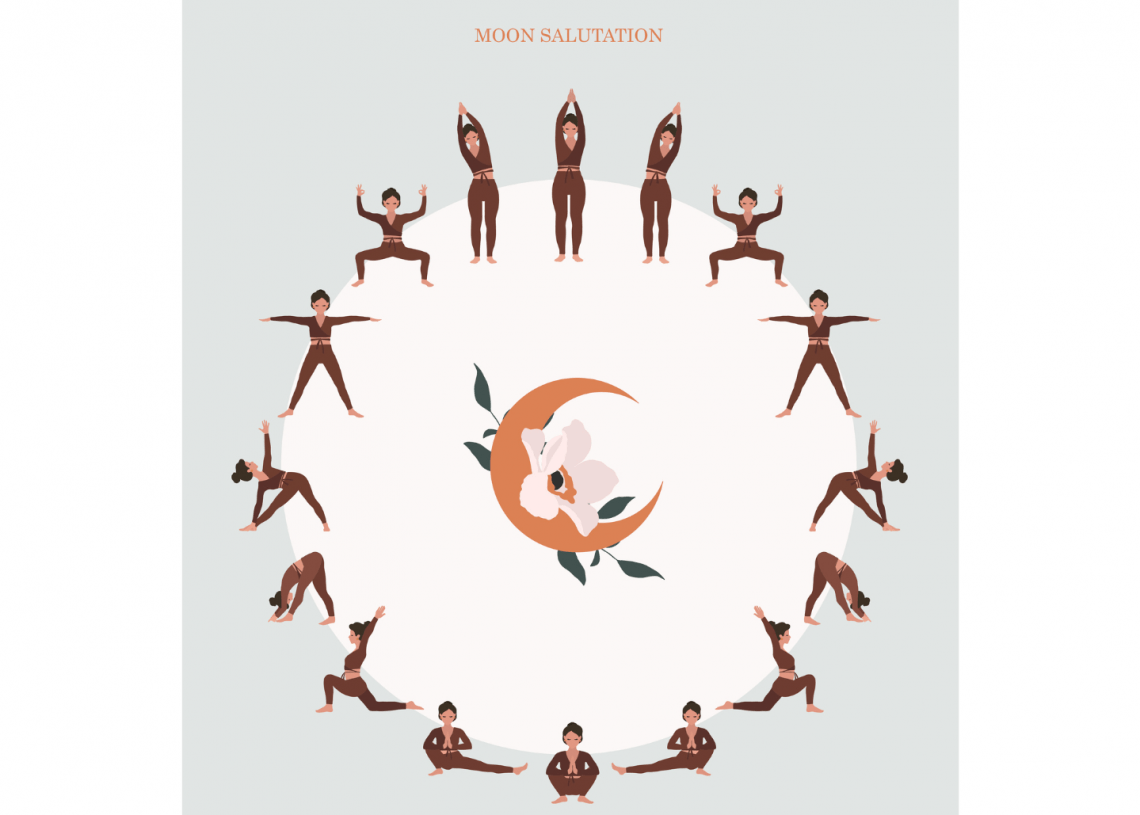
How to do Moon Salutations
While sun salutations are generally an invigorating morning yoga practice, moon salutations are thought to be more calming and often recommended for evening sessions
May brings the Flower Moon – a full moon symbolising a season of blooms and new life. That’s one good reason for a full-moon swim, but here’s another. Occasionally, a month can include a ‘Blue Moon’ – the second full moon in a single calendar month – and we will experience this at the end of May 2026.
To celebrate this phenomenon and lunar energy, here is a grounding moon salutations practice. Moon salutations are a modern yoga sequence, developed as a counterpart to the traditional sun salutations. While sun salutations are generally an invigorating morning practice, moon salutations are thought to be more calming and often recommended for evening sessions.
Moon Salutations are performed as a circular flow, moving sideways on the mat. In yogic philosophy, the left side of the body is associated with cooling, lunar energy, while the right side is linked to more warming, active energy, so it’s often suggested to begin this sequence moving to the left. Linking movements with breath can make the practice more mindful and grounding.
How to do Moon Salutations
Mountain pose
Begin facing the long side of your mat. In this simple yet powerful pose, feel the connection of your feet with the ground.
Upward salute/crescent
Raise arms and take a side stretch. Try to soften any neck or shoulder tension.
Goddess pose
Moving in the same direction, step into a squat, toes turned out, arms to ‘cactus’ position. A wide, deep squat may not be accessible – make it as shallow or narrow as needed to be comfortable.
Triangle pose
Straighten both legs, pivoting front toes towards top of the mat. Extend one arm and side bend towards that leg. Again, this doesn’t need to be a deep movement and can be more challenging for the core if held higher. Fully extending the arms and letting the top hand ease back a little can increase the upperbody stretch.
Pyramid pose
Pivot both feet to the top of the mat and shorten your stance. Hinging from the hips, either fold over the front leg or keep torso parallel to the ground if preferred.
Low lunge
Lower the back knee, using a cushion for support if needed, and raise arms overhead.
Snake squat
Move into a side lunge, with knee tracking toes. Again, make it as narrow and shallow as needed. From here, transition to the other side of the mat – via an optional deep squat – and reverse the sequence. Repeat as desired.
Disclaimer: If you are currently experiencing any pain or are working with a current or previous injury, please consult a healthcare professional before trying any new exercises. Please only attempt movements that are appropriate for your body currently. If anything causes pain, discomfort, or just doesn’t feel right, please stop the exercise and seek professional advice.

Outdoor Swimmer
Outdoor Swimmer is the magazine for outdoor swimmers by outdoor swimmers. We write about fabulous wild swimming locations, amazing swim challenges, swim training advice and swimming gear reviews.